One $kg$ of water, at $20\,^oC$, is heated in an electric kettle whose heating element has a mean (temperature averaged) resistance of $20\, \Omega $. The rms voltage in the mains is $200\, V$. Ignoring heat loss from the kettle, time taken for water to evaporate fully, is close to.......... $\min$ [Specific heat of water $= 4200\, J/kg\, ^oC$), Latent heat of water $= 2260\, k\,J/kg$]
JEE MAIN 2019, Diffcult


Download our appand get started for free
Experience the future of education. Simply download our apps or reach out to us for more information. Let's shape the future of learning together!No signup needed.*
Similar Questions
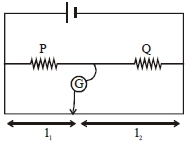
- 1The meter bridge shown is in balanced position with $\frac{\mathrm{P}}{\mathrm{Q}}=\frac{\mathrm{l}_{1}}{\mathrm{l}_{2}}$. If we now litterchange the positions of gavanometer and cell, will the bridge work? If yes, what will be balance condition?View Solution
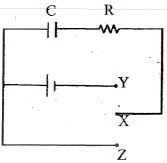
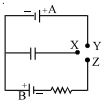
- 2The capacitor $C$ is initially without charge.$X$ is now j oined to $Y$ for a long time, during which $H_1$ heat is produced in the resistance $R$. $X-Y$ connection is removed and $X$ is now joined to $Z$ for a long time, during which heat $H_2$ is produced in $R$.View Solution
- 3An electrical circuit consists of ten $100 \,\Omega$ resistors. Out of these $10$ resistors, a group of $n _1$ resistors are connected in parallel and another group of $n _2$ resistors are separately connected in parallel. These two groups are then connected in series and this combination is connected to a voltage source of $100 \,V$. If the net current though the circuit is $2.5 \,A$. The values of $n _1$ and $n _2$ areView Solution
- 4Two conductors have the same resistances at $0^{\circ} \mathrm{C}$ but their temperature coefficients of resistance are $\alpha_1$ and $\alpha_2$. The respective temperature coefficients for their series and parallel combinations are :View Solution
- 5$10$ resistors each of resistance $10\,\Omega$ can be connected in such as to get maximum and minimum equivalent resistance. The ratio of maximum and minimum equivalent resistance will be $..........$.View Solution
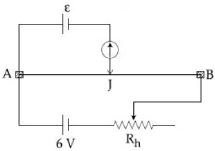
- 6The resistance of the meter bridge $AB$ in given figure is $4\,\Omega $. With a cell of emf $\varepsilon \, = 0.5\,\,V$ and rheostat resistance $R_h = 2\,\Omega $ the null point is obtained at some point $J.$ When the cell is replaced by another one of emf $\varepsilon \, = {\varepsilon _2}$ the same null point $J$ is found for $R_h = 6\,\Omega .$ The $emf$ ${\varepsilon _2}$ is ................. $V$View Solution
- 7In the circuit shown the cells are ideal and of equal emfs, the capacitance of the capacitor is $C$ and the resistance of the resistor is $R. X$ is first joined to $Y$ and then to $Z$. After a long time, the total heat produced in the resistor will beView Solution
- 8A current i passes through a wire of length $l$, radius of cross-section $r$ and resistivity $\rho$. The rate of heat generation isView Solution
- 9The temperature coefficient of resistance of tungsten is $4.5 \times 10^{-3}{ }^{\circ} C ^{-1}$ and that of germanium is $-5 \times 10^{-2}{ }^{\circ} C ^{-1}$. A tungsten wire of resistance $100 \,\Omega$ is connected in series with a germanium wire of resistance $R$. The value of $R$ for which the resistance of combination does not change with temperature is .......... $\Omega$View Solution
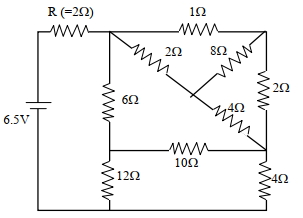
- 10In the following circuit, the current through the resistor $R(=2 \Omega)$ is $I$ Amperes. The value of $I$ isView Solution