Question
During a total solar eclipse the moon almost entirely covers the sphere of the sun. Write the relation between the distances and sizes of the sun and moon.
Answer

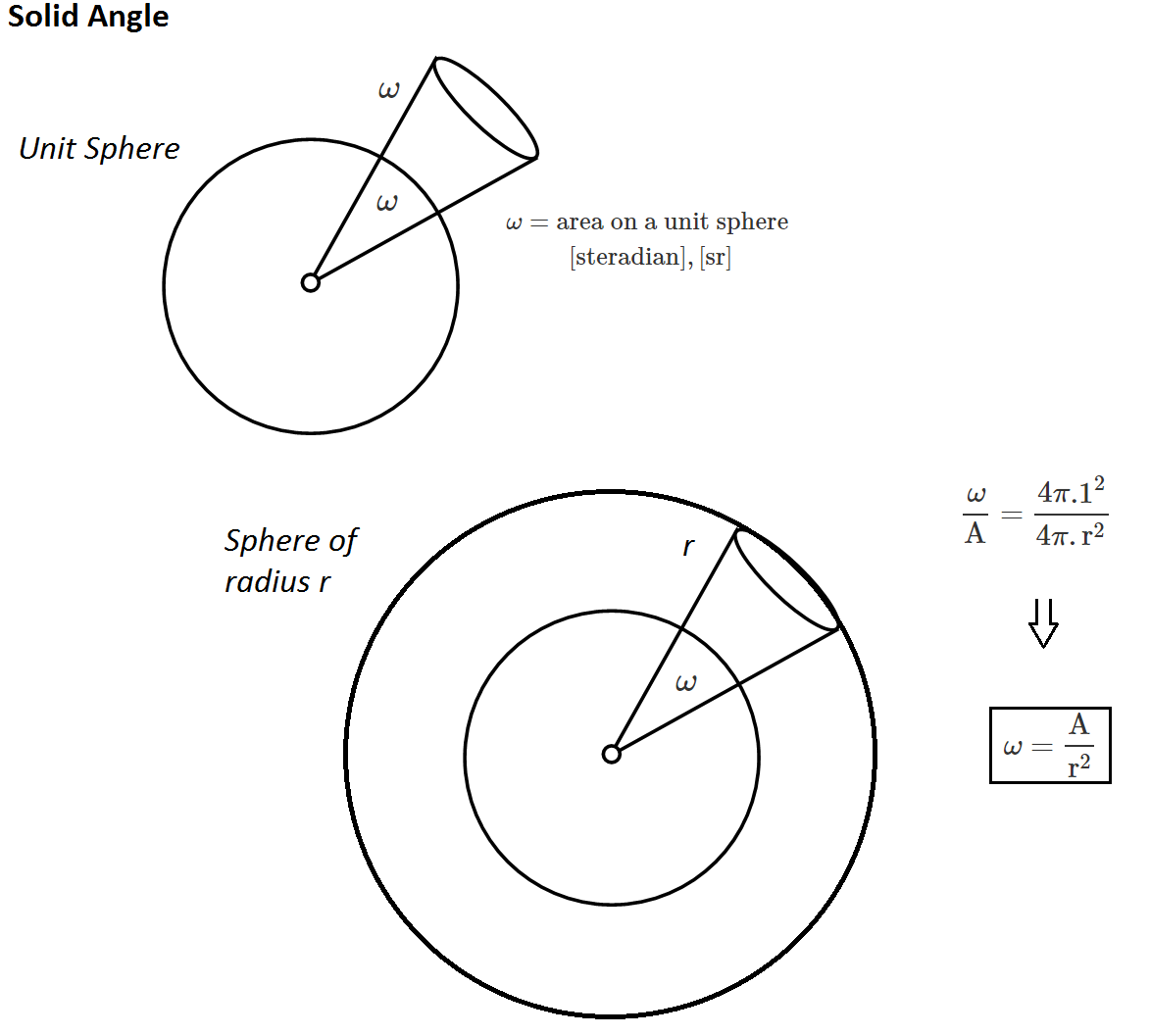
Key point: In geometry, a solid angle (symbol: $\Omega$ or w) is the two­dimensional angle in three-dimensional space that an object subtends at a point. It is a measure of how large the object appears to an observer looking from that point. In the International System of Units (SI), a solid angle is expressed in a dimensionless unit called a steradian (symbol: sr).

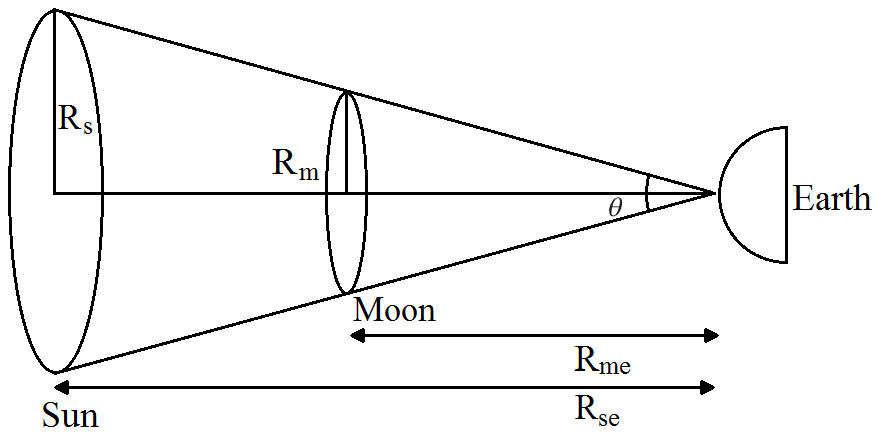
A small object nearby may subtend the solid angle as a larger object farther away. For example, although the Moon is much smaller than the Sun, it is also much closer to Earth. Diagram given below shows that moon almost entirely covers the sphere of the sun. $R_{me}$ = Distance of moon from earth $R_{se}$ = Distance of sun from earth Let the solid angle made by sun and moon is $\text{d}\Omega,$ we can write

$\text{d}\Omega=\frac{\text{A}_\text{sun}}{\text{R}^2_\text{se}}=\frac{\text{A}_\text{moon}}{\text{R}^2_\text{me}}$
Here, $A_{sun}$ = Area of the sun $A_{moon}$ = Area of the moon$\Rightarrow\theta=\frac{\pi\text{R}_\text{s}^2}{\text{R}_\text{se}^2}=\frac{\pi\text{R}_\text{m}^2}{\text{R}_\text{me}^2}$
$\Rightarrow\Big(\frac{\text{R}_\text{s}}{\text{R}_\text{se}}\Big)^2=\Big(\frac{\text{R}_\text{m}}{\text{R}_\text{me}}\Big)^2$
$\Rightarrow\frac{\text{R}_\text{s}}{\text{R}_\text{se}}=\frac{\text{R}_\text{m}}{\text{R}_\text{me}}\ \text{or}\ \frac{\text{R}_\text{s}}{\text{R}_\text{m}}=\frac{\text{R}_\text{se}}{\text{R}_\text{me}}$
(Here, radius of sun and moon represent their sizes respectively)

Need a full question paper?

Generate a complete, print-ready paper with questions like this in minutes — across 16+ boards, with answer keys.
Start Generating Free

Similar questions

  1. It is known that density r of air decreases with height y as $\rho_0\text{e}^{-\frac{\text{y}}{\text{y}_0}}$ where $\rho=1.25\text{kg m}^{-3}$ is the density at sea level, and $y_0$ is a constant. This density variation is called the law of atmospheres. Obtain this law assuming that the temperature of atmosphere remains a constant (isothermal conditions). Also assume that the value of g remains constant.
  2. A large He balloon of volume $1425m^3$ is used to lift a payload of 400kg. Assume that the balloon maintains constant radius as it rises. How high does it rise? [Take $y^0 = 8000m$ and $rHe = 0.18 kgm^{–3}​​​​​​​$].
If $x, y$ and $z$ are distances moved by a particle moving with a constant acceleration during the $l^{th}, m^{th}$ and $n^{th}$ second of its motion respectively. Show that, $x(m - n) + y(n - l) + z(l - m) = 0$
Explain by giving definition of Bulk Modulus of elasticity, Modulus of Rigidity and compressibility what are their units and dimensions? What is the relation between co-efficient of elasticity $Y , K$ and $\eta$ ?
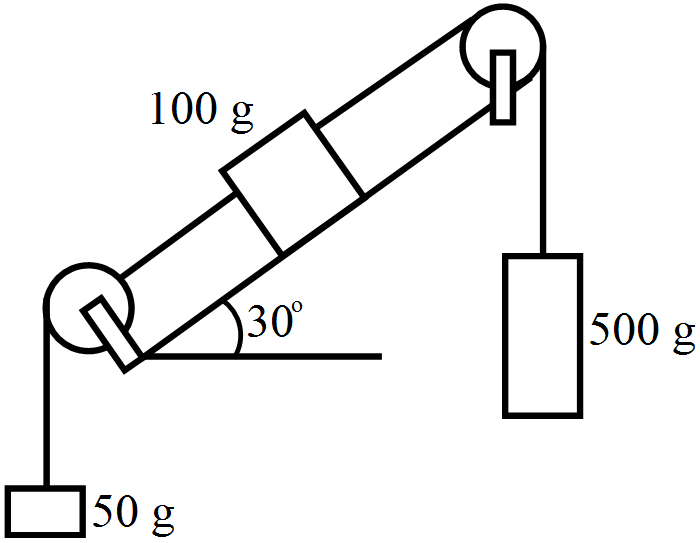
Find the acceleration of the $500\ g$ block in figure.
A coil of resistance $40\Omega$ is connected across a 4.0V battery 0.10s after the battery is connected, the current in the coil is 63mA. Find the inductance of the coil.
The free surface of oil in a tanker, at rest, is horizontal. If the tanker starts accelerating the free surface will be titled by an angle $\theta.$ If the acceleration is a m $s^{-2}$, what will be the slope of the free surface?
Position $x$, time of particle moving in onedimensional motion depends on as follows :
$x=5+5 t-t^2$
(All quantities are in SI units) For this motion draw (i) displacement-time (ii) Velocity-time (iii) Acceleration-time graphs for the time interval $t=0 sec$ to $t=6 sec$ and describe the motion.
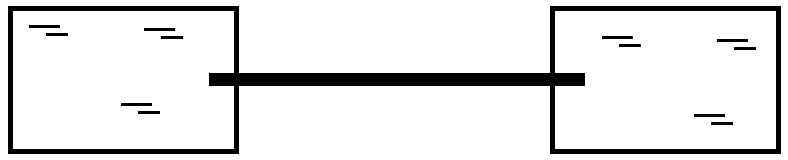
Figure, shows two adiabatic vessels, each containing a mass m of water at different temperatures. The ends of a metal rod of length L, area of cross section A and thermal conductivity K, are inserted in the water as shown in the figure. Find the time taken for the difference between the temperatures in the vessels to become half of the original value. The specific heat capacity of water is s. Neglect the heat capacity of the rod and the container and any loss of heat to the atmosphere.
A small block of superdense material has a mass of $3 \times 10^{24}kg$. It is situated at a height h (much smaller than the earth's radius) from where it falls on the earth's surface. Find its speed when its height from the earth's surface has reduced to $\frac{\text{h}}{2}.$ The mass of the earth is $6 \times 10^{24}kg$.
A baloon filled with helium rises against gravity increasing its potential energy. The speed of the baloon also increases as it rises. How do you reconcile this with the law of conservation of mechanical energy? You can neglect viscous drag of air and assume that density of air is constant.