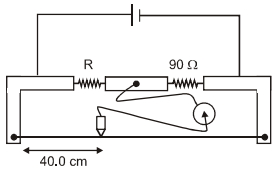
- A$60 \pm 0.15 \ \Omega$
- B$135 \pm 0.56 \ \Omega$
- ✓$60 \pm 0.25 \ \Omega$
- D$135 \pm 0.23 \ \Omega$
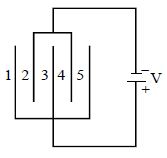
$\frac{X}{R}=\frac{\ell}{(100-\ell)}$
$\frac{X}{40}=\frac{90}{60} \Rightarrow X=60 \Omega$
$X=R \frac{\ell}{(100-\ell)}$
$\frac{\Delta X}{X}=\frac{\Delta \ell}{\ell}+\frac{\Delta \ell}{100-\ell}=\frac{0.1}{40}+\frac{0.1}{60}$
$\Delta X=0.25$
$\text { so अत: } X=(60 \pm 0.25) \Omega$
Generate a complete, print-ready paper with questions like this in minutes — across 16+ boards, with answer keys.


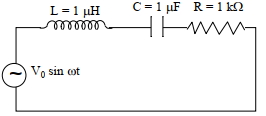
[$A$] The frequency at which the current will be in the phase with the voltage is independent of $R$.
$[B]$ At $\omega \sim 0$ the current flowing through the circuit becomes nearly zero.
[$C$] At $\omega \gg 10^6 \mathrm{rad} . \mathrm{s}^{-1}$, the circuit behave like a capacitor.
[$D$] The current will be in phase with the voltage if $\omega=10^4 \mathrm{rad} . \mathrm{s}^{-1}$