$E$ denotes electric field in a uniform conductor, $I$ corresponding current through it, ${v_d}$ drift velocity of electrons and $P$ denotes thermal power produced in the conductor, then which of the following graph is incorrect
Easy
Download our app for free and get started
$E = \frac{{iR}}{L} = \frac{{i.\rho }}{A} = \frac{{neA{v_d}\rho }}{A}$ $ \Rightarrow $ ${v_d} \propto E$ (Straight line)
$P = {i^2}R = {\left( {\frac{{EA}}{\rho }} \right)^2}R$ $ \Rightarrow $ $P \propto {E^2}$ (Symmetric parabola)
Also $P \propto {i^2}$ (parabola)
Hence all graphs $a, b, d$ are correct and $c$ is incorrect.

Download our appand get started for free
Experience the future of education. Simply download our apps or reach out to us for more information. Let's shape the future of learning together!No signup needed.*
Similar Questions
- 1If a power of $100\, W$ is being supplied across a potential difference of $200\, V$, current flowing is ............ $A$View Solution
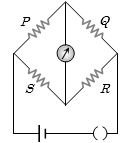
- 2In the Wheatstone's bridge shown, $P = 2\,\Omega ,$ $Q = 3\,\Omega ,$ $R = 6\,\Omega $ and $S = 8\,\Omega $. In order to obtain balance, shunt resistance across '$S$' must be .............. $\Omega$View Solution
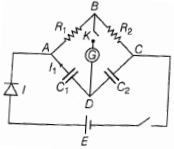
- 3ln the circuit in the figure, if no current flows through the galvanometer when the key $K$ is closed, the bridge is balanced. The balancing condition for bridge isView Solution
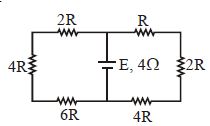
- 4A battery of internal resistance $4\,\Omega $ is connected to the network of the resistance as shown in Fig. If the maximum power can be delivered to the network, the magnitude of $R$ in $\Omega $ should beView Solution
- 5View SolutionThe conductivity of a superconductor is
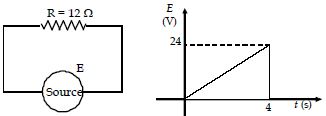
- 6A resistance $R = 12\, \Omega$ is connected across a source of emf as shown in the figure . Its $emf$ changes with time as shown in the graph . What is the heat developed in the resistance in the first four seconds ? ............. $J$View Solution
- 7If two electric bulbs have $40\, W$ and $60\, W$ rating at $220\, V$, then the ratio of their resistances will beView Solution
- 8What is the number density of donor atoms which must be added to a pure germanium semiconductor to make $n-$ type semiconductor of conductivity $6.4\ {\Omega ^{ - 1}}\,c{m^{ - 1}}$? The mobility of electr ons in $n-$ type germanium is $4 \times {10^3}\ cm^2\ V^{-1}\ s^{-1}$. Neglect the contribution of holes to conductivityView Solution
- 9A heating coil can heat the water of a vessel from $20\,^oC$ to $60\,^oC$ in $30$ minutes. Two such heating coils are put in series and then used to heat the same amount of water through the same temperature range. The time taken now will be ............ $min$ (neglecting thermal capacity of the coils)View Solution
- 10Two cells of $e.m.f.$ $E_1$ and $E_2$ are joined in series and the balancing length of the potentiometer wire is $625$ $cm$. If the terminals of $E_1$ are reversed, the balancing length obtained is $125 \,cm$. Given $E_2 > E_1$, the ratio $E_1: E_2$ will beView Solution