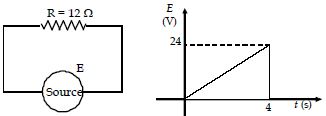
A resistance $R = 12\, \Omega$ is connected across a source of emf as shown in the figure . Its $emf$ changes with time as shown in the graph . What is the heat developed in the resistance in the first four seconds ? ............. $J$
Medium


Download our appand get started for free
Experience the future of education. Simply download our apps or reach out to us for more information. Let's shape the future of learning together!No signup needed.*
Similar Questions
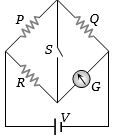
- 1In the circuit shown $P \ne R$, the reading of the galvanometer is same with switch $S$ open or closed. ThenView Solution
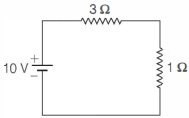
- 2In the following circuit, $1 \,\Omega$ resistor dissipates power $P$. If the resistor is replaced by $9 \,\Omega$, the power dissipated in it isView Solution
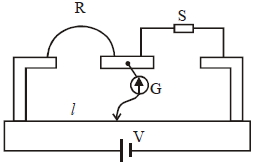
- 3In a meter bridge experiment $\mathrm{S}$ is a standard resistance. $\mathrm{R}$ is a resistance wire. It is found that balancing length is $l=25 \;\mathrm{cm} .$ If $\mathrm{R}$ is replaced by a wire of half length and half diameter that of $\mathrm{R}$ of same material, then the balancing distance $\left.l^{\prime} \text { (in } \mathrm{cm}\right)$ will now beView Solution
- 4Two resistances $r_1$ and $r_2\left(r_1 < r_2\right)$ are joined in parallel. The equivalent resistance $R$ is such thatView Solution
- 5View SolutionA bird sitting on a single high tension wire does not get electrocuted because
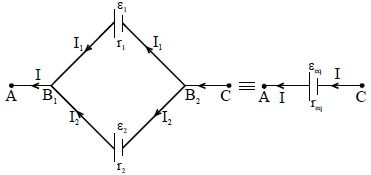
- 6Three resistances of magnitude $2$, $3$ and $5$ $ohm$ are connected in parallel to a battery of $10\, volts$ and of negligible resistance. The potential difference across $3\,\Omega $ resistance will be ............... $volts$View Solution
- 7A battery consists of a variable number '$n$' of identical cells having internal resistances connected in series. The terminals of battery are short circuited and the current $i$ is measured. Which of the graph below shows the relation ship between $i$ and $n$View Solution
- 8The number of electrons flowing per second in the filament of a $110 \mathrm{~W}$ bulb operating at $220 \mathrm{~V}$ is : (Given $\mathrm{e}=1.6 \times 10^{-19} \mathrm{C}$ )View Solution
- 9View SolutionAccording to Joule's law, if the potential difference across a conductor having a material of specific resistance remains constant, then the heat produced in the conductor is directly proportional to
- 10Consider a parallel combination of the cellsshown in the figure.The potential difference in between $B_1$ and $B_2$ isView Solution