MCQ
Each capacitor in the circuit shown is a 1F capacitor. What would be the equivalent capacitance between A and B?
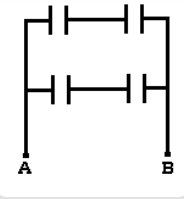
- A0.5F
- BF
- C2F
- D4F
Explanation:
Equivalent capacitance of each pair of capacitance in series$=\frac{1\times1}{1+1}\text{F}=0.5\text{F}$
The two series combination are connected in parallel. Hence the net capacitance becomes 0.5F + 0.5F = 1F
Generate a complete, print-ready paper with questions like this in minutes — across 16+ boards, with answer keys.
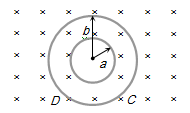
Plane figures made of thin wires of resistance R = 50 milli ohm/metre are located in a uniform magnetic field perpendicular into the plane of the figures and which decrease at the rate dB/dt = 0.1 m T/s. Then currents in the inner and outer boundary are. (The inner radius a = 10 cm and outer radius b = 20 cm)
|
(a) 10– 4 A (Clockwise), 2 × 10– 4 A (Clockwise) |
|
(b) 10– 4 A (Anticlockwise), 2 × 10– 4 A (Clockwise) |
|
(c) 2 × 10– 4 A (clockwise), 10– 4 A (Anticlockwise) |
|
(d) 2 × 10– 4 A (Anticlockwise), 10– 4 A (Anticlockwise) |
The mutual characteristic curves of a triode are as shown in figure. The cut off voltage for the triode is

| (a) 0 V | (b) 2 V | (c) – 4 V | (d) 6 V |
Magnetic dipole moment is a
|
(a) Scalar quantity |
(b) Vector quantity |
(c) Constant quantity |
(d) None of these |
A resistance of 4 and a wire of length 5 metres and resistance 5 are joined in series and connected to a cell of e.m.f. 10 V and internal resistance 1. A parallel combination of two identical cells is balanced across 300 cm of the wire. The e.m.f. E of each cell is

|
(a) 1.5 V |
(b) 3.0 V |
(c) 0.67 V |
(d) 1.33 V |