MCQ
When is hydrogen stable?
- AWhen the electron jumps to higher energy levels.
- BWhen an electric field is introduced.
- CWhen a magnetic field is introduced.
- DWhen the electron is at its ground state.
Explanation:
The hydrogen atom is stable when the electron rests at the ground level of energy, i.e. when the principal quantum number, n = 1. '
In other words, when the electron is revolving in the first orbit around the nucleus, the hydrogen atom is stable.
Generate a complete, print-ready paper with questions like this in minutes — across 16+ boards, with answer keys.
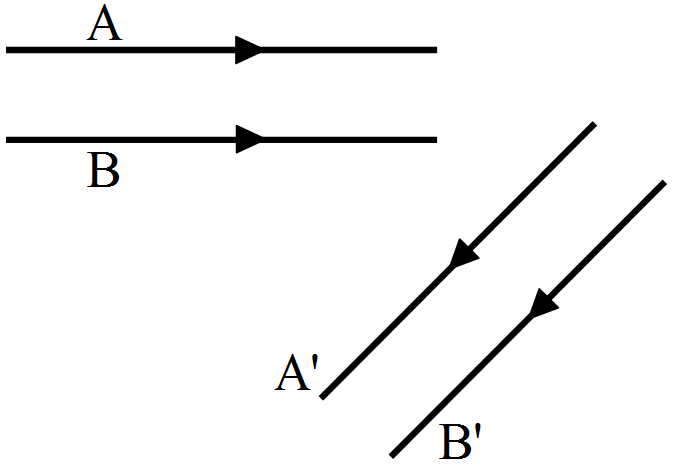
Two rays A and B being reflected by a mirror and going as A' and B'. The mirror:
Photons of energy 6 eV are incident on a metal surface whose work function is 4 eV. The minimum kinetic energy of the emitted photo-electrons will be
|
(a) 0 eV |
(b) 1 eV |
(c) 2 eV |
(d) 10 eV |
A radioactive nucleus with Z protons and N neutrons emits an a-particle, 2b-particles and 2 gamma rays. The number of protons and neutrons in the nucleus left after the decay respectively, are
|
(a) Z – 3, N – 1 |
(b) Z – 2, N – 2 |
(c) Z – 1, N – 3 |
(d) Z, N – 4 |
NPN transistor are preferred to PNP transistor because they have
|
(a) Low cost |
|
(b) Low dissipation energy |
|
(c) Capability of handing large power |
|
(d) Electrons having high mobility than holes |
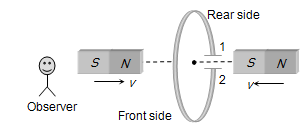
The north and south poles of two identical magnets approach a coil, containing a condenser, with equal speeds from opposite sides. Then
|
(a) Plate 1 will be negative and plate 2 positive |
|
(b) Plate 1 will be positive and plate 2 negative |
|
(c) Both the plates will be positive |
|
(d) Both the plates will be negative |