Question
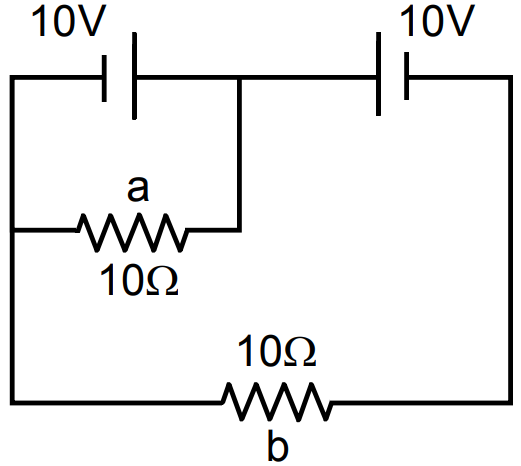
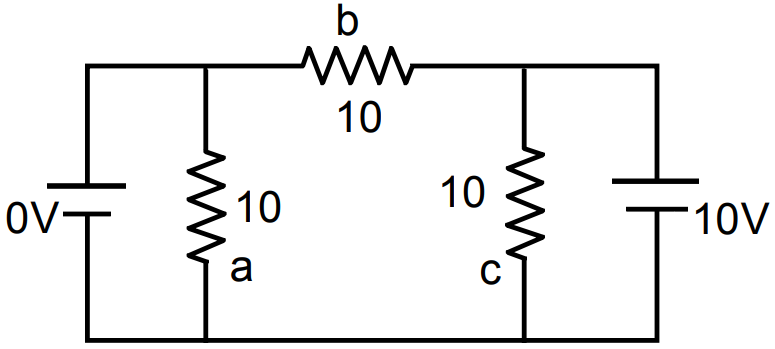
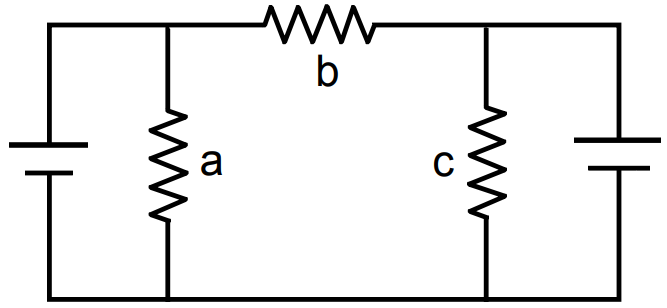
Each of the resistors shown in figure. has a resistance of $10\Omega$ and each of the batteries has an emf of 10V. Find the currents through the resistors a and b in the two circuits.
Answer

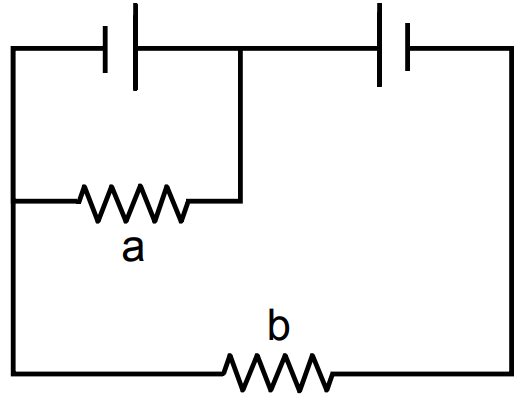
  1. Potential difference between terminals of ‘a’ is 10V.


i through $\text{a}=\frac{10}{10}=1\text{A}$

Potential different between terminals of b is 10 - 10 = 0V

i through $\text{b}=\frac{0}{10}=0\text{A}.$
  1. Potential difference across ‘a’ is 10V


i through $\text{a}=\frac{10}{10}=1\text{A}$

Potential different between terminals of b is 10 - 10 = 0V

i through $\text{b}=\frac{0}{10}=0\text{A}.$

Need a full question paper?

Generate a complete, print-ready paper with questions like this in minutes — across 16+ boards, with answer keys.
Start Generating Free

Similar questions

Find the magnitude and direction of the resultant of two vectors $A$ and $B$ in terms of their magnitudes and angle $\theta $ between them.
Image
Define thermal conduction. Write a relation for rate of flow of heat energy by conduction. Use it to find the equivalent resistance when two rods are placed in series or parallel.
A constant force $\text{F}=\frac{\text{m}_2\text{g}}{2}$ is applied on the block of mass $m_1$ as shown in figure. The string and the pulley are light and the surface of the table is smooth. Find the acceleration of $m_1$.
0.040g of He is kept in a closed container initially at 100.0°C. The container is now heated. Neglecting the expansion of the container, calculate the temperature at which the internal energy is increased by 12J.
A solid disc and a ring, both of radius 10 cm are placed on a horizontal table simultaneously, with initial angular speed equal to $10 \pi rad s ^{-1}$. Which of the two will start to roll earlier? The co-efficient of kinetic friction is $\mu_k=$
What is the ratio between the distance travelled by the oscillator in one time period and amplitude?
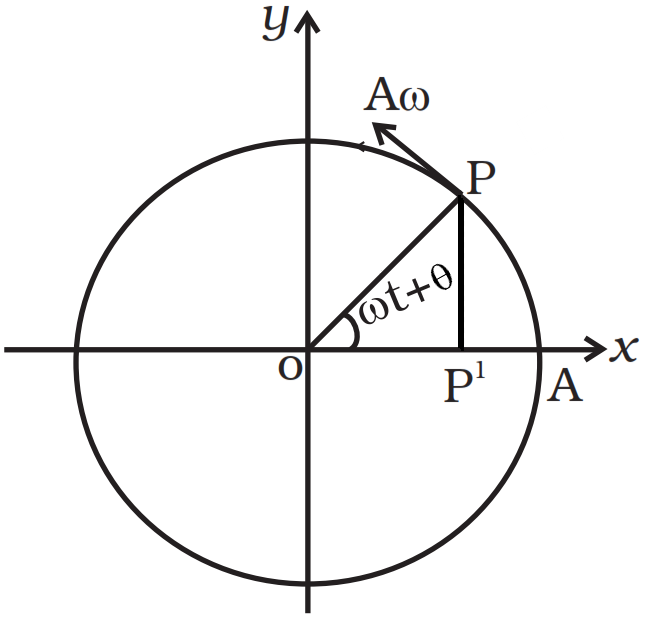
In Fig. 14.9, what will be the sign of the velocity of the point, which is the projection of the velocity of the P′ reference particle P .P is moving in a circle of radius R in anticlockwise direction.
A moving car encounters air resistance which is proportional to the square of the speed of the car. What is the ratio of the power required at $40kmh^{-1}$ to that required at $80kmh^{-1}$ with the same braking force?
Write the theorem of perpendicular and parallel axes of moment of inertia.
Define the work done by a constant force on an object and describe their specific situations.