MCQ
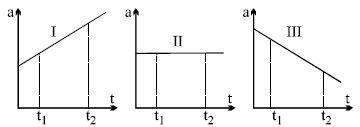
Each of the three graphs represents acceleration versus time for an object that already has a positive velocity at time $t_1$. Which graphs show an object whose speed is increasing for the entire time interval between $t_1$ and $t_2$ ?
  • A
    graph $I$, only
  • B
    graphs $I$ and $II$, only
  • C
    graphs $I$ and $III$, only
  • graphs $I, II$ and $III$

Answer

Correct option: D.
graphs $I, II$ and $III$
d
Acceleration is positive in all three cases

Need a full question paper?

Generate a complete, print-ready paper with questions like this in minutes — across 16+ boards, with answer keys.

Start Generating Free

Similar questions

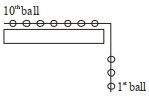
A system to $10$ balls each of mass $2 \; kg$ are connected via massless and unstretchable string. The system is allowed to slip over the edge of a smooth table as shown in figure. Tension on the string between the $7^{th}$ and $8^{th}$ ball is $N$ when $6^{th}$ ball just leaves the table.
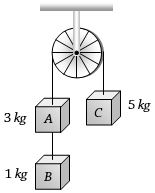
Three weight $A, B$ and $C$ are connected by string as shown in the figure. The system moves over a frictionless pulley. The tension in the string connecting $A$ and $B$ is (where $g$ is acceleration due to gravity)
Assertion : If a compass needle be kept at magnetic north pole of the earth the compass needle may stay in any direction.

Reason : Dip needle will stay vertical at the north pole of earth

Which of the following colourful patterns is due to diffraction of light?
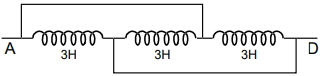
The inductance between $A$ and $D$ is
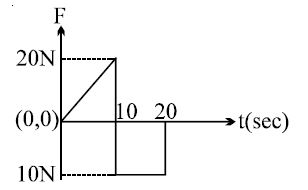
A particle of mass $1\,\, kg$ is acted upon by a force $'F'$ which varies as shown in the figure. If initial velocity of the particle is $10 ms^{^{-1}},$ the maximum velocity attained by the particle during the period is  ........ $ms^{-1}$
The graph between terminal velocity (along $y-axis$ ) and square of radius (along $x-axis$ ) of spherical body of density $\rho $ allowed to fall through a fluid of density $\rho $  is $a$
Consider a mercury-filled tube as shown in the figure below 

Which of the following options about the pressures at the lettered locations $(A, B, C, D)$ is true?

An ideal fluid flows (laminar flow) through a pipe of non-uniform diameter. The maximum and minimum diameters of the pipes are $6.4 \;\mathrm{cm}$ and $4.8 \;\mathrm{cm},$ respectively. The ratio of the minimum and the maximum velocities of fluid in this pipe is:
A vessel of volume $0.02 \,\,m^3$ contains a mixture of hydrogen and helium at $20\,^oC$ and $2$ atmospheric pressure. The mass of mixture is $5\,\, gms$. Find the ratio of mass of hydrogen to that of helium in the mixture.