MCQ
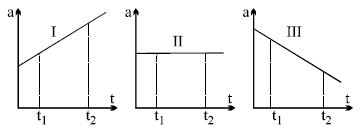
Each of the three graphs represents acceleration versus time for an object that already has a positive velocity at time $t_1$. Which graphs show an object whose speed is increasing for the entire time interval between $t_1$ and $t_2$ ?
  • A
    graph $I$, only
  • B
    graphs $I$ and $II$, only
  • C
    graphs $I$ and $III$, only
  • graphs $I, II$ and $III$

Answer

Correct option: D.
graphs $I, II$ and $III$
d
Acceleration is positive in all three cases

Need a full question paper?

Generate a complete, print-ready paper with questions like this in minutes — across 16+ boards, with answer keys.

Start Generating Free

Similar questions

If final momentum is equal to initial momentum of the system then
$Joule-second$ is the unit of
The maximum focal length of the eye-lens of a person is greater than its distance from the retina. The eye is:
  1. Always strained in looking at an object.
  2. Strained for objects at large distances only.
  3. Strained for objects at short distances only.
  4. Unstrained for all distances.
Consider a car moving along a straight horizontal road with a speed of $72\, km/h$. If the coefficient of kinetic friction between the tyres and the road is $0.5,$ the shortest distance in which the car can be stopped is ........ $m$ .$[g = 10\,m{s^{ - 2}}]$
A plank with a small block on top of it is under going vertical $SHM$ . Its period is $2\ sec$ . The minimum amplitude at which the block will separate from plank is
A particle moves from a point $\left( { - 2\hat i + 5\hat j} \right)$  to $\left( {4\hat i + 3\hat j} \right)$ when a force of $\left( {4\hat j + 3\hat k} \right)$ is applied. How much work has been done by the force ?......$J$
Let $\vec A\, = \,(\hat i\, + \,\hat j)\,$  and $\vec B\, = \,(2\hat i\, - \,\hat j)\,.$  The magnitude of a coplanar vector $\vec C$ such that  $\vec A\cdot \vec C\, = \,\vec B\cdot \vec C\, = \vec A\cdot \vec B$ is given by
A spring of force constant $k$ is cut into lengths of ratio $1:2:3$ . They are connected in series and the new force constant is $k'$ . Then they are connected in parallel and force constant is $k''$ . Then $k':k''$ is
Arrangement of two block system is as shown. The net force acting on $1 \,kg$ and $2 \,kg$ blocks are (assuming the surfaces to be frictionless) respectively
A spherical ball of radius $r$ and relative density $0.5$ is floating in equilibrium in water with half of it immersed in water. The work done in pushing the ball down so that whole of it is just immersed in water is : (where $\rho $ is the density of water)