Question
Earth’s orbit is an ellipse with eccentricity $0.0167$. Thus, earth’s distance from the sun and speed as it moves around the sun varies from day to day. This means that the length of the solar day is not constant through the year. Assume that earth’s spin axis is normal to its orbital plane and find out the length of the shortest and the longest day. A day should be taken from noon to noon. Does this explain variation of length of the day during the year?
Answer

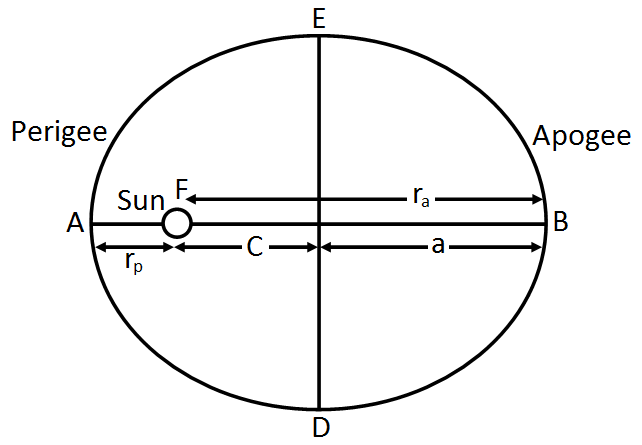
According to the diagram,
$r_p$ = radius of perigee = $2R$
$r_a$ = radius of apogee = $6R$
a = semi - major axis of the ellipse

Hence, we can write
$r_a = a(1 + e) = 6R$
$P_p = a(1 - e) = 2R$
$\frac{\text{a(1+e)}}{\text{a(1}-\text{e})}=\frac{6\text{R}}{2\text{R}}=3$
By solving, we get eccentricity $\text{e}=\frac{1}{2}$
If $v_a$ and $v_p$ are the velocities of the satellite (of mass m) at aphelion and perihelion respectively, then by conservation of angular momentum
$\therefore\ \text{L}_\text{at perigee}=\text{L}_\text{at apogee}$
$\text{mv}_\text{p}\text{r}_\text{p}=\text{mv}_\text{a}\text{r}_\text{a}$
$\therefore\ \frac{\text{v}_\text{a}}{\text{v}_\text{p}}=\frac{\text{r}_\text{p}}{\text{r}_\text{a}}=\frac{1}{3}$
Applying conservation of energy,
Energy at perigee = Energy at apogee
where M is the mass of the earth
$\therefore\ \text{v}_\text{p}^2\Big(1-\frac{1}{9}\Big)=-2\text{GM}\Big(\frac{1}{\text{r}_\text{a}}-\frac{1}{\text{r}_\text{p}}\Big)$
$=2\text{GM}\Big(\frac{1}{\text{r}_\text{p}}-\frac{1}{\text{r}_\text{a}}\Big)$ $(\text{By putting v}_\text{a}=\frac{\text{v}_\text{p}}{3})$
$\text{v}_\text{p}=\frac{\Big[2\text{GM}\big(\frac{1}{\text{r}_\text{p}}-\frac{1}{\text{r}_\text{a}}\big)\Big]^{\frac{1}{2}}}{\Big[1-\big(\frac{\text{v}_\text{a}}{\text{v}_\text{p}}\big)^2\Big]^{\frac{1}{2}}}$
$=\Bigg[\frac{\frac{2\text{GM}}{\text{R}}\Big(\frac{1}{2}-\frac{1}{6}\Big)}{\Big(1-\frac{1}{9}\Big)}\Bigg]^{\frac{1}{2}}=\Big(\frac{\frac{2}{3}}{\frac{8}{9}}\frac{\text{GM}}{\text{R}}\Big)^{\frac{1}{2}}=\sqrt{\frac{3}{4}\frac{\text{GM}}{\text{R}}}=6.85\text{km/ s}$
$\text{v}_\text{p}=6.85\text{km/ s,}\text{ v}_\text{a}=2.28\text{km/ s,}$
For circular orbit of radius r,
$v_c$ = orbital velocity $=\sqrt{\frac{\text{GM}}{\text{r}}}$
For $r = 6R, v_c$ $=\sqrt{\frac{\text{GM}}{\text{6R}}}$ = 3.23km/ s

Need a full question paper?

Generate a complete, print-ready paper with questions like this in minutes — across 16+ boards, with answer keys.

Start Generating Free

Similar questions

One end of a U-tube containing mercury is connected to a suction pump and the other end to atmosphere. A small pressure difference is maintained between the two columns. Show that, when the suction pump is removed, the column of mercury in the U-tube executes simple harmonic motion.
The ceiling of a long hall is $25m$ high. What is the maximum horizontal distance that a ball thrown with a speed of $40ms^{-1}$ can go without hitting the ceiling of the hall?
A thin circular loop of radius R rotates about its vertical diameter with an angular frequency $\omega.$ Show that a small bead on the wire loop remains at its lowermost point for $\omega\le\sqrt{\frac{\text{g}}{\text{R}}}.$ What is the angle made by the radius vector joining the centre to the bead with the vertical downward direction for $\omega=\sqrt{\frac{2\text{g}}{\text{R}}}?$ Neglect friction.
The time constant of an LR circuit is 40ms. The circuit is connected at t = 10 and the steady-state current is found to be 2.0A. Find the current at:
  1. t = 10ms
  2. t = 20ms
  3. t = 100ms
  4. t = 1s.
Define gravitational potential. Derive the formulas of gravitional potential due to a solid sphere of mass M and radius R at points located on its outer surface and inside.
  1. It is known that density r of air decreases with height y as $\rho_0\text{e}^{-\frac{\text{y}}{\text{y}_0}}$ where $\rho=1.25\text{kg m}^{-3}$ is the density at sea level, and $y_0$ is a constant. This density variation is called the law of atmospheres. Obtain this law assuming that the temperature of atmosphere remains a constant (isothermal conditions). Also assume that the value of g remains constant.
  2. A large He balloon of volume $1425m^3$ is used to lift a payload of $400kg$. Assume that the balloon maintains constant radius as it rises. How high does it rise? [Take $y^0 = 8000m$ and $rHe = 0.18 kgm^{–3}$​​​​​​​​​​​​​​].
A particle having mass 10g oscillates according to the equation $\text{x}=(2.0\text{cm})\sin\big[(100\text{s}^{-1})\text{t}+\frac{\pi}{6}\big].$ Find (a) the amplitude, the time period and the spring constant (b) the position, the velocity and the acceleration at t = 0.
A uniform metre stick of mass 200g is suspended from the ceiling through two vertical strings of equal lengths fixed at the ends. A small object of mass 20g is placed on the stick at a distance of 70cm from the left end. Find the tensions in the two strings.
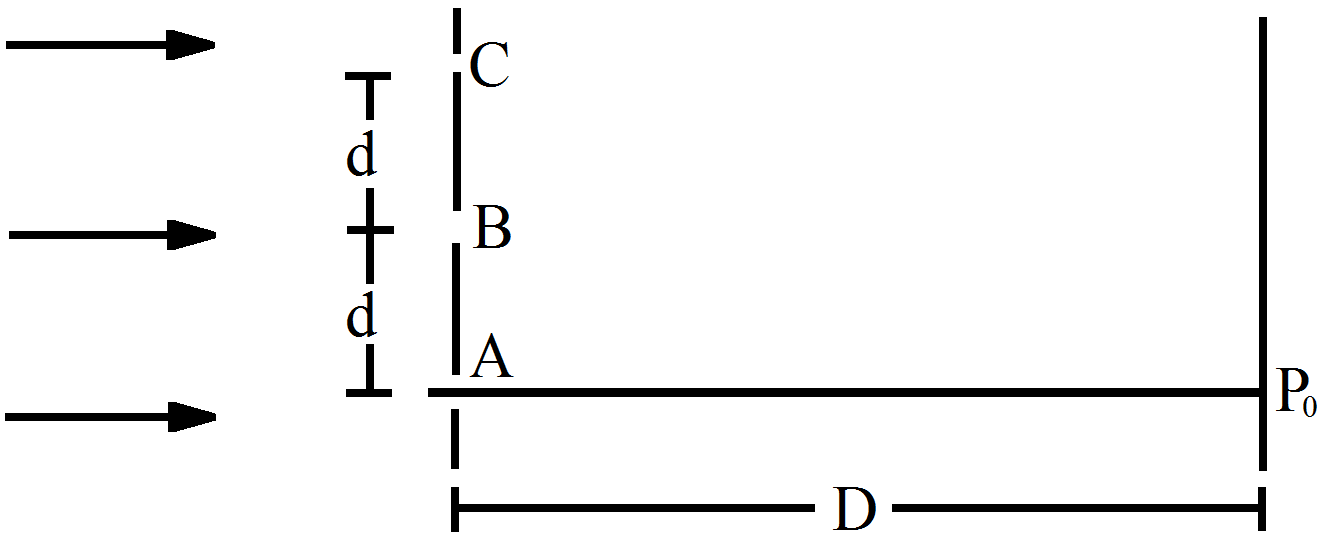
Figure shows three equidistant slits being illuminated by a monochromatic parallel beam of light. Let $\text{BP}_0-\text{AP}=\frac{\lambda}{3}$ and $\text{D}>\lambda.$
  1. Show that in this case $\text{d}=\sqrt{\frac{2\lambda\text{D}}{3}}.$
  2. Show that the intensity at P, is three times the intensity due to any of the three slits individually.
A block of mass $15kg$ is placed on a long trolley. The coefficient of static friction between the block and the trolley is $0.18$. The trolley accelerates from rest with $0.5ms^{-2}$ for $20s$ and then moves with uniform velocity. Discuss the motion of the block as viewed by (a) a stationary observer on the ground, (b) an observer moving with the trolley.