MCQ
Electric charges are distributed in a small volume. The flux of the electric field through a spherical surface of radius $10\ cm$ surrounding the total charge is $25V-m.$ The flux over a concentric sphere of radius $20\ cm$ will be:
  • $25V-m$
  • B
    $50V-m$
  • C
    $100V-m$
  • D
    $200V-m$

Answer

Correct option: A.
$25V-m$
$F$ is not depend on the shape $\&$ size of the closed volume surface.
$q_m\ Þ\ q_m$ is the net charge inside the closed volume surface.

Need a full question paper?

Generate a complete, print-ready paper with questions like this in minutes — across 16+ boards, with answer keys.

Start Generating Free

Similar questions

$Assertion :$ A thin stainless steel needle can lay floating on a still water surface.
$Reason :$ Any object floats when the buoyancy force balances the weight of the object
Water is flowing steadily through a horizontal tube of non uniform cross-section. If the pressure of water is $4$ $\times $ $10^4$ $N/m^2$ at a point where cross-section is $0.02$ $m^2$ and velocity of flow is $2$ $m/s$, what is pressure at a point where cross-section reduces to $0.01$ $m^2$.
The tension in a piano wire is $10N$. What should be the tension in the wire to produce a note of double the frequency .... $N$
A guitar string of length $90\,cm$ vibrates with a fundamental frequency of $120\,Hz.$ The length of the string producing a fundamental frequency of $180\,Hz$ will be $...........cm$.
Longitudinal stress of $1\,kg/m{m^2}$ is applied on a wire. The percentage increase in length is $(Y = {10^{11}}\,N/{m^2})$
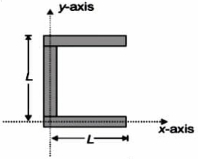
Locate the centre of mass of arrangement shown in figure. The three rods are identical in mass and length
A ball of mass m moves with speed $v$ and it strikes normally with a wall and reflected back normally, if its time of contact with wall is $t$ then find force exerted by ball on wall
Two particles oscillating in $SHM$ along two very close parallel path such that they have same mean position. The equation of $SHM$ of two particles are $x_1 = A\, sin\,\omega t$ and $x_2 = A\,sin(\omega t + \phi )$ respectively. If maximum distance between them is $\frac{6A}{5}$ then $\phi $ equal to ..... $^o$
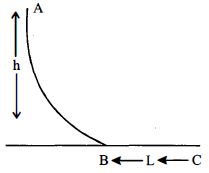
A small ball of mass $m$ starts at a point $A$ with speed $v_0$ and moves along a frictionless track $AB$ as shown. The track $BC$ has coefficient of friction $\mu $. The ball comes to stop at $C$ after travelling a distance $L$ which is
Which of the following does not have potential energy ?