MCQ
Electric field at a point varies as $r^0$ for
  • A
    An electric dipole
  • B
    A point charge
  • A plane infinite sheet of charge
  • D
    A line charge of infinite length

Answer

Correct option: C.
A plane infinite sheet of charge

Need a full question paper?

Generate a complete, print-ready paper with questions like this in minutes — across 16+ boards, with answer keys.

Start Generating Free

Similar questions

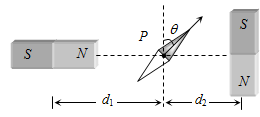
Two magnets $A$ and $B$ are identical and these are arranged as shown in the figure. Their length is negligible in comparison to the separation between them. A magnetic needle is placed between the magnets at point $P$ which gets deflected through an angle $\theta$ under the influence of magnets. The ratio of distance $d_1$  and $d_2$ will be
Resistivity of a wire depends on:
Figures below show regular hexagons, with charges at the vertices. In which of the following cases the electric field at the centre is not zero
Consider an NPN transistor amplifier in common-emitter configuration. The current gain of the transistor is 100. If the collector current changes by 1 mA, what will be the change in emitter current(a) 1.1 mA(b) 1.01 mA (c) 0.01 mA(d) 10 mA
       
Photoelectric effect was successfully explained first by(a) Planck(b) Hallwash(c) Hertz  (d) Einstein
       
Quantity that remains unchanged in a transformer is(a) Voltage(b) Current(c) Frequency(d) None of the above
       
A photon with energy twice the work function of the metal is incident on the surface of the metal. The value of maximum kinetic energy of the emitted photoelectron will be :
In a beryllium atom, if $a_0$ be the radius of the first orbit, then the radius of the second orbit will be in general
The refractive index of water is $\frac{4}{3}$ and that of glass is $\frac{5}{3}$. What will be the critical angle for the ray of light entering water from the glass  
If threshold wavelength for sodium is 6800Å then the work function will be(a) 1.8 eV (b) 2.5 eV(c) 2.1 eV (d) 1.4 eV