Electric field at a point $(x, y, z)$ is represented by $\vec E = 2x\hat i + {y^2}\hat j$ if potential at $(0,0,0)$ is $2\, volt$ find potential at $(1, 1, 1)$
Medium
Download our app for free and get started
$\mathrm{V}-\mathrm{V}_{(0,0,0)}=\int_{0}^{1} \mathrm{E}_{\mathrm{x}} \mathrm{d} \mathrm{x}+\int_{0}^{1} \mathrm{E}_{\mathrm{y}} \mathrm{d} \mathrm{y}$
$\mathrm{V}-2=\left[\mathrm{x}^{2}\right]_{0}^{1}+\frac{1}{3}\left[\mathrm{y}^{3}\right]_{0}^{1}$
$\mathrm{V}=2+1+\frac{1}{3}=\frac{10}{3} \mathrm{\,volt}$

Download our appand get started for free
Experience the future of education. Simply download our apps or reach out to us for more information. Let's shape the future of learning together!No signup needed.*
Similar Questions
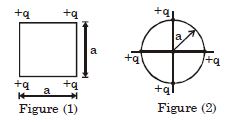
- 1Consider the configuration of a system of four charges each of value $+q$ . The work done by external agent in changing the configuration of the system from figure $(1)$ to figure $(2)$ isView Solution
- 2View SolutionA conductor with a positive charge
- 3A particle $A$ has charge $+q$ and particle $B$ has charge $+ 4q$ with each of them having the same mass $m$. When allowed to fall from rest through same electrical potential difference, the ratio of their speed $V_A : V_B$ will be :-View Solution
- 4The plates of parallel plate capacitor are charged upto $100\;V$. A $2\,mm$ thick plate is inserted between the plates. Then to maintain the same potential difference, the distance between the plates is increased by $1.6\;mm$. The dielectric constant of the plate isView Solution
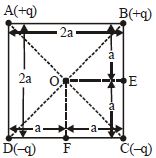
- 5The ratio of electric potentials at the point $E$ to that at the point $F$ isView Solution
- 6View SolutionThe capacity of the conductor does not depend upon
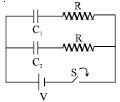
- 7In the circuit shown in figure $C_1=2C_2$. Switch $S$ is closed at time $t=0$. Let $i_1$ and $i_2$ be the currents flowing through $C_1$ and $C_2$ at any time $t$, then the ratio $i_1/ i_2$View Solution
- 8A molecule with a dipole moment $p$ is placed in an electric field of strength $E$. Initially the dipole is aligned parallel to the field. If the dipole is to be rotated to be anti-parallel to the field, the work required to be done by an external agent isView Solution
- 9The potential $V$ is varying with $x$ and $y$ as $V\, = \,\frac{1}{2}\,\left( {{y^2} - 4x} \right)\,volt.$ The field at ($1\,m, 1\,m$ ) isView Solution
- 10Two small spheres each carrying a charge $q$ are placed $r$ metre apart. If one of the spheres is taken around the other one in a circular path of radius $r$, the work done will be equal toView Solution