Two small spheres each carrying a charge $q$ are placed $r$ metre apart. If one of the spheres is taken around the other one in a circular path of radius $r$, the work done will be equal to
Easy


Download our appand get started for free
Experience the future of education. Simply download our apps or reach out to us for more information. Let's shape the future of learning together!No signup needed.*
Similar Questions
- 1Two opposite and equal charges $4 \times {10^{ - 8}}\,coulomb$ when placed $2 \times {10^{ - 2}}\,cm$ away, form a dipole. If this dipole is placed in an external electric field $4 \times {10^8}\,newton/coulomb$, the value of maximum torque and the work done in rotating it through $180^\circ $ will beView Solution
- 2A pellet carrying a charge of $0.5$ coulomb is accelerated through a potential of $2000$ volts. It attains some kinetic energy equal toView Solution
- 3The plates of a parallel plate capacitor of capacity $50\,\mu C$ are charged to a potential of $100\;volts$ and then separated from each other so that the distance between them is doubled. How much is the energy spent in doing soView Solution
- 4Four identical charges $ + \,50\,\mu C$ each are placed, one at each corner of a square of side $2\,m$. How much external energy is required to bring another charge of $ + \,50\,\mu C$ from infinity to the centre of the square......$J$ $\left( {{\rm{Given}}\frac{{\rm{1}}}{{{\rm{4}}\pi {\varepsilon _{\rm{0}}}}} = 9 \times {{10}^9}\,\frac{{N{m^2}}}{{{C^2}}}} \right)$View Solution
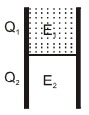
- 5A parallel plate capacitor has a dielectric slab of dielectric constant $K$ between its plates that covers $1 / 3$ of the area of its plates, as shown in the figure. The total capacitance of the capacitor is $C$ while that of the portion with dielectric in between is $C _1$. When the capacitor is charged, the plate area covered by the dielectric gets charge $Q_1$ and the rest of the area gets charge $Q_2$. Choose the correct option/options, igonoring edge effects.View Solution
$(A)$ $\frac{E_1}{E_2}=1$ $(B)$ $\frac{E_1}{E_2}=\frac{1}{K}$ $(C)$ $\frac{Q_1}{Q_2}=\frac{3}{K}$ $(D)$ $\frac{ C }{ C _1}=\frac{2+ K }{ K }$
- 6Determine the electric field strength vector if the potential of this field depends on $x, y$ coordinates as $V=10$ axyView Solution
- 7A parallel plate capacitor is charged to a potential difference of $50\, V$. It is discharged through a resistance. After $1$ second, the potential difference between plates becomes $40 \,V$. ThenView Solution
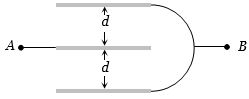
- 8Three plates of common surface area $A$ are connected as shown. The effective capacitance will beView Solution
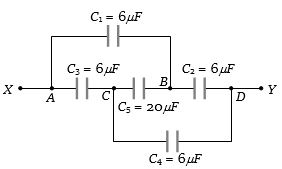
- 9What is the effective capacitance between points $X$ and $Y$.......$\mu F$View Solution
- 10The condensers of capacity ${C_1}$ and ${C_2}$ are connected in parallel, then the equivalent capacitance isView Solution