Question
Electric field in a plane electromagnetic wave is given by ${E}=50 \sin \left(500 {x}-10 \times 10^{10} {t}\right) \,{V} / {m}$ The velocity of electromagnetic wave in this medium is :

(Given ${C}=$ speed of light in vacuum)

Answer

${V}=\frac{\omega}{{K}}=\frac{10 \times 10^{10}}{500}=2 \times 10^{8}$

$V=\frac{2 {C}}{3}$

Need a full question paper?

Generate a complete, print-ready paper with questions like this in minutes — across 16+ boards, with answer keys.
Start Generating Free

Similar questions

Given : $\sigma$ is the compressibility of water, $\rho$ is the density of water and $K$ is the  bulk modulus of water. What is the energy density of water at the bottom of a lake $‘h’$  metre deep ?
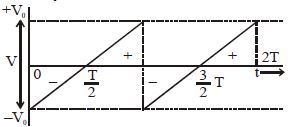
Find the rms value for the saw-tooth voltage of peak value $V_0$ from $t = 0$ to $t = 2T$ as shown in figure
When $x\, grams$ of steam at $100\,^oC$ is mixed  with $y\,grams$ of ice at $0\,^oC$ , We obtain $(x + y)\,grams$ of water at $100\,^oC$  . What is the ratio $y/x$ ?
An alpha nucleus of energy $\frac{1}{2}m{v^2}$ bombards a heavy nuclear target of charge $Ze$. Then the distance of closest approach for the alpha nucleus will be proportional to
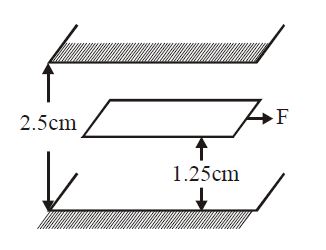
A space $2.5\ cm$ wide between two large plane surfaces is filled with oil. Force required to drag very thin plate of area $0.5\ m^2$ just midway the surfaces at a speed of $0.5\ m/sec$ is $1\ N$ The coefficient of viscosity in $kg-s/m^2$ is :
A galvanometer has resistance of $7\,\Omega $ and gives a full scale deflection for a current of $1.0\, A$. How will you convert it into a voltmeter of range $10\, V$
During an experiment with a metre bridge, the galvanometer shows a null point when the joceky is pressed at $40.0 \ cm$ using a standard resistance of $90 \ \Omega$, as shown in the figure. The least count of the scale used in the meter bridge is $1 \ mm$. The unknown resistance is:
Latent heat of $1\,gm $ of steam is $536 \,cal/gm,$ then its value in $joule/kg$ is
A potentiometer consists of a wire of length $4\, m$ and resistance $10\,\Omega $. It is connected to a cell of $e.m.f.$ $2\, V$. The potential difference per unit length of the wire will be ............. $V/m$
A particle is moving along a straight line parallel to $x-$ axis with constant velocity. Its angular momentum about the origin