MCQ
Electron volt is a unit of
  • A
    Potential
  • B
    Charge
  • C
    Power
  • Energy

Answer

Correct option: D.
Energy
d
(d) The electron volt (symbol $ev$ also written electronvolt) is a unit of energy equal to approximately $1.602 \times 10 ^{-19}$  joule $(SI$ unit $J).$

By definition, it is the amount of energy gained by the charge of a single electron moved across an electric potential difference of one volt.

Need a full question paper?

Generate a complete, print-ready paper with questions like this in minutes — across 16+ boards, with answer keys.
Start Generating Free

Similar questions

The displacement of a particle starting from rest (at $t = 0$) is given by $s = 6{t^2} - {t^3}$. The time in seconds at which the particle will attain zero velocity again, is ..... $\sec$
An $ac$ source of variable frequency $f$ is connected to an $LCR$ series circuit. Which one of the graphs in figure. represents the variation of current of current $I$ in the circuit with frequency $f$
Heat required to convert $5\ kg$ ice at $0\ ^oC$ into water at $100\ ^oC$ is
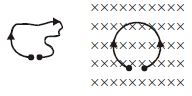
A thin flexible wire of length $L$ is connected to two adjacent fixed points carries a current $I$ in the clockwise direction, as shown in the figure. When system is put in a uniform magnetic field of strength $B$ going into the plane of paper, the wire takes the shape of a circle. The tension in the wire is
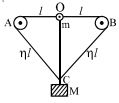
A loop of light inextensible string passes over smooth small pulleys $A$ and $B$. Two masses $m$ and $M$ are attached to the points $O$ and $C$ respectively. Then the condition that $m$ and $M$ will cross each other. [Take $AB = 2l$ and $AC = AB = \eta l$] will be
If $\oint_s \vec{E} \cdot \overrightarrow{d S}=0$ over a surface, then:
A small sphere of radius $r$ falls from rest in a viscous liquid. As a result, heat is produced due to viscous force. The rate of production of heat when the sphere attains its terminal velocity, is proportional to
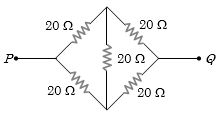
The equivalent resistance between $P$ and $Q$ in the given figure, is ............... $\Omega$
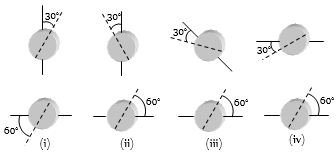
The figure shows four pairs of polarizing sheets, seen face-on. Each pair is mounted in the path of initially unpolarized light. The polarizing direction of each sheet (indicated by the dashed line) is referenced to either a horizontal $x$ - axis or $a$ vertical $y$ axis. Rank the pair according to the fraction of the initial intensity that they pass, greatest first
The relaxation time in conductors