Question
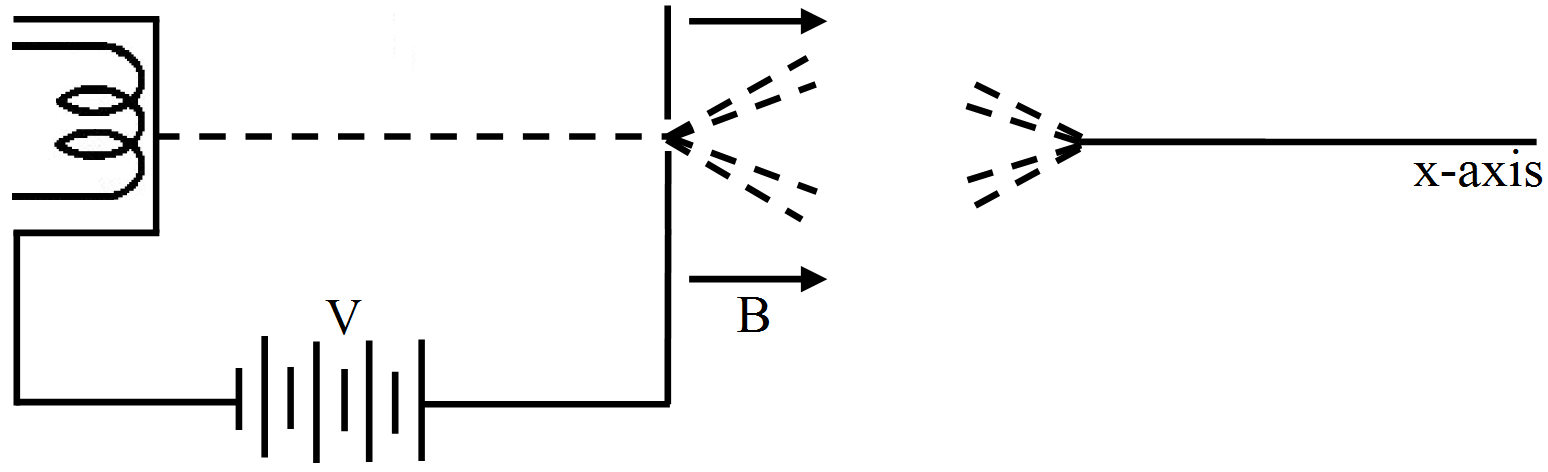
Electrons emitted with negligible speed from an electron gun are accelerated through a potential difference V along the x-axis. These electrons emerge from a narrow hole into a uniform magnetic field B directed along this axis. However, some of the electrons emerging from the hole make slightly divergent angles, as shown in the figure. Show that these paraxial electrons are refocussed on the x-axis at a distance $\sqrt{\frac{8\pi^2\text{mV}}{\text{eB}^2}}.$
Answer

Given magnetic field = B, Pd = V, mass of electron = m, Charge = q,
Let electric field be ‘E’
$\therefore\text{E}=\frac{\text{V}}{\text{R}'}$
Force Experienced = eE
Acceleration $=\frac{\text{eE}}{\text{m}}=\frac{\text{eE}}{\text{Rm}}$
Now, $V^2 = 2 \times a × s [\because\text{x}=0]$
$\text{V}=\sqrt{\frac{2\text{e}\times\text{V}\times\text{R}}{\text{Rm}}}=\sqrt{\frac{\text{2eV}}{\text{m}}}$
Time taken by particle to cover the arc $=\frac{2\pi\text{m}}{\text{qB}}=\frac{2\pi\text{m}}{\text{eB}}$
Since the acceleration is along ‘Y’ axis.
Hence it travels along x axis in uniform velocity,
Therefore, $\text{v}\times\text{t}=\sqrt{\frac{2\text{em}}{\text{m}}}\times\frac{2\pi\text{m}}{\text{eB}}\sqrt{\frac{8\pi^2\text{mV}}{\text{eB}^2}}$

Need a full question paper?

Generate a complete, print-ready paper with questions like this in minutes — across 16+ boards, with answer keys.

Start Generating Free

Similar questions

An inductor-coil of resistance $10\Omega$ and induetanes 120mH is connected across a battery of emf 6V and Internal resistance $2\Omega.$ Find the charge which flows through the inductor in:
  1. 10ms
  2. 20ms
  3. 100 ms after the connections are made.
The two blocks in an Atwood machine have masses 2.0kg and 3.0kg. Find the work done by gravity during the fourth second after the system is released from rest.
Write the mathematical relation for the resistivity of a material in terms of relaxation time, number density, mass and charge of charge carriers in it. Explain using this relation, why the resistivity of a metal increases and that of a semiconductor decreases with rise in temperature.
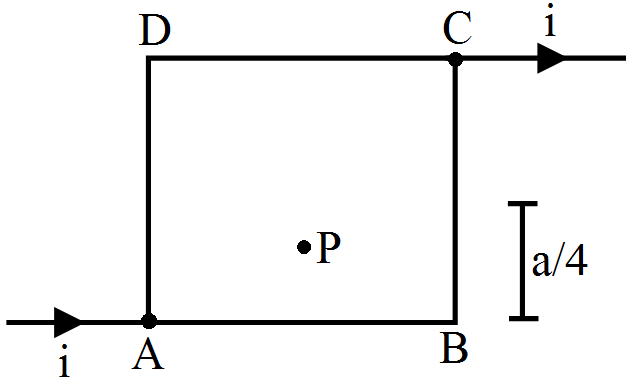
Figure shows a square loop of edge a made of a uniform wire. A current i enters the loop at the point A and leaves it at the point C. Find the magnetic field at the point P which is on the perpendicular bisector of AB at a distance $\frac{\text{a}}{4}$ from it.
The bob of a pendulum at rest is given a sharp hit to impart a horizontal velocity $\sqrt{10\text{gl}},$ where l is the length of the pendulum. Find the tension in the string when,
  1. The string is horizontal.
  2. The bob is at its highest point.
  3. The string makes an angle of 60° with the upward vertical.
$a.$ Derive an expression for the potential energy of an electric dipole in a uniform electric field. Explain conditions for stable and unstable equilibrium.
$b.$ Is the electrostatic potential necessarily zero at a point where the electric field is zero? Give an example to support your answer.
Three identical charges, each having a value $1.0 \times 10^{-8}C$, are placed at the corners of an equilateral triangle of side 20cm. Find the electric field and potential at the centre of the triangle.
  1. Derive an expression for the force between two long parallel current carrying conductors.
  2. Use this expression to define S.I. unit of current.
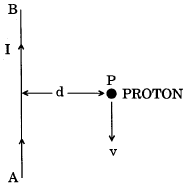
  3. A long straight wire AB carries a current I. A proton P travels with a speed v, parallel to the wire, at a distance d from it in a direction opposite to the current as shown in the figure. What is the force experienced by the proton and what is its direction?
An X-ray tube operates at 40kV. Suppose the electron converts 70% of its energy into a photon at each collision. Find the lowest there wavelengths emitted from the tube. Neglect the energy imparted to the atom with which the electron collides.
Write Gauss' law in electrostatics. With the help of a suitable example and a diagram, show that the outward flux due to point charge ' $q$ ' in a closed surface in vaccum does not depend on the size and shape of the surface and its magnitude is $\frac{q}{\epsilon_0}$.