Question
  1. Derive an expression for the force between two long parallel current carrying conductors.
  2. Use this expression to define S.I. unit of current.
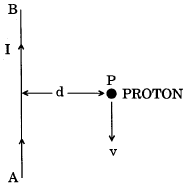
  3. A long straight wire AB carries a current I. A proton P travels with a speed v, parallel to the wire, at a distance d from it in a direction opposite to the current as shown in the figure. What is the force experienced by the proton and what is its direction?
Answer

  1.  


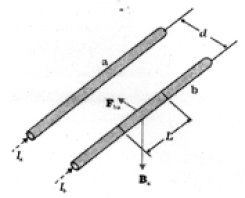
Two long parallel conductors ‘a’ and ‘b’ are separated by a distance d and carry (parallel) currents $I_a$ and $I_b$, respectively. The conductor ‘a’ produces, the same magnetic field $B_a$ at all points along the conductor ‘b’.

$\text{B}_{a} = \frac{\mu_{0}\text{I}_{a}}{2\pi\text{d}}$

$F_{ba},$ is the force on a segment L of ‘b’ due to ‘a’. The magnitude of this force is given by

$F_{ba}= I_b\  LB_a$

$=\frac{\mu_{0}\text{I}_{a}\text{I}_{b}}{2\pi\text{d}}\text{L}$
  1. The ampere is the value of that steady current which, when maintained in each of the two very long, straight, parallel conductors of negligible cross-section, and placed one metre apart in vacuum, would produce on each of these conductors a force equal to $2 \times 10^{–7}$ newton per metre of length.
  2. Magnetic field due to the straight wire AB at a perpendicular distance d from it.
$\text{B} = \frac{\mu_{0}\text{I}}{2\pi\text{d}}$

Therefore, force on proton moving with velocity ‘v’ perpendicular to B, is

$\text{f} = \text{qvB} = \frac{\mu_{0}\text{Iqv}}{2\pi\text{d}}$

Direction: Towards right.

Need a full question paper?

Generate a complete, print-ready paper with questions like this in minutes — across 16+ boards, with answer keys.

Start Generating Free

Similar questions

A thin prism of angle $6.0^\circ,\omega=0.07$ and $\mu_\text{y}=1.50$ is combined with another thin prism having $\omega=0.08$ and $\mu_\text{y}=1.60.$ The combination produces no deviation in the mean ray.
  1. Find the angle of the second prism.
  2. Find the net angular dispersion produced by the combination when a beam of white light passes through it.
  3. If the prisms are similarly directed, what will be the deviation in the mean ray
  4. Find the angular dispersion in the situation described in (c).
Ten positively charged particles are kept fixed on the x-axis at points $x = 10cm, 20cm, 30cm, ..., 100cm$. The first particle has a charge $1.0 \times 10^{-8}C$, the second $8 \times 10^{-8}C$, the third $27 \times 10^{-8}C$ and so on. The tenth particle has a charge $1000 \times 10^{-8}C$. Find the magnitude of the electric force acting on a 1C charge placed at the origin.
In the circuit shown in the figure. $\in_1=3\text{V},\in_2=2\text{V},\in_3=1\text{V}$ and $\text{r}_1=\text{r}_2=\text{r}_3=1\Omega.$ Find the potential difference between the points A and B and the current through each branch.
The door of an almirah is 6ft high, 1.5ft wide and weighs 8kg. The door is supported by two hinges situated at a distance of 1ft from the ends. If the magnitudes of the forces exerted by the hinges on the door are equal, find this magnitude.
If the above capacitor is connected across a 6.0V battery, find:
  1. The charge supplied by the battery.
  2. The induced charge on the dielectric.
  3. The net charge appearing on one of the coated surfaces.
A charge Q located at a point $\vec{\text{r}}$ is in equilibrium under the combined electric field of three charges $q_1, q_2, q_3.$ If the charges $q_1, q_2$ are located at points $\vec{\text{r}}_1$ and $\vec{\text{r}}_2$ respectively, find the direction of the force on Q, due to $q_3$ in terms of $q_1, q_2, \vec{\text{r}}_1,\ \vec{\text{r}}_2$ and $\vec{\text{r}}.$
When a p-n junction is reverse-biased, the current becomes almost constant at $25\mu\text{A}.$ When it is forwardbiased at 200mV, a current of $75\mu\text{A}$ is obtained. Find the magnitude of diffusion current when the diode is,
  1. Unbiased.
  2. Reverse-biased at 200mV.
  3. Forward-biased at 200mV.
Suppose the ceiling in the previous problem is that of an elevator which is going up with an acceleration of $2.0m/s^2.$ Find the elongations.
A rectangular loop of sides 20cm and 10cm carries a current of 5.0A. A uniform magnetic field of magnitude 0.20T exists parallel to the longer side of the loop.
  1. What is the force acting on the loop?
  2. What is the torque acting on the loop?
Consider the fission of $^{238}_{92}\text{U}$ by fast neutrons. In one fission event, no neutrons are emitted and the final end products, after the beta decay of the primary fragments, are $^{140}_{58}\text{Ce}$ and $^{99}_{44}\text{Ru}.$ Calculate Q for this fission process.
The relevant atomic and particle masses are:
$\text{m}(^{238}_{92}\text{U})=238.05079\text{ u}$
$\text{m}(^{140}_{58}\text{Ce})=139.90543\text{ u}$
$\text{m}(^{99}_{44}\text{Ru})=98.90594\text{ u}$