Question
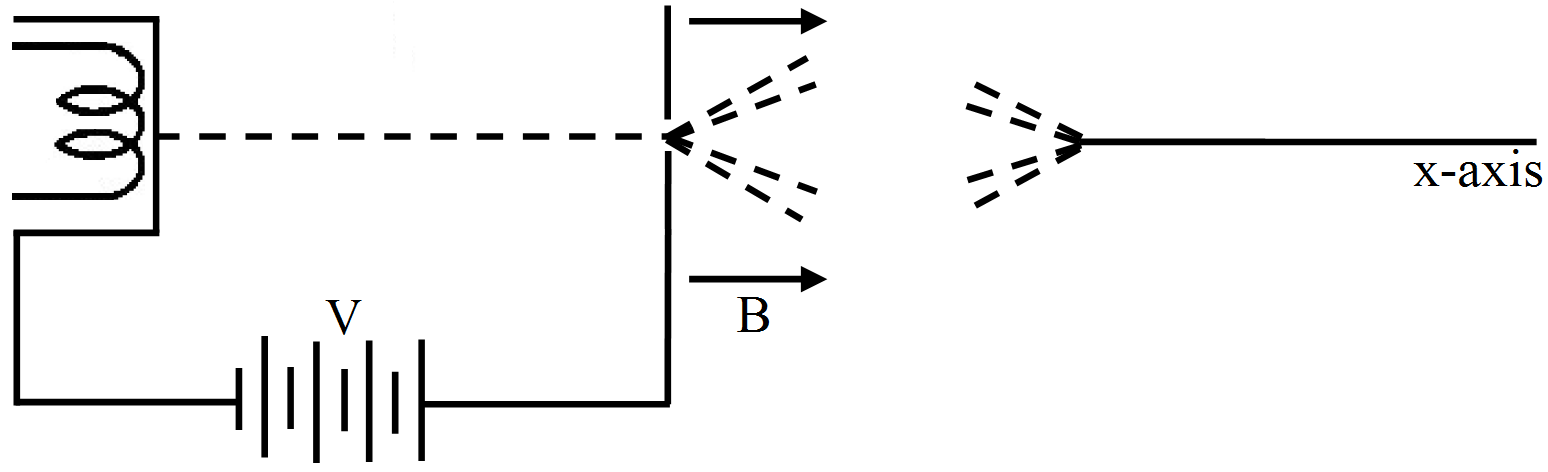
Electrons emitted with negligible speed from an electron gun are accelerated through a potential difference V along the x-axis. These electrons emerge from a narrow hole into a uniform magnetic field B directed along this axis. However, some of the electrons emerging from the hole make slightly divergent angles, as shown in the figure. Show that these paraxial electrons are refocussed on the x-axis at a distance $\sqrt{\frac{8\pi^2\text{mV}}{\text{eB}^2}}.$
Answer

Given magnetic field = B, Pd = V, mass of electron = m, Charge = q,
Let electric field be ‘E’
$\therefore\text{E}=\frac{\text{V}}{\text{R}'}$
Force Experienced = eE
Acceleration $=\frac{\text{eE}}{\text{m}}=\frac{\text{eE}}{\text{Rm}}$
Now $, V^2 = 2 \times a \times s [\because\text{x}=0]$
$\text{V}=\sqrt{\frac{2\text{e}\times\text{V}\times\text{R}}{\text{Rm}}}=\sqrt{\frac{\text{2eV}}{\text{m}}}$
Time taken by particle to cover the arc $=\frac{2\pi\text{m}}{\text{qB}}=\frac{2\pi\text{m}}{\text{eB}}$
Since the acceleration is along ‘Y’ axis.
Hence it travels along x axis in uniform velocity,
Therefore, $\text{v}\times\text{t}=\sqrt{\frac{2\text{em}}{\text{m}}}\times\frac{2\pi\text{m}}{\text{eB}}\sqrt{\frac{8\pi^2\text{mV}}{\text{eB}^2}}$

Need a full question paper?

Generate a complete, print-ready paper with questions like this in minutes — across 16+ boards, with answer keys.

Start Generating Free

Similar questions

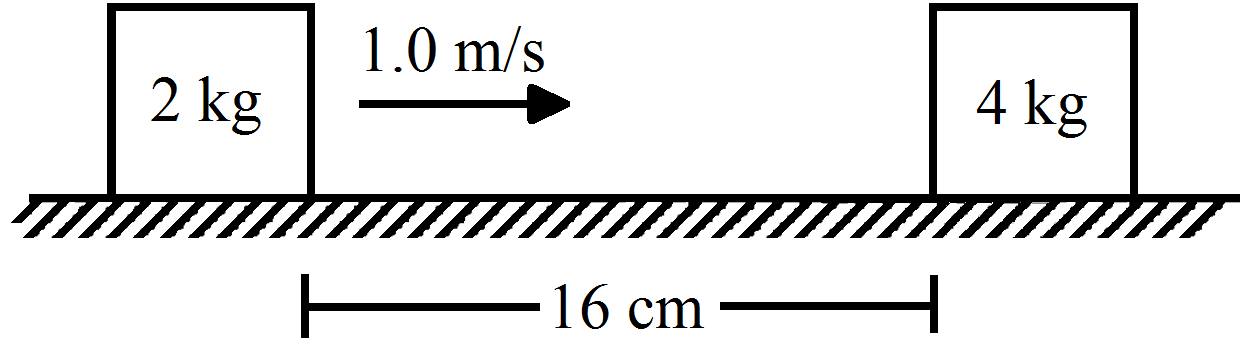
The friction coefficient between the horizontal surface and each of the blocks shown in figure is 0.20. The collision between the blocks is perfectly elastic. Find the separation between the two blocks when they come o rest. Take $g = 10 m/s^2.$
For the same objective, find the ratio of the least separation between two points to be distinguished by a microscope for light of 5000A and electrons accelerated through 100V used as the illuminating substance.
The current−voltage characteristic of an ideal p-n junction diode is given by $\text{i}=\text{i}_0\Big(\text{e}^{\frac{\text{eV}}{\text{kT}}}-1\Big)$ where, the drift current $i_0$ equals $10\mu\text{A}.$ Take the temperature T to be 300K.
  1. Find the voltage $V_0$ for which $\text{e}^{\frac{\text{eV}}{\text{KT}}}=100.$ One can neglect the term 1 for voltages greater than this value.
  2. Find an expression for the dynamic resistance of the diode as a function of V for $V > V_0.$
  3. Find the voltage for which the dynamic resistance is $0.2\Omega.$
A simple pendulum of length I is suspended through the ceiling of an elevator. Find the time period of small oscillations if the elevator,
  1. Is going up with an acceleration $a_0$
  2. Is going down with an acceleration $a_0$.
  3. Is moving with a uniform velocity.
Calculate potential on the axis of a disc of radius R due to a charge Q uniformly distributed on its surface.
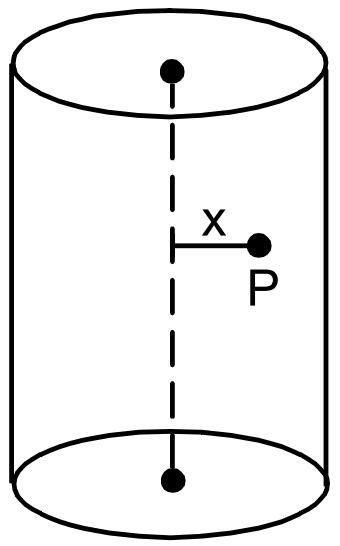
A long cylindrical volume contains a uniformly distributed charge of density $\rho.$ Find the electric field at a point P inside the cylindrical volume at a distance x from its axis (figure).
For an LCR circuit driven at frequency $\omega$, the equation reads $\text{L}\frac{\text{di}}{\text{dt}}+\text{Ri}+\frac{\text{q}}{\text{C}}=\text{v}_\text{i}=\text{v}_\text{m}\sin\omega\text{t}$.
  1. Multiply the equation by i and simplify where possible.
  2. Interpret each term physically.
  3. Cast the equation in the form of a conservation of energy statement.
  4. Intergrate the equation over one cycle to find that the phase difference between v and i must be acute.
Consider the situation shown in figure. Suppose a small electric field E exists in the space in the vertically upward direction and the upper block carries a positive charge Q on its top surface. The friction coefficient between the two blocks is g but the floor is smooth. What maximum horizontal force F can be applied without disturbing the equilibrium?
[Hint: The force on a charge Q by the electric field E is F = QE in the direction of E.]
A ball of mass m moving at a speed v makes a head-on collision with an identical ball at rest. The kinetic energy of the balls after the collision is three fourths of the original. Find the coefficient of restitution.
An optical instrument used for angular magnification has a 25D objective and a 20D eyepiece. The tube length is 25cm when the eye is least strained.
  1. Whether it is a microscope or a telescope?
  2. What is the angular magnification produced?