MCQ
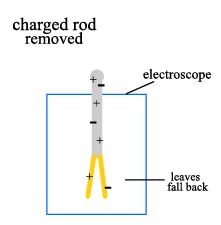
Electroscope is used:
  • A
    To detect and test small electric charges.
  • B
    To calculate the amount of electric charge flowing through the conductor in the given interval of time.
  • C
    To find out the presence of antimatter.
  • D
    To test the presence of magnetic field.
Need a full question paper?

Generate a complete, print-ready paper with questions like this in minutes — across 16+ boards, with answer keys.

Start Generating Free

Similar questions

If length of a conductor is doubled and cross-section is made half, then the specific resistance of the substance of changed wire will become:
Potentiometer measures potential more accurately because:

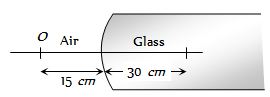
A point object O is placed in front of a glass rod having spherical end of radius of curvature 30 cm.  The image would be formed at

(a) 30 cm left

(b) Infinity

(c) 1 cm to the right

(d) 18 cm to the left

Which of the following particles will experience maximum magnetic force circle when projected with the same velocity perpendicular to a magnetic field?
  1. Electron
  2. Proton
  3. He+
  4. Li++

Five resistors of given values are connected together as shown in the figure. The current in the arm BD will be

(a) Half the current in the arm ABC

(b) Zero

(c) Twice the current in the arm ABC

(d) Four times the current in the arm ABC

To increase the angular magnification of a simple microscope, one should increase:

To compare magnetic moments of two magnets by vibration magnetometer, 'sum and difference method' is better because

(a) Determination of moment of inertia is not needed which minimises the errors

(b) Less observations are required

(c) Comparatively less calculations

(d) All the above

99% of a radioactive element will decay between

(a) 6 and 7 half lives

(b) 7 and 8 half lives

(c) 8 and 9 half lives

(d) 9 half lives

Assertion   :   In photoemissive cell inert gas is used.

Reason       : Inert gas in the photoemissive cell gives greater current.

(a) If both assertion and reason are true and the reason is the correct explanation of the assertion.

(b) If both assertion and reason are true but reason is not the correct explanation of the assertion.

(c) If assertion is true but reason is false.

(d) If the assertion and reason both are false.

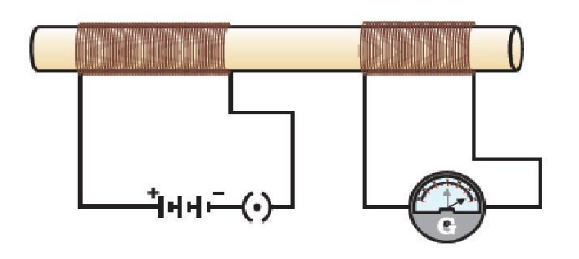
In the arrangement shown in given Figure, there are two coils wound on a non-conducting cylindrical rod. Initially the key is not inserted. Then the key is inserted and later removed. Then,