MCQ
To increase the angular magnification of a simple microscope, one should increase:
- AThe focal length of the lens.
- BThe power of the lens.
- CThe aperture of the lens.
- DThe object size.
To increase the angular magnification of a simple microscope, one should increase:
The power of the lens.
Explanation:
For a simple microscope in normal adjustment, the object is placed at a distance equal to f (the focal length) from the lens, And the angular magnification is given by the relation
$\text{m}=\frac{\text{D}}{\text{f}}$
for $\text{u}<\text{f},\text{m}=\frac{\text{D}}{\text{f}}+1$
power of lens
$=\frac{1}{\text{f}}$Angular magnification depends on power.
Generate a complete, print-ready paper with questions like this in minutes — across 16+ boards, with answer keys.
Focal length of a convex lens of refractive index 1.5 is 2 cm. Focal length of lens when immersed in a liquid of refractive index of 1.25 will be
|
(a) 10 cm |
(b) 2.5 cm |
(c) 5 cm |
(d) 7.5 cm |
If the distance of the far point for a myopia patient is doubled, the focal length of the lens required to cure it will become
|
(a) Half |
(b) Double |
|
(c) The same but a convex lens |
(d) The same but a concave lens |
The electric field near a conducting surface having a uniform surface charge density σ is given by
|
(a) |
(b) |
|
(c) |
(d) |
Here, A refers to.
A convex lens has a focal length f. It is cut into two parts along the dotted line as shown in the figure. The focal length of each part will be
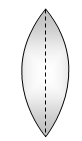
|
(a) |
(b) f |
(c) |
(d) 2f |
A current carrying rectangular coil is placed in a uniform magnetic field. In which orientation, the coil will not tend to rotate
|
(a) The magnetic field is parallel to the plane of the coil |
|
(b) The magnetic field is perpendicular to the plane of the coil |
|
(c) The magnetic field is at 45o with the plane of the coil |
|
(d) Always in any orientation |
An α particle and a proton travel with same velocity in a magnetic field perpendicular to the direction of their velocities, find the ratio of the radii of their circular path
|
(a) 4 : 1 |
(b) 1 : 4 |
(c) 2 : 1 |
(d) 1 : 2 |


