MCQ
Elements having similar outer shell electronic configuration in their atoms are arranged in :
  • A
    Groups.
  • B
    Vertical columns.
  • C
    Families.
  • All of these.

Answer

Correct option: D.
All of these.
Similar outer configuration in their atoms are arranged in vertical columns called groups or families.

Need a full question paper?

Generate a complete, print-ready paper with questions like this in minutes — across 16+ boards, with answer keys.

Start Generating Free

Similar questions

$(\Delta H - \Delta U)$ for the formation of carbon monoxide $(CO)$ from its elements at $298\, K$ is ............. $\mathrm{J\,mol}^{-1}$   $(R= 8.314\,J\,K^{-1}\, mol^{-1})$
One gram sample of $N{H_4}N{O_3}$ is decomposed in a bomb calorimeter. The temperature of the calorimeter increases by $ 6.12\, K$  the heat capacity of the system is  $1.23\, kJ/g/deg.$  What is the molar heat of decomposition for $N{H_4}N{O_3}$ ......$kJ/mol$
Which of the following represent pair of enantiomers ?
If gas, at constant temperature and pressure expands then its
Match List-$I$ with List-$II$.

List-$I$

(Molecule)

List-$II$.

(Number and types of bond/s between two carbon atoms)

$A$. ethane $I$. one $\sigma$-bond and two $\pi$-bonds
$B$. ethene $II$. two $\pi$-bonds
$C$. carbon molecule, $\mathrm{C}_2$ $III$. one $\sigma$-bond
$D$. ethyne $IV$. one $\sigma$-bond and one $\pi$-bond

Choose the correct answer from the options given below:

$o-$ nitrophenol can be easily steam distilled whereas $p-$ nitrophenol cannot be.  This is because of
$\mathrm{A}(\mathrm{s}) \rightleftharpoons \mathrm{M}(\mathrm{s})+\frac{1}{2} \mathrm{O}_{2}(\mathrm{~g})$

The equilibrium constant for the reaction is $K_{p}=4$, At equilibrium, the partial pressure of $\mathrm{O}_{2}$ is $....\,atm.$ (Round off to the nearest integer).
Addition of $HCN$ to ethyne in presence of $Ba{(CN)_2}$ as catalyst gives
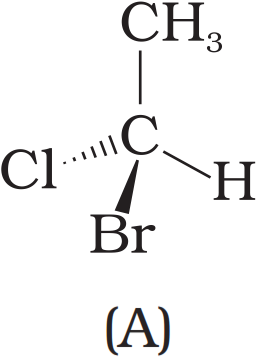
In which of the following representations given below spatial arrangement of group/ atom different from that given in structure ‘A’?
Note : Consider the following four compounds for answering questions :
  1. $\ \ \ \ \ \ \ \ \ \ \ \ \ \ \ \ \ \ \ \ \ \ \ \ \ \ \ \ \ \ \ \ \ \ \ \ \ \ \ \ \ \ \ \ \ \ \ \ \ \ \text{O}\\\ \ \ \ \ \ \ \ \ \ \ \ \ \ \ \ \ \ \ \ \ \ \ \ \ \ \ \ \ \ \ \ \ \ \ \ \ \ \ \ \ \ \ \ \ \ \ \ \ \ ||\\\text{CH}_3-\text{CH}_2-\text{CH}_2-\text{CH}_2-\text{C}-\text{H}$
  2. $\ \ \ \ \ \ \ \ \ \ \ \ \ \ \ \ \ \ \ \ \ \ \ \ \ \ \ \ \ \ \ \ \ \ \ \ \ \ \ \ \ \ \ \ \ \text{O}\\\ \ \ \ \ \ \ \ \ \ \ \ \ \ \ \ \ \ \ \ \ \ \ \ \ \ \ \ \ \ \ \ \ \ \ \ \ \ \ \ \ \ \ \ \ ||\\\text{CH}_3-\text{CH}_2-\text{CH}_2\text{CH}_2-\text{C}-\text{CH}_3$
  3. $\text{CH}_3-\text{CH}_2-\text{C}-\text{CH}_2-\text{CH}_3\\\ \ \ \ \ \ \ \ \ \ \ \ \ \ \ \ \ \ \ \ \ \ \ \ \ ||\\\ \ \ \ \ \ \ \ \ \ \ \ \ \ \ \ \ \ \ \ \ \ \ \ \ \text{O}$
  4. $\text{CH}_3-\text{CH}-\text{CH}_2-\text{C}-\text{H}\\\ \ \ \ \ \ \ \ \ \ \ \ \ \ \ \ \ \ \ \ \ \ \ \ |\ \ \ \ \ \ \ \ \ \ \ ||\\\ \ \ \ \ \ \ \ \ \ \ \ \ \ \ \ \ \ \ \ \ \ \ \text{CH}_3\ \ \ \ \ \text{O}$
Which of the following pairs are position isomers?