MCQ
Let $\overrightarrow{\text{A}}$ be a unit vector along the axis of rotation of a purely rotating body and $\overrightarrow{\text{B}}$ be a unit vector along the velocity of a particle $P$ of the body away from the axis. The value of $\overrightarrow{\text{A}}.\overrightarrow{\text{B}}$ is:
  • A
    $1$
  • B
    $-1$
  • $0$
  • D
    None of these.

Answer

Correct option: C.
$0$
For a purely rotating body, the axis of rotation is always perpendicular to the velocity of the particle. Therefore, we have:
$\overrightarrow{\text{A}}.\overrightarrow{\text{B}}=0$

Need a full question paper?

Generate a complete, print-ready paper with questions like this in minutes — across 16+ boards, with answer keys.

Start Generating Free

Similar questions

A particle of mass $m = 5$ is moving with a uniform speed $v = 3\sqrt 2$ in the $XOY$ plane along the line $Y = X + 4$ . The magnitude of the angular momentum of the particle about the origin is .......
If a liquid neither falls nor rise in a capillary tube, then the angle of contact between the liquid and the capillary material will be:
A sine wave is travelling in a medium. The minimum distance between the two particles, always having same speed, is:
forceA particle moves with constant speed $v$ along a circular path of radius $r$ and completes the circle in time $T$. The acceleration of the particle is
A signal of $0.1\, kW$ is transmitted in a cable. The attenuation of cable is $-5 \,dB$ per $km$ and cable length is $20\, km$. The power received at receiver is $10^{-x} \, W$. The value of $x$ is ....... .

$\left[\right.$ Gain in $\left. dB =10 \log _{10}\left(\frac{ P _{0}}{ P _{i}}\right)\right]$

A body is thrown vertically upwards with a velocity $u$. Find the true statement from the following
A certain string will resonant to several frequencies, the lowest of which is $200 \,cps$. What are the next three higher frequencies to which it resonants?
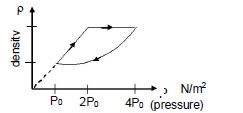
An ideal gas undergoes cyclic process as shown in density pressure graph. During the process $AB$ the work done $|W_{AB}| = 70\,J$ . During the process $BC$, the gas absorbs $150\,J$ of heat. During the process $CA$ , gas undergoes expansion and does $210\,J$ of work
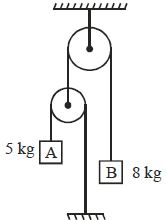
Find the acceleration of block $B$
$A$ block of mass $m$ moving with a velocity $v_0$ on a smooth horizontal surface strikes and compresses a spring of stiffness $k$ till mass comes to rest as shown in the figure. This phenomenon is observed by two observers:

$A$: standing on the horizontal surface

$B$: standing on the block According to the observer $A$