MCQ
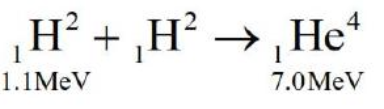
Energy released when two deuterons $\left({ }_{1} \mathrm{H}^{2}\right)$ fuse to form a helium nucleus $\left({ }_{2} \mathrm{He}^{4}\right)$ is :
(Given : Binding energy per nucleon of ${ }_{1} \mathrm{H}^{2}=1.1 \mathrm{MeV}$ and binding energy per nucleon of ${ }_{2} \mathrm{He}^{4}=7.0 \mathrm{MeV}$ )
  • A
    8.1 MeV
  • B
    5.9 MeV
  • C
    23.6 MeV
  • D
    26.8 MeV

Need a full question paper?

Generate a complete, print-ready paper with questions like this in minutes — across 16+ boards, with answer keys.

Start Generating Free

Similar questions

Amount of light entering into the camera depends upon
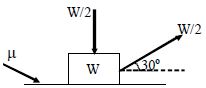
A block of weight $W$ is kept on a rough horizontal surface (friction coefficient $\mu$). Two forces $W/2$ each are applied as shown in the figure. Choose the $CORRECT$ statement :-
The electric field of a plane electromagnetic wave is given by $\overrightarrow{ E }= E _{0}(\hat{ x }+\hat{ y }) \sin ( kz -\omega t )$ Its magnetic field will be given by
For a prism of apex angle $45^o$, it is found that the angle of emergence is $45^o$ for grazing incidence. Calculate the refractive index of the prism.
Photons of an electromagnetic radiation has an energy $11\, keV$ each. To which region of electromagnetic spectrum does it belong ?
What is the ratio of wavelength of radiations emitted when an electron in hydrogen atom jump from fourth orbit to second orbit and from third orbit to second orbit
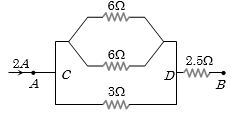
The equivalent resistance and potential difference between $A$ and $B$ for the circuit is respectively
$A$ luminous point object is moving along the principal axis of a concave mirror of focal length $12\, cm$ towards it. When its distance from mirror is $20\, cm$ its velocity is $4\, cm/s$. The velocity of the image in $cm/s$ at that instant is :
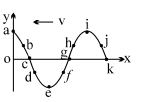
The figure represents the instantaneous picture of a longitudinal harmonic wave travelling along the negative $x$-axis. Identify the correct statement $(s)$ related to the movement of the points shown in the figure. The maximum displaced points are
The temperature of hot and cold end of a $20cm$ long rod in thermal steady state are at ${100^o}C$ and ${20^o}C$ respectively. Temperature at the centre of the rod is...... $^oC$