Questions

SECTION - A [PHYSICS MCQ]

Take a timed test

20 questions · self-marked practice — reveal the answer and mark yourself.

MCQ 14 Marks
Consider a circular loop that is uniformly charged and has a radius $\mathrm{a} \sqrt{2}$. Find the position along the positive z - axis of the cartesian coordinate system where the electric field is maximum if the ring was assumed to be placed in xy - plane at the origin :
  • A
    $\frac{\mathrm{a}}{\sqrt{2}}$
  • B
    $\frac{a}{2}$
  • C
    a
  • D
    $0$
Answer
C. a
$E=\frac{K Q r}{\left(x^{2}+R^{2}\right)^{3 / 2}}$
$\frac{\mathrm{dE}}{\mathrm{dx}}=0$
$\therefore \mathrm{x}=\frac{\mathrm{R}}{\sqrt{2}}=\frac{\sqrt{2} \mathrm{a}}{\sqrt{2}}=\mathrm{a}$
View full question & answer
MCQ 24 Marks
Match List-I with List-II.
List-IList-II
(A) Heat capacity of body(I) $\mathrm{J} \mathrm{kg}^{-1}$
(B) Specific heat capacity of body(II) $\mathrm{JK}^{-1}$
(C) Latent heat(III) $\mathrm{J} \mathrm{kg}^{-1} \mathrm{~K}^{-1}$
(D) Thermal conductivity(IV) $\mathrm{Jm}^{-1} \mathrm{~K}^{-1} \mathrm{~s}^{-1}$
Choose the correct answer from the options given below :
  • A
    (A)-(III), (B)-(I), (C)-(II), (D)-(IV)
  • B
    (A)-(IV), (B)-(III), (C)-(II), (D)-(I)
  • C
    (A)-(III), (B)-(IV), (C)-(I), (D)-(II)
  • D
    (A)-(II), (B)-(III), (C)-(I), (D)-(IV)
Answer
D. (A)-(II), (B)-(III), (C)-(I), (D)-(IV)
$\mathrm{C}^{\prime}=\frac{\Delta \mathrm{Q}}{\Delta \mathrm{T}}=\mathrm{JK}^{-1}$
$\mathrm{S}=\frac{\Delta \mathrm{Q}}{\mathrm{m} \Delta \mathrm{T}}=\mathrm{Jkg}^{-1} \mathrm{~K}^{-1}$
$\mathrm{L}=\frac{\Delta \mathrm{Q}}{\mathrm{m}}=\mathrm{Jkg}^{-1}$
$\Delta \mathrm{Q}=\frac{\mathrm{KA} \Delta \mathrm{T}}{\mathrm{L}} \Rightarrow \mathrm{K}=\frac{\Delta \mathrm{Q}(\mathrm{L})}{\mathrm{A} \Delta \mathrm{T}}=\mathrm{Jm}^{-1} \mathrm{~K}^{-1} \mathrm{~s}^{-1}$
View full question & answer
MCQ 34 Marks
If $\mu_{0}$ and $\varepsilon_{0}$ are the permeability and permittivity of free space, respectively, then the dimension of $\left(\frac{1}{\mu_{0} \varepsilon_{0}}\right)$ is :
  • A
    $L / T^{2}$
  • B
    $L^{2} / T^{2}$
  • C
    $\mathrm{T}^{2} / \mathrm{L}$
  • D
    $\mathrm{T}^{2} / \mathrm{L}^{2}$
Answer
B. $L^{2} / T^{2}$
$\mathrm{C}=\frac{1}{\sqrt{\mu_{0} \varepsilon_{0}}} \Rightarrow \frac{1}{\mu_{0} \varepsilon_{0}}=\mathrm{C}^{2}=\mathrm{L}^{2} \mathrm{~T}^{-2}$
View full question & answer
MCQ 44 Marks
A bi-convex lens has radius of curvature of both the surfaces same as $1 / 6 \mathrm{~cm}$. If this lens is required to be replaced by another convex lens having different radii of curvatures on both sides ( $\mathrm{R}_{1} \neq \mathrm{R}_{2}$ ), without any change in lens power then possible combination of $R_{1}$ and $R_{2}$ is :
  • A
    $\frac{1}{3} \mathrm{~cm}$ and $\frac{1}{3} \mathrm{~cm}$
  • B
    $\frac{1}{5} \mathrm{~cm}$ and $\frac{1}{7} \mathrm{~cm}$
  • C
    $\frac{1}{3} \mathrm{~cm}$ and $\frac{1}{7} \mathrm{~cm}$
  • D
    $\frac{1}{6} \mathrm{~cm}$ and $\frac{1}{9} \mathrm{~cm}$
Answer
B. $\frac{1}{5} \mathrm{~cm}$ and $\frac{1}{7} \mathrm{~cm}$
This will happen when
$\frac{1}{f_{1}}=\frac{1}{\mathrm{f}_{2}}$
$(\mu-1)\left(\frac{1}{\mathrm{R}_{1}}-\frac{1}{-\mathrm{R}_{2}}\right)=(\mu-1)\left(\frac{2}{\mathrm{R}}\right)$
$\frac{1}{\mathrm{R}_{1}}+\frac{1}{\mathrm{R}_{2}}=\frac{2}{\mathrm{R}}$
View full question & answer
MCQ 74 Marks
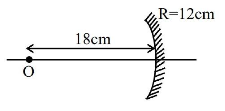
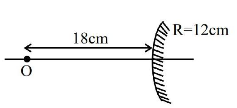
Two identical objects are placed in front of convex mirror and concave mirror having same radii of curvature of 12 cm , at same distance of 18 cm from the respective mirrors. The ratio of sizes of the images formed by convex mirror and by concave mirror is :
  • A
    $1 / 2$
  • B
    2
  • C
    3
  • D
    $1 / 3$
View full question & answer
MCQ 94 Marks
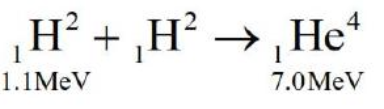
Energy released when two deuterons $\left({ }_{1} \mathrm{H}^{2}\right)$ fuse to form a helium nucleus $\left({ }_{2} \mathrm{He}^{4}\right)$ is :
(Given : Binding energy per nucleon of ${ }_{1} \mathrm{H}^{2}=1.1 \mathrm{MeV}$ and binding energy per nucleon of ${ }_{2} \mathrm{He}^{4}=7.0 \mathrm{MeV}$ )
  • A
    8.1 MeV
  • B
    5.9 MeV
  • C
    23.6 MeV
  • D
    26.8 MeV
View full question & answer
MCQ 104 Marks
Assuming the validity of Bohr's atomic model for hydrogen like ions the radius of $\mathrm{Li}^{++}$ion in its ground state is given by $\frac{1}{X} a_{0}$, where $X=$ __________ .
(Where $\mathrm{a}_{0}$ is the first Bohr's radius.)
  • A
    2
  • B
    1
  • C
    3
  • D
    9
Answer
C. 3
$\mathrm{r}=\mathrm{r}_{0} \frac{\mathrm{n}^{2}}{\mathrm{z}} \& \mathrm{z}=3$ for $\mathrm{Li}^{+2}$ and $\mathrm{n}=1$
$\therefore \mathrm{r}=\mathrm{r}_{0} \frac{1^{2}}{3}=\frac{\mathrm{r}_{0}}{3} \quad \therefore \mathrm{x}=3$
View full question & answer
MCQ 114 Marks
Identify the characteristics of an adiabatic process in a monoatomic gas.
(A) Internal energy is constant.
(B) Work done in the process is equal to the charge in internal energy.
(C) The product of temperature and volume is a constant.
(D) The product of pressure and volume is a constant.
(E) The work done to change the temperature from $\mathrm{T}_{1}$ to $\mathrm{T}_{2}$ is proportional to $\left(\mathrm{T}_{2}-\mathrm{T}_{1}\right)$
Choose the correct answer from the options given below :
  • A
    (A), (C), (D) only
  • B
    (A), (C), (E) only
  • C
    (B), (E) only
  • D
    (B), (D) only
Answer
C. (B), (E) only
$\mathrm{Q}=\Delta \mathrm{U}+\mathrm{W}=0 \Rightarrow-\Delta \mathrm{U}=\mathrm{W}$
$\mathrm{WD}=-\mathrm{nC}_{\mathrm{v}} \Delta \mathrm{T} \Rightarrow|\mathrm{WD}|=\mathrm{nC}_{\mathrm{v}} \Delta \mathrm{T} \propto \mathrm{T}_{2}-\mathrm{T}_{1}$
$\therefore \mathrm{B} \& \mathrm{E}$ [Only possibility]
View full question & answer
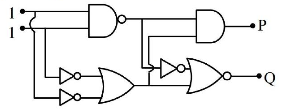
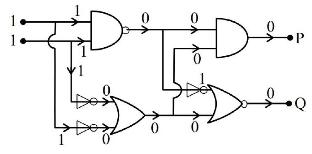
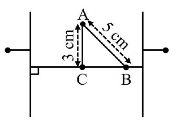
MCQ 124 Marks
  • A
    $\frac{1}{4} \mathrm{~V}$
  • B
    $\frac{2}{5} \mathrm{~V}$
  • C
    $\frac{3}{4} \mathrm{~V}$
  • D
    1 V
View full question & answer
MCQ 134 Marks
A solenoid having area A and length '$l$' is filled with a material having relative permeability 2 . The magnetic energy stored in the solenoid is :
  • A
    $\frac{\mathrm{B}^{2} \mathrm{~A} l}{\mu_{0}}$
  • B
    $\frac{\mathrm{B}^{2} \mathrm{~A} l}{2 \mu_{0}}$
  • C
    $\mathrm{B}^{2} \mathrm{Al}$
  • D
    $\frac{\mathrm{B}^{2} \mathrm{~A} l}{4 \mu_{0}}$
Answer
D. $\frac{\mathrm{B}^{2} \mathrm{~A} l}{4 \mu_{0}}$
$\frac{U}{V}=\frac{B^{2}}{2 \mu_{r} u_{0}} \Rightarrow U=\frac{B^{2}}{4 \mu_{0}} V=\frac{B^{2}}{4 \mu_{0}} A \ell$
View full question & answer
MCQ 144 Marks
Given a charge $q$, current I and permeability of vacuum $\mu_{0}$. Which of the following quantity has the dimension of momentum?
  • A
    $q \mathrm{I} / \mu_{0}$
  • B
    $q \mu_{0} I$
  • C
    $q^{2} \mu_{0} I$
  • D
    $q \mu_{0} / I$
Answer
B. $q \mu_{0} I$
$\mathrm{Q}=\mathrm{AT}$
$\mathrm{I}=\mathrm{A}$
$\mu_{0}=\mathrm{MLT}^{-2} \mathrm{~A}^{-2}$
$\mathrm{P}=\mathrm{Q}^{\mathrm{x}} \mu_{0}^{\mathrm{y}} \mathrm{I}^{\mathrm{z}}=[\mathrm{AT}]^{\mathrm{x}}\left[\mathrm{MLT}^{-2} \mathrm{~A}^{-2}\right]^{\mathrm{y}}[\mathrm{A}]^{\mathrm{z}}$
$\mathrm{MLT}^{-1}=\mathrm{M}^{y} \mathrm{~L}^{\mathrm{y}} \mathrm{T}^{\mathrm{x}-2 \mathrm{y}} \mathrm{A}^{-2 \mathrm{y}+\mathrm{z+x}}$
Now; $\mathrm{y}=1$
$x-2 y=-1$
$-2 y+z=0$
$\therefore \mathrm{x}=\mathrm{y}=\mathrm{z}=1$
View full question & answer
MCQ 154 Marks
A sinusoidal wave of wavelength 7.5 cm travels a distance of 1.2 cm along the x -direction in 0.3 sec. The crest $P$ is at $x=0$ at $t=0 \mathrm{sec}$ and maximum displacement of the wave is 2 cm. Which equation correctly represents this wave ?
  • A
    $y=2 \cos (0.83 x-3.35 t) \mathrm{cm}$
  • B
    $y=2 \sin (0.83 x-3.5 t) \mathrm{cm}$
  • C
    $y=2 \cos (3.35 x-0.83 t) \mathrm{cm}$
  • D
    $y=2 \cos (0.13 x-0.5 t) \mathrm{cm}$
Answer
A. $y=2 \cos (0.83 x-3.35 t) \mathrm{cm}$
$\mathrm{v}=\frac{\text { dis tance }}{\text { time }}$
$\mathrm{v}=\frac{12}{0.3}=4 \mathrm{~cm} / \mathrm{s}$
$\mathrm{k}=\frac{2 \pi}{\lambda}=\frac{2 \pi}{7.5}=\frac{4 \pi}{15}=0.83$
$\mathrm{v}=\frac{\omega}{\mathrm{k}} \Rightarrow \omega=\mathrm{vk}=4 \times \frac{4 \pi}{15}=3.35$
So $\mathrm{y}=\mathrm{A} \cos (\mathrm{kx}-\omega \mathrm{t})$
View full question & answer
MCQ 164 Marks
An electron with mass '$m$' with an initial velocity $(t=0) \overrightarrow{\mathrm{v}}=\mathrm{v}_{0} \hat{\mathrm{i}}\left(\mathrm{v}_{0}>0\right)$ enters a magnetic field $\vec{B}=B_{0} \hat{j}$. If the initial de-Broglie wavelength at $t=0$ is $\lambda_{0}$ then its value after time 't' would be :
  • A
    $\frac{\lambda_{0}}{\sqrt{1-\frac{\mathrm{e}^{2} \mathrm{~B}_{0}^{2} \mathrm{t}^{2}}{\mathrm{~m}^{2}}}}$
  • B
    $\frac{\lambda_{0}}{\sqrt{1+\frac{\mathrm{e}^{2} \mathrm{~B}_{0}^{2} \mathrm{t}^{2}}{\mathrm{~m}^{2}}}}$
  • C
    $\lambda_{0} \sqrt{1+\frac{\mathrm{e}^{2} \mathrm{~B}_{0}^{2} \mathrm{t}^{2}}{\mathrm{~m}^{2}}}$
  • D
    $\lambda_{0}$
Answer
D. $\lambda_{0}$
Magnetic field does not work
$\therefore$ Speed will not charge, so De-Broglie wavelength remains same.
View full question & answer
MCQ 174 Marks
Two water drops each of radius 'r' coalesce to from a bigger drop. If 'T' is the surface tension, the surface energy released in this process is :
  • A
    $4 \pi r^{2} T\left[2-2^{\frac{2}{3}}\right]$
  • B
    $4 \pi r^{2} T\left[2-2^{\frac{1}{3}}\right]$
  • C
    $4 \pi r^{2} \mathrm{~T}[1+\sqrt{2}]$
  • D
    $4 \pi r^{2} \mathrm{~T}[\sqrt{2}-1]$
Answer
A. $4 \pi r^{2} T\left[2-2^{\frac{2}{3}}\right]$
$2 \times \frac{4}{3} \pi R^{3}=\frac{4}{3} \pi r^{3} \Rightarrow r=2^{1 / 3} R$
$\mathrm{U}_{\mathrm{i}}=2 \times 4 \pi \mathrm{R}^{2} \mathrm{~T}$
$\mathrm{U}_{\mathrm{f}}=4 \pi \mathrm{r}^{2} \mathrm{~T}=4 \pi \mathrm{R}^{2} \mathrm{~T}^{2 / 3}$
$\therefore$ Heat lost $=u_{i}-u_{f}=4 \pi R^{2} T\left[2-2^{2 / 3}\right]$
View full question & answer
MCQ 184 Marks
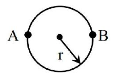
The moment of inertia of a circular ring of mass M and diameter r about a tangential axis lying in the plane of the ring is :
  • A
    $\frac{1}{2} \mathrm{Mr}^{2}$
  • B
    $\frac{3}{8} \mathrm{Mr}^{2}$
  • C
    $\frac{3}{2} \mathrm{Mr}^{2}$
  • D
    $2 \mathrm{Mr}^{2}$
Answer
B. $\frac{3}{8} \mathrm{Mr}^{2}$
Diameter is given as R.
$\therefore$ Radius $=\mathrm{R} / 2$
$\mathrm{I}_{\text {tan gent }}=\frac{3}{2} \mathrm{~m}\left(\frac{\mathrm{R}}{2}\right)^{2}=\frac{3}{8} \mathrm{mR}^{2}$
View full question & answer
MCQ 194 Marks
In a moving coil galvanometer, two moving coils $\mathrm{M}_{1}$ and $\mathrm{M}_{2}$ have the following particulars :
$\mathrm{R}_{1}=5 \Omega, \mathrm{~N}_{1}=15, \mathrm{~A}_{1}=3.6 \times 10^{-3} \mathrm{~m}^{2}, \mathrm{~B}_{1}=0.25 \mathrm{~T}$
$\mathrm{R}_{2}=7 \Omega, \mathrm{~N}_{2}=21, \mathrm{~A}_{2}=1.8 \times 10^{-3} \mathrm{~m}^{2}, \mathrm{~B}_{2}=0.50 \mathrm{~T}$
Assuming that torsional constant of the springs are same for both coils, what will be the ratio of voltage sensitivity of $M_{1}$ and $M_{2}$ ?
  • A
    $1: 1$
  • B
    $1: 4$
  • C
    $1: 3$
  • D
    $1: 2$
Answer
A. $1: 1$
Voltage sensitivity $=\frac{\theta}{\mathrm{V}}=\frac{\mathrm{NAB}}{\mathrm{cR}}$
Ratio $=\left(\frac{\mathrm{N}_{1} \mathrm{~A}_{1} \mathrm{~B}_{1}}{\mathrm{~N}_{2} \mathrm{~A}_{2} \mathrm{~B}_{2}}\right) \frac{\mathrm{R}_{2}}{\mathrm{R}_{1}}=\frac{15 \times 3.6 \times 0.25}{21 \times 1.8 \times 0.5} \times \frac{7}{5}=\frac{1}{1}$
View full question & answer
MCQ 204 Marks
Given below are two statements : one is labelled as Assertion (A) and the other is labelled as Reason (R).
Assertion (A) : Net dipole moment of a polar linear isotropic dielectric substance is not zero even in the absence of an external electric field.
Reason (R) : In absence of an external electric field, the different permanent dipoles of a polar dielectric substance are oriented in random directions.
In the light of the above statements, choose the most appropriate answer from the options given below :
  • A
    (A) is correct but $(\mathbf{R})$ is not correct
  • B
    Both (A) and (R) are correct but (R) is not the correct explanation of (A)
  • C
    Both (A) and (R) are correct and (R) is the correct explanation of (A)
  • D
    (A) is not correct but ( $\mathbf{R}$ ) is correct
Answer
D. (A) is not correct but ( $\mathbf{R}$ ) is correct
A : Since polar dielectrics are randomly oriental $\overrightarrow{\mathrm{P}}_{\mathrm{net}}=\overrightarrow{0}$.
$R$ : If $\vec{E}$ is absent, polar dielectric remain polar & are randomly oriented.
View full question & answer