MCQ
Energy supplied to convert unit mass of substance from solid to liquid state at its melting point is called:
  • Latent heat of fusion
  • B
    Evaporation
  • C
    Solidification
  • D
    Latent heat of fission

Answer

Correct option: A.
Latent heat of fusion
The heat energy supplied per unit mass of a substance at its melting point to convert the state of the substance from solid to liquid is known as Latent heat of Fusion.

Need a full question paper?

Generate a complete, print-ready paper with questions like this in minutes — across 16+ boards, with answer keys.
Start Generating Free

Similar questions

When frequency of oscillations is high then motion is called:
The centre of a wheel rolling on a plane surface moves with a speed $v_0$. A particle on the rim of the wheel at the same level as the centre will be moving at speed:
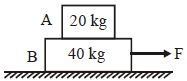
In figure, the coefficient of friction between the floor and the block $B$ is $0.2$ and  between blocks $A$ and $B$ is $0.3$. ........ $N$  is the maximum horizontal force $F$ can be  applied to the block $B$ so that both blocks move together .
A particle slides from the top of a smooth hemispherical surface of radius $R$ which is fixed on a horizontal surface. If it separates from the hemisphere at a height $h$ from the horizontal surface, then the speed of the particle is
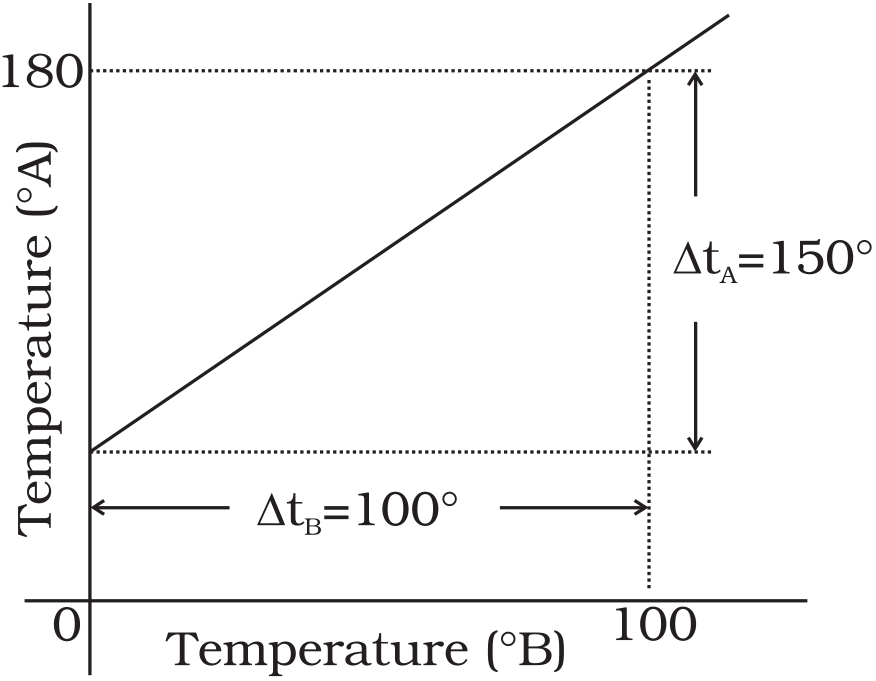
The graph between two temperature scales $A$ and $B$ is shown in between upper fixed point and lower fixed point there are $150$ equal division on scale $A$ and $100$ on scale $B$. The relationship for conversion between the two scales is given by:
Two trains, each $50 \,m$ long are travelling in opposite direction with velocity $10 \,m/s$ and $15 \,m/s$. The time of crossing is...........$s$
In a medium sound travels $2\, km$ in $3\, sec$ and in air, it travels $3 \,km$ in $10\, sec$. The ratio of the wavelengths of sound in the two media is
A horizontal circular loop carries a current that looks clockwise when viewed from above. It is replaced by an equivalent magnetic dipole consisting of a south pole $S$ and a north pole $N:$
  1. The line $SN$ should be along a diameter of the loop.
  2. The line $SN$ should be perpendicular to the plane of the loop.
  3. The south pole should be slow the loop.
  4. The north pole should be below the loop.
A point object O is placed on the principal axis of a convex lens of focal length f = 20cm at a distance of 40cm to the left of it. The diameter of the lens is 10cm. An eye is placed 60cm to right of the lens and a distance h below the principal axis. The maximum value of h to see the image is:
A body takes $4\, {min}$. to cool from $61^{\circ} {C}$ to $59^{\circ} {C}$. If the temperature of the surroundings is $30^{\circ} {C}$, the time taken by the body to cool from $51^{\circ} {C}$ to $49^{\circ} {C}$ is $....\,min$