Question
Enlist the different stages of prophase – I.
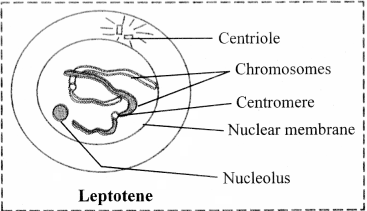
a. Leptotene:
The volume of the nucleus increases.
The chromosomes become long distinct and coiled.
They orient themselves in a specific fonn known as bouquet stage. This is characterized with the ends of chromosomes converged towards the side of nucleus where the centrosome lies. j Lep
The centriole duplicates into two and migrates to opposite poles. [Note: Centrioles divide during Gj phase of interphase.]
b. Zygotene:
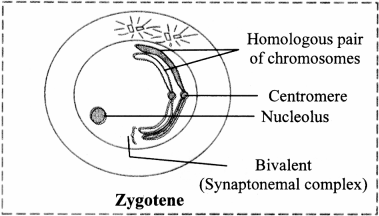
Pairing of non-sister chromatids of homologous chromosomes takes place by formation of synaptonemal complex. This pairing is called synapsis.
Each pair consists of a maternal chromosome and a paternal chromosome. Chromosomal pairs are called bivalents or tetrads.
c. Pachytene:
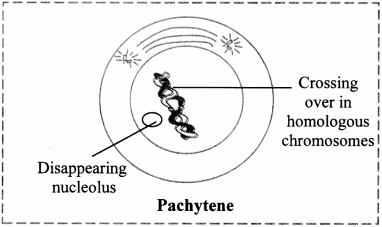
Each individual chromosome begins to split longitudinally into two similar chromatids. Therefore, each bivalent now appears as a tetrad consisting of four chromatids.
The homologous chromosomes begin to separate but they do not separate completely and remain attached to one or more points. These points are called chiasmata (Appear like a cross-X).
Chromatids break at these points and broken segments are exchanged between non-sister chromatids of homologous chromosomes resulting in recombination.
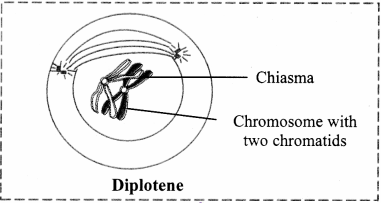
d. Diplotene:
The chiasma becomes clearly visible in diplotene due to beginning of repulsion between synapsed homologous chromosomes. This is known as desynapsis. Synaptonemal complex also starts to disappear.
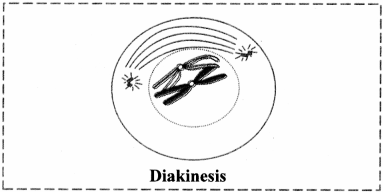
e. Diakinesis:
The chiasmata begin to move along the length of chromosomes from the centromere towards the ends of chromosomes. The displacement of chiasmata is termed as terminalization.
The terminal chiasmata exist till the metaphase.
The nucleolus and nuclear membrane completely disappear and spindle fibres begin to appear.
Generate a complete, print-ready paper with questions like this in minutes — across 16+ boards, with answer keys.