MCQ
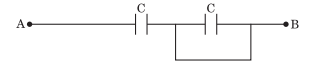
Equivalent capacity between A and B in figure is:
Image
  • C
  • B
    $\frac{c}{2}$
  • C
    2C
  • D
    $\frac{2}{C}$

Answer

Correct option: A.
C
A

Need a full question paper?

Generate a complete, print-ready paper with questions like this in minutes — across 16+ boards, with answer keys.
Start Generating Free

Similar questions

In hydrogen atom, an electron is revolving in the orbit of radius $0.53 \mathring A$ with $6.6 \times 10^{15}$ rotations/second. Magnetic field produced at the centre of the orbit is
The range of wavelength of the visible light is(a) 10 Å to 100 Å(b) 4,000 Å to 8,000 Å(c) 8,000 Å to 10,000 Å(d) 10,000 Å to 15,000 Å
       
The radius of a circular loop is $r$ and $a$ current $i$  is flowing in it. The equivalent magnetic moment will be
The distinction between conductors, insulators and semiconductors is largely concerned with:
A charged particle is moving in a uniform magnetic field in a circular path. Radius of circular path is $R$. When energy of particle is doubled, then new radius will be
Two identical bar magnets are placed on above the other such that they are mutually perpendicular and bisect each other. The time period of this combination in a horizontal magnetic field is $T.$ The time period of each magnet in the same field is
A light wave is incident normally over a slit of width $24\times 10^{-5}\ cm$. The angular position of second dark fringe from the central maxima is $30^\circ$. What is the wavelength of light
A parallel combination of two resistors, of $1\Omega$ each, is connected in series with a $1.5\Omega$ resistor. The total combination is connected across a $10\ V$ battery. The current flowing in the circuit is
The impurity atoms with which pure silicon may be doped to make it a p-type semiconductor are those of:
  1. Phosphorus.
  2. Boron.
  3. Antimony.
  4. Aluminium.
Assertion  :  A transistor amplifier in common emitter configuration has a low input impedence.
Reason      : The base to emitter region is forward biased.(a) If both assertion and reason are true and the reason is the correct explanation of the assertion.(b) If both assertion and reason are true but reason is not the correct explanation of the assertion.(c) If assertion is true but reason is false.(d) If the assertion and reason both are false.