Question
Establish a relation between electric current and drift velocity.$OR$
Prove that the current density of a metallic conductor is directly proportional to the drift speed of electrons.
Answer

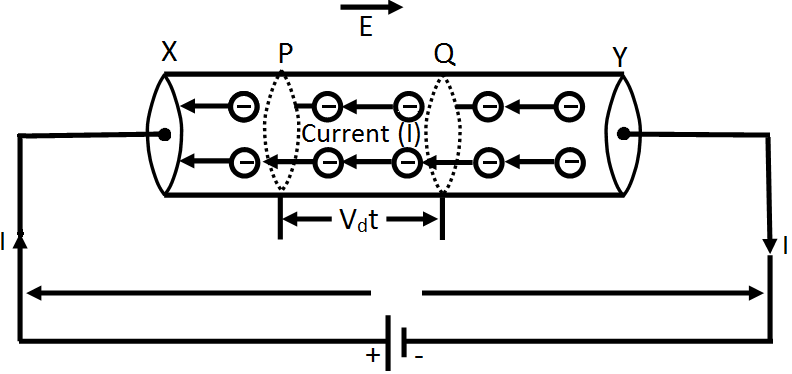
Relation between electric current and drift velocity: Consider a uniform metallic wire $XY$ of length l and cross$-$sectional area A. A potential difference $V$ is applied across the ends $X$ and $Y$ of the wire. This causes an electric field at each point of the wire of strength.

$\text{E}=\frac{\text{V}}{\text{l}}\dots\text{(i)}$ Due to this electric field, the electrons gain a drift velocity $vd$ opposite to direction of electric field. If $q$ be the charge passing through the cross$-$section of wire in $t$ seconds, then $\text{Current in write I}=\frac{\text{q}}{\text{r}}\dots\text{(ii)}$
The distance traversed by each electron in time $t =$ average velocity $\times$ time $= vd\ t$ If we consider two planes $P$ and $Q$ at a distance $vd$ t in a conductor, then the total charge flowing in time $t$ will be equal to the total charge on the electrons present within the cylinder $PQ.$ The volume of this cylinder $=$ cross sectional area $\times$ height $= A\ vd\ t$ If $n$ is the number of free electrons in the wire per unit volume, then the number of free electrons in the cylinder $= n(Avd\ t)$ If charge on each electron is $-e (e = 1.6 \times 10^{-19}C),$ then the total charge flowing through a cross$-$section of the wire $q = (nA_vd t) (-e) = –neA_vd\ t ...(iii)$
$\therefore$ Current flowing in the wire, $\text{I}=\frac{\text{q}}{\text{t}}=\frac{-\text{v}}{\text{t}}$ i.e., current $I = -neAvd ...(iv)$
This is the relation between electric current and drift velocity. Negative sign shows that the direction of current is opposite to the drift velocity. Numerically I$ = -neAvd ...(v)$
$\therefore$ Current density, $\text{J}=\frac{\text{I}}{\text{A}}=\text{d}$
$\Rightarrow\text{J}\propto\text{vd.}$ That is, current density of a metallic conductor is directly proportional to the drift velocity.

Need a full question paper?

Generate a complete, print-ready paper with questions like this in minutes — across 16+ boards, with answer keys.

Start Generating Free

Similar questions

Write the need of modulation in communication system.
Do magnetic forces obey Newton's third law. Verify for two current elements $\text{dI}_1=\text{dI}\hat{\text{i}}$ located at the origin and $\text{dI}_2=\text{dI}\hat{\text{j}}$ located at $(0, R, 0)$. Both carry current $I.$
A coil of resistance $40\Omega$ is connected across a 4.0V battery 0.10s after the battery is connected, the current in the coil is 63mA. Find the inductance of the coil.
A source of sound emitting a 1200Hz note travelg along a straight line at a speed of 170m/s. A detector is placed at a distance of 200m from the line of motion of the source.
  1. Find the frequency of sound received by the detector at the instant when the source gets closest to it.
  2. Find the distance between the source and the detector at the instant it detects the frequency 1200Hz. Velocity of sound in air = 340m/s.
A wave propagates on a string in the positive $x-$direction at a velocity v. The shape of the string at $t =$ to is given by $\text{g}(\text{x},\text{t}_0)=\text{A}\sin\big(\frac{\text{x}}{\text{a}}\big).$ Write the wave equation for a general time t.
A parallel $-$ plate capacitor having plate area $20\ cm^2$ and separation between the plates $1.00\ mm$ is connected to a battery of $12.0V.$ The plates are pulled apart to increase the separation to $2.0\ mm.$
  1. Calculate the charge flown through the circuit during the process.
  2. How much energy is absorbed by the battery during the process?
  3. Calculate the stored energy in the electric field before and after the process.
  4. Using the expression for the force between the plates, find the work done by the person pulling the plates apart.
  5. Show and justify that no heat is produced during this transfer of charge as the separatio
  1. n is increased.
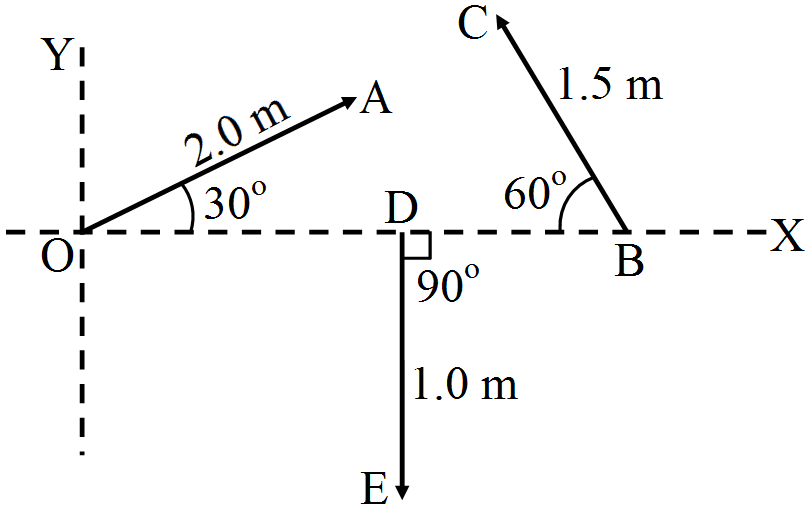
Refer to figure. Find
  1. The magnitude.
  2. x and y components
  3. The angle with the $X-$axis of the resultant of $\overrightarrow{\text{OA}},\overrightarrow{\text{BC}}$ and $\overrightarrow{\text{DE}}.$
A circuit containing a $80 mH$ inductor and a $60 \mu F$ capacitor in series is connected to a $230V, 50Hz$ supply. The resistance of the circuit is negligible.
  1. Obtain the current amplitude and rms values.
  2. Obtain the rms values of potential drops across each element.
  3. What is the average power transferred to the inductor?
  4. What is the average power transferred to the capacitor?
  5. What is the total average power absorbed by the circuit? $['$Average' implies 'averaged over one cycle'.$]$
Water at $50^\circ C$ is filled in a closed cylindrical vessel of height $10\ cm$ and cross sectional area $10\ cm^2.$ The walls of the vessel are adiabatic but the flat parts are made of $1mm$ thick aluminium $(\text{K}=200\ \text{Js}^{-1}\text{m}^{-1}{^{\circ}}\text{C}^{-1}).$ Assume that the outside temperature is $20^\circ C.$ The density of water is $1000\ kgm^{-3},$ and the specific heat capacity of water $= 4200\ \text{Jkg}^{-1}{^{\circ}}\text{C}^{-1}.$ Estimate the time taken for the temperature to fall by $1.0^\circ C.$ Make any simplifying assumptions you need but specify them.
State Ampere's circuital law. Using Ampere's circuital law, derive an expression for the magnetic field along the axis of a toroidal solenoid.