Question
Write the need of modulation in communication system.

Answer

Need of Modulation : Modulation is necessary due to the following three reasons:
(i) Size of the antenna: For transmitting a signal, we need an antenna. This antenna should have a size comparable to the wavelength $\lambda$ of the signal (at least $\lambda/4$ in dimension) so that the antenna properly senses the time variation of the signal. For an electromagnetic wave of frequency 20 kHz the wavelength is 15 km. Obviously, such a long antenna is not possible to construct and operate. Hence direct transmission of such base band signals is not practical. We can obtain transmission with reasonable antenna lengths if transmission frequency is high (for example, if $v$ is 1 MHz, then $\lambda$ is 300 m). Therefore, there is a need of translating the information contained in our original low frequency base band signal into high or radio frequencies before transmission.
(ii) Effective power radiated by an antenna : A theoretical study of radiation from a linear antenna (length $l$) shows that the power radiated is proportional to $(l/\lambda)^{2}$ or directly proportional to the $v^{2}$. This implies that for the same antenna length, the power radiated increases with decreasing $\lambda$, i.e., increasing frequency. Hence, the effective power radiated by a long wavelength baseband signal would be small. For a good transmission, we need high powers and hence this also points out to the need of using high frequency transmission.
(iii) Mixing up of signal : If a number of transmitters are transmitting base band signals simultaneously, then all these signals cover the same frequency range (20 Hz to 20 kHz) and will get mixed up. If transmission is being done at a high frequency, different users may use adequate band width for that given high frequency.

Need a full question paper?

Generate a complete, print-ready paper with questions like this in minutes — across 16+ boards, with answer keys.
Start Generating Free

Similar questions

A solenoid is connected to a battery so that a steady current flows through it. If an iron core is inserted into the solenoid, will the current increase or decrease? Explain.
A bicycle is resting on its stand in the east$-$west direction and the rear wheel is rotated at an angular speed of $100$ revolutions per minute. If the length of each spoke is $30.0\ cm$ and the horizontal component of the earth's magnetic field is $2.0 \times 10^{-5} T,$ find the emf induced between the axis and the outer end of a spoke. Neglect centripetal force acting on the free electrons of the spoke.
Prove : $n_{12}=\frac{1}{n_{21}}$
A plane electromagnetic wave is passing through a region. Consider (a) electric field (b) magnetic field (c) electrical energy in a small volume and (d) magnetic energy in a small volume. Construct the pairs of the quantities that oscillate with equal frequencies.
Light is incident from glass $(\mu=1.50)$ to water $(\mu=1.33).$ Find the range of the angle of deviation for which there are two angles of incidence.
Air is pumped into the tubes of a cycle rickshaw at a pressure of $2\ atm$. The volume of each tube at this pressure is $0.002m^3$. One of the tubes gets punctured and the volume of the tube reduces to $0.0005m^3$. How many moles of air have leaked out? Assume that the temperature remains constant at $300K$ and that the air behaves as an ideal gas.
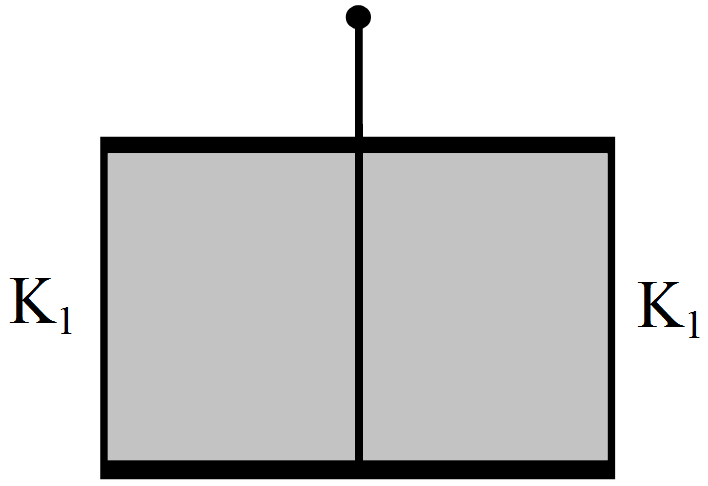
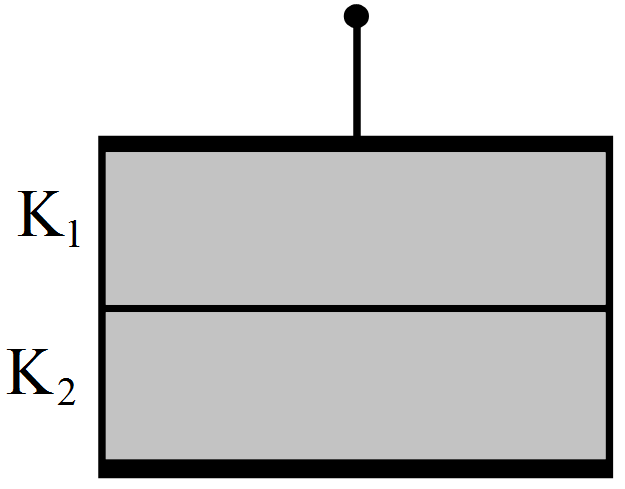
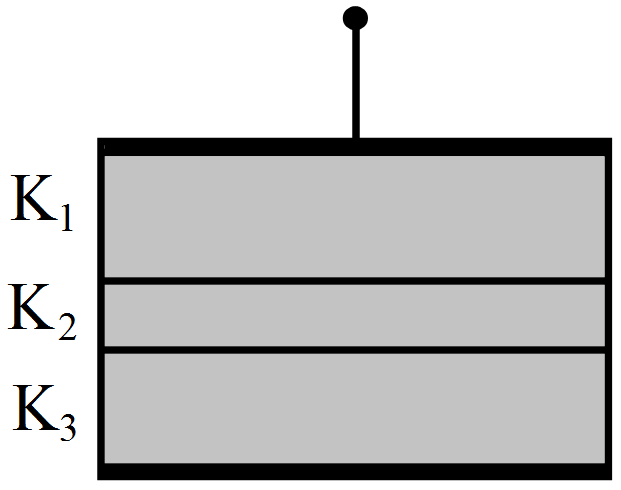
Find the capacitances of the capacitors shown in figure. The plate area is A and the separation between the plates is d. Different dielectric slabs in a particular part of the figure are of the same thickness and the entire gap between the plates is filled with the dielectric slabs.


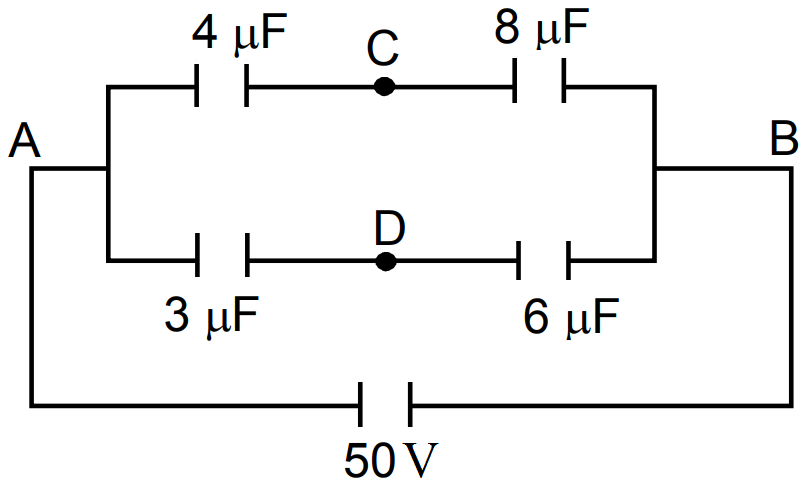
Take the potential of the point B in figure to be zero:
  1. Find the potentials at the points C and D.
  2. If a capacitor is connected between C and D, what charge will appear on this capacitor?
The two blocks in an Atwood machine have masses $2.0\ kg$ and $3.0\ kg$. Find the work done by gravity during the fourth second after the system is released from rest.
Obtain an expression for induced electromotive force due to rotational motion of a disc in a uniform magnetic field.