Question
Establish an expression for force on a current carrying conductor kept in a magnetic field. Explain right hand palm rule for the direction of force.

Answer

SELF

Need a full question paper?

Generate a complete, print-ready paper with questions like this in minutes — across 16+ boards, with answer keys.
Start Generating Free

Similar questions

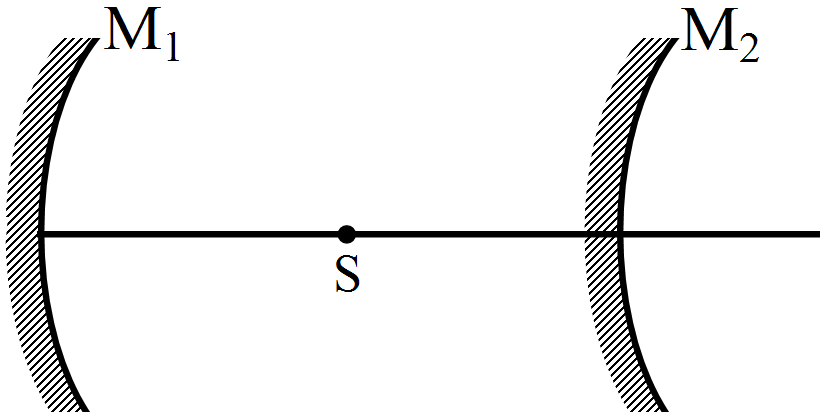
A converging mirror M1, a point source S and a diverging mirror M2 are arranged as shown in figure. The source is placed at a distance of 30cm from M1. The focal length of each of the mirrors is 20cm. Consider only the images formed by a maximum of two reflections. It is found that one image is formed on the source itself.
  1. Find the distance between the two mirrors.
  2. Find the location of the image formed by the single reflection from M2.

By describing electromagnetic spectrum, give a description of its various parts.
A uniform wheel of radius R is set into rotation about its axis at an angular speed $\omega.$ This rotating wheel is now placed on a rough horizontal surface with its axis horizontal. Because of friction at the contact, the wheel accelerates forward and its rotation decelerates till the wheel starts pure rolling on the surface. Find the linear speed of the wheel after it starts pure rolling.
Define common potential. Find the expression for redistribution of charges and energy loss when capacitors are connected together.
Two long, straight wires, each carrying a current of 5A, are placed along the X and Y-axes respectively. The currents point along the positive directions of the axes. Find the magnetic fields at the points (a) (1m, 1m), (b) (-1m, 1m), (c) (-1m,-1m) and (d) (1m, -1m),
With the help of a ray diagram, show the formation of image of a point object due to refraction of light at a spherical surface separating two media of refractive indices n1 and n2 (n2 > n1) respectively. Using this diagram, derive the relation.
$\frac{\text{n}_2}{\text{v}}-\frac{\text{n}_1}{\text{u}}=\frac{\text{n}_1-\text{n}_2}{\text{R}}$
Write the sign conventions used. What happens to the focal length of convex lens when it is immersed in water?
Figure shows a cylindrical tube with adiabatic walls and fitted with an adiabatic separator. The separator can be slid into the tube by an external mechanism. An ideal gas $(\gamma=1.5)$ is injected in the two sides at equal pressures and temperatures. The separator remains in equilibrium at the middle. It is now slid to a position where it divides the tube in the ratio 1 : 3. Find the ratio of the temperatures in the two parts of the vessel.

A particle of mass m and charge q is released from the origin in a region in which the electric field and magnetic field are given by
$\overrightarrow{\text{B}}=-\text{B}_0\overrightarrow{\text{j}}$ and $\overrightarrow{\text{E}}=\text{E}_0\overrightarrow{\text{k}}.$ Find the speed of the particle as a function of its z-coordinate.
A group of hydrogen atoms are prepared in n = 4 states. List the wavelength that are emitted as the atoms make transitions and return to n = 2 states.
Derive the lens formula,  $\frac{1}{\text{f}} = \frac{1}{\text{v}} - \frac{1}{\text{u}}$ for a concave lens, using the necessary ray diagram.
Two lenses of powers 10 D and – 5 D are placed in contact.
  1. Calculate the power of the new lens.
  2. Where should an object be held from the lens, so as to obtain a virtual image of magnification 2?