Question
Establish the expression for equivalent parallel combination of resistance separately.

Answer

Resistances in Parallel Combination : "A number of resistors are said to be connected in parallel combination when they are arranged in such a way that their first ends are joined at one point and the second ends at another point."
In this combination when some potential difference is applied across the ends of the combination, by connecting a cell between these points, then the potential difference between the ends of all the resistors is the same as that of applied potential difference but electric current in different resistors is different according to their resistance. The sum of individual currents is equal to the main current in the circuit.
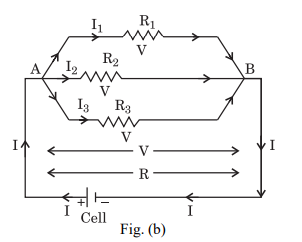
In Fig. (b) three resistors of resistances $ R_1, R_2 $ and $ R_3 $ are connected in parallel combination between two points
Image
A and B. When a potential difference V is applied between these points by connecting a cell between the points, then let the current drawn from the cell in the circuit be I. The potential difference across the ends of individual resistors will also be V. At point A the current I is divided into three parts. Let $ I_1, I_2, $ and $ I_3 $ be the electric current in the resistors of the resistances $ R_1, R_2 $ and $ R_3 $, respectively. Let R be the equivalent resistance of this parallel combination.
According to Ohm's law,
$ V = IR \Rightarrow I = V/R $
and $ I_1 = V/R_1, I_2 = V/R_2 $ and $ I_3 = V/R_3 $
But in parallel combination:
$ I = I_1 + I_2 + I_3 $
$ \Rightarrow \frac{V}{R} = \frac{V}{R_1} + \frac{V}{R_2} + \frac{V}{R_3} $
$ \Rightarrow \frac{1}{R} = \frac{1}{R_1} + \frac{1}{R_2} + \frac{1}{R_3} $
"Thus the reciprocal of the equivalent resistance of the resistances of resistors connected in parallel is equal to the sum of the reciprocals of the individual resistances. The value of the equivalent resistance is always less than the value of the smallest resistance in the combination."

Need a full question paper?

Generate a complete, print-ready paper with questions like this in minutes — across 16+ boards, with answer keys.
Start Generating Free

Similar questions

Huygen's principle is the basis of wave theory of light. Each point on a wavefront acts as a fresh source of new disturbance, called secondary waves or wavelets. The secondary wavelets spread out in all directions with the speed light in the given medium.
An initially parallel cylindrical beam travels in a medium of refractive index $\mu(\text{I})=\mu_0+\mu_2\text{I}$, where $\mu_0$ and $\mu_2$ are positive constants and I is the intensity of the light beam. The intensity of the beam is decreasing with increasing radius.
  1. The initial shape of the wavefront of the beam is:
  1. Planar.
  2. Convex.
  3. Concave.
  4. Convex near the axis and concave near the periphery.
  1. According to Huygens Principle, the surface of constant phase is:
  1. Called an optical ray.
  2. Called a wave.
  3. Called a wavefront.
  4. Always linear in shape.
  1. As the beam enters the medium, it will:
  1. Travel as a cylindrical beam.
  2. Diverge.
  3. Converge.
  4. Diverge near the axis and converge near the periphery.
  1. Two plane wavefronts oflight, one incident on a thin convex lens and another on the refracting face of a thin prism. After refraction at them, the emerging wavefronts respectively become.
  1. Plane wavefront and plane wavefront.
  2. Plane wavefront and spherical wavefront.
  3. Spherical wavefront and plane wavefront.
  4. Spherical wavefront and spherical wavefront.
  1. Which of the following phenomena support the wave theory of light?
  1. Scattering.
  2. Interference.
  3. Diffraction.
  4. Velocity of light in a denser medium is less than the velocity of light in the rarer medium.
  1. 1, 2, 3
  2. 1, 2, 4
  3. 2, 3, 4
  4. 1, 3, 4
The electrostatic force on a small sphere of charge $0.4 \mu C$ due to another small sphere of charge $-0.8 \mu C$ in air is 0.2 N (a) What is the distance between the two spheres? (b) What is the force on the second sphere due to the first?

The field of a hollow wire with constant current is homageneous.
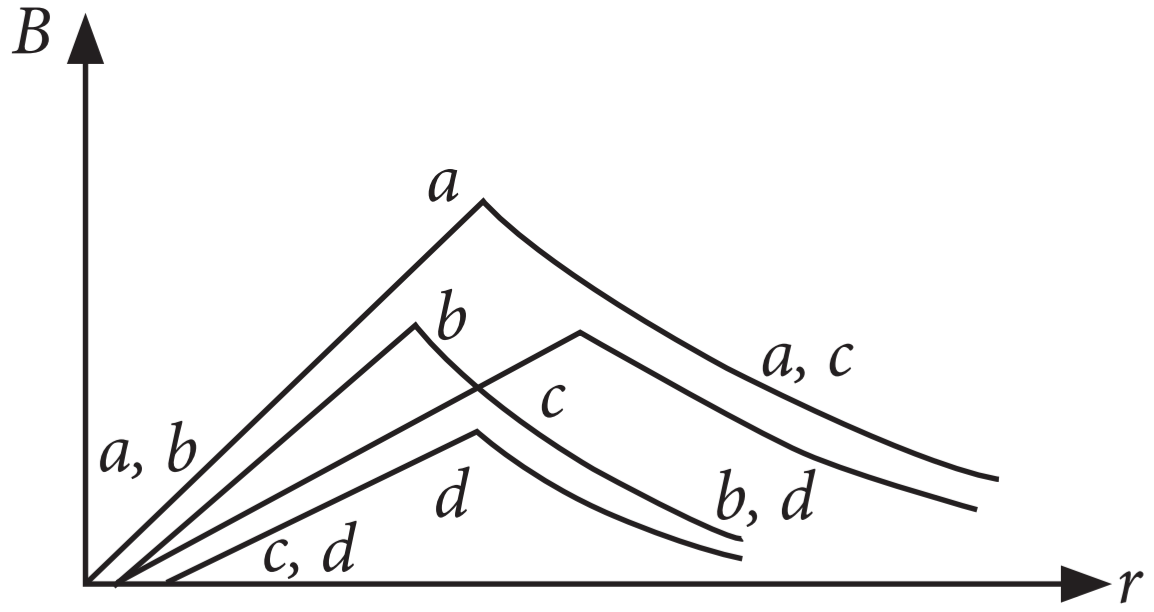
Curves in the graph shown give, as functions of radius distance r, the magnitude B of the magnetic field inside and outside four long wires a, b, c and d, carrying currents that are uniformly distributed across the cross sections of the wires. Overlapping portions of the plots are indicated by double labels.
  1. Which wire has the greatest magnitude of the magnetic field on the surface?
  1. a
  2. b
  3. c
  4. d
  1. The current density in a wire a is:
  1. Greater than in wire c.
  2. Less than in wire c.
  3. Equal to that in wire c.
  4. Not comparable to that of in wire c due to lack of information.
  1. Which wire has the greatest radius?
  1. a
  2. b
  3. c
  4. d
  1. A direct current I flows along the length of an infinitely long straight thin walled pipe, then the magnetic field is:
  1. Uniform throughout the pipe but not zero.
  2. Zero only along the axis of the pipe.
  3. Zero at any point inside the pipe.
  4. Maximum at the centre and minimum at the edges.
  1. In a coaxial, straight cable, the central conductor and the outer conductor carry equal currents in opposite direction. The magnetic field is zero.
  1. Outside the cable.
  2. Inside the inner conductor.
  3. Inside the outer conductor.
  4. In between the two conductor.
The distance between the centres of two insulated charged copper spheres ' $A$ ' and ' $B$ ' which are identical in size is 50 cm and the charge on each is $6.5 \times 10^{-7} C$. A third uncharged sphere ' C ' of the same size was first brought in contact with the sphere ' $A$ ', and then brought in contact with the second sphere ' $B$ ' and finally separated from both. Then find the magnitude of repulsive foce between ' $A$ ' and ' $B$ '.
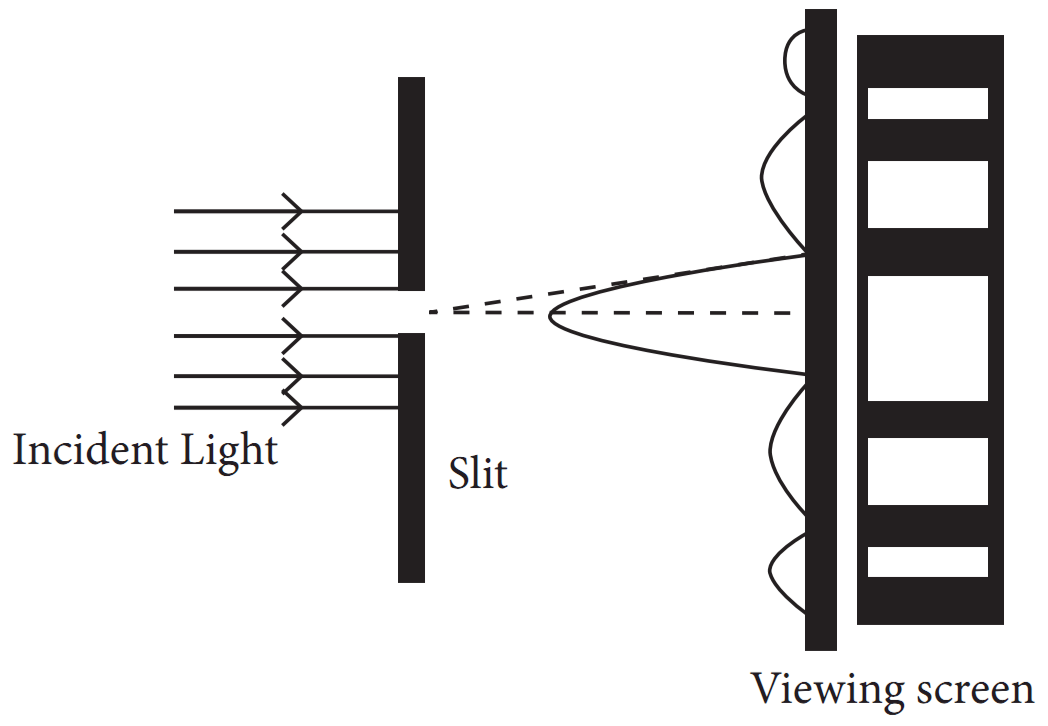
When light from a monochromatic source is incident on a single narrow slit, it gets diffracted and a pattern of ahem ate bright and dark fringes is obtained on screen, called "Diffraction Pattern" of single slit. ln diffraction pattern of single slit, it is found that.
  1. Central bright fringe is of maximum intensity and the intensity of any secondary bright fringe decreases with increase in its order.
  2. Central bright fringe is twice as wide as any other secondary bright or dark fringe.
  1. A single slit of width $0.1\ mm$ is illuminated by a parallel beam oftight of wavelength $6000\mathring{\text{A}}$ and diffraction bands are observed on a screen $0.5\ m$ from the slit. The distance of the third dark band from the central bright band is:
  1. Should be $\frac{\lambda}{2}$, where $\lambda$, is the wavelength.
  2. Should be of the order of wavelength.
  3. Has no relation to wavelength.
  4. Should be much larger than the wavelength.
  5. To observe diffraction, the size of the obstacle.
  6. Bands disappear
  7. Bands become broader and farther apart
  8. No change will take place
  9. Diffraction bands become narrower and crowded together.
  10. A diffraction pattem is obtained by using a beam of red light. What will happen, if the red light is replaced by the blue light?
  11. $6 \times 10^{-3}$ rad
  12. $4 \times 10^{-3}$ rad
  13. $2.4 \times 10^{-3}$ rad
  14. $4.5 \times 10^{-3}$ rad
  15. Light of wavelength $600\ nm$ is incident normally on a slit of width $0.2mm$. The angular width of central maxima in the diffraction pattern is $($measured from minimum to minimum$).$
  16. $10^{-1}m$
  17. $10^{-2}m$
  18. $2 \times 10^{-2}m$
  19. $2 \times 10^{-1}m$
  20. ln Fraunhofer diffraction pattern, slit width is $0.2\ mm$ and screen is at $2\ m$ away from the lens. If wavelength of tight used is $5000\mathring{\text{A}}$ then the distance between the first minimum on either side the central maximum is:
  21. $3\ mm$
  22. $1.5\ mm$
  23. $9\ mm$
  24. $4.5\ mm$
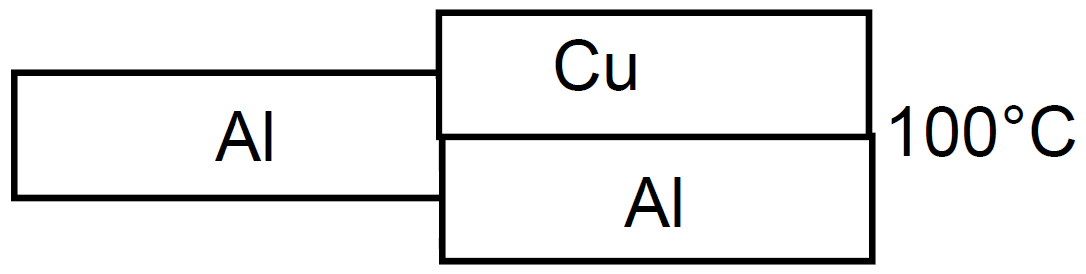
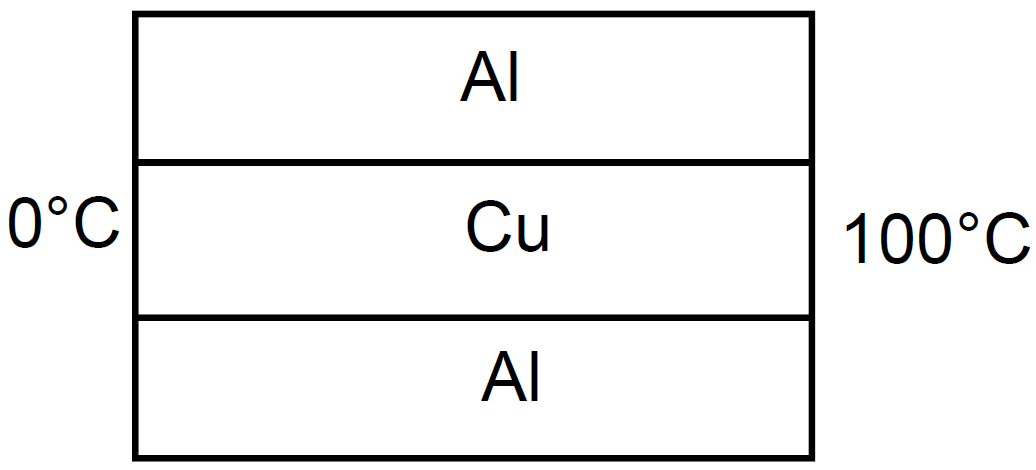
The three rods shown in figure, have identical geometrical dimensions. Heat flows from the hot end at a rate of $40$ Win the arrangement $(a)$ Find the rates of heat flow when the rods are joined as in arrangement $(b)$ and in $(c)$ Thermal conductivities of aluminium and copper are $200Wm^{-1^\circ }C^{-1}$ and $400Wm^{-1^\circ }C^{-1}$ respectively.
  1.  
  1.  
  1.  
In an electromagnetic wave both the electric and magnetic fields are perpendicular to the direction of propagation, that is why electromagnetic waves are transverse in nature. Electromagnetic waves carry energy as they travel through space and this energy is shared equally by the electric and magnetic fields. Energy density of an electromagnetic waves is the energy in unit volume of the space through which the wave travels.
(i) The electromagnetic waves propagated perpendicular to both $\vec{E}$ and $\vec{B}$. The electromagnetic waves travel in the direction of
(a) $\vec{E} \cdot \vec{B}$
(b) $\vec{B} \cdot \vec{E}$
(c) $\vec{E} \times \vec{B}$
(d) $\vec{B} \times \vec{E}$

(ii) Fundamental particle in an electromagnetic wave is
(a) photon (b) phonon (c) electron (d) proton

(iii) Electromagnetic waves are transverse in nature is evident by
(a) diffraction (b) interference (c) polarisation (d) reflection

OR

The electric and magnetic fields of an electromagnetic waves are
(a) in opposite phase and parallel to each other
(b) in phase and parallel to each other.
(c) in phase and perpendicular to each other
(d) in opposite phase and perpendicular to each other

(iv) d) in opposite phase and perpendicular to each other
(a) frequency (b) wavelength (c) velocity (d) all these depend on each other
Complete the following table:
Car Model
Driver $X$
Reaction time $0.20s$
Driver $Y$
Reaction time $0.30s$
$A\ ($deceleration on hard braking $= 6.0\ m/s^2)$
Speed $= 54\ km/h$
Braking distance
$a = ...$
Total stopping distance
$b = ...$
Speed $= 72\ km/h$
Braking distance
$c = ...$
Total stopping distance
$d = ...$
$B\ ($deceleration on hard braking $= 7.5\ m/s^2)$
Speed $= 54\ km/h$
Breaking distance
$e = ...$
Total stopping distance
$f = ...$
Speed $72\ km/h$
Braking distance
$g = ...$
Total stopping distance
$h = ...$
Why do marine animals live deep inside a lake when the surface of the lake freezes?