Question
When light from a monochromatic source is incident on a single narrow slit, it gets diffracted and a pattern of ahem ate bright and dark fringes is obtained on screen, called "Diffraction Pattern" of single slit. ln diffraction pattern of single slit, it is found that.
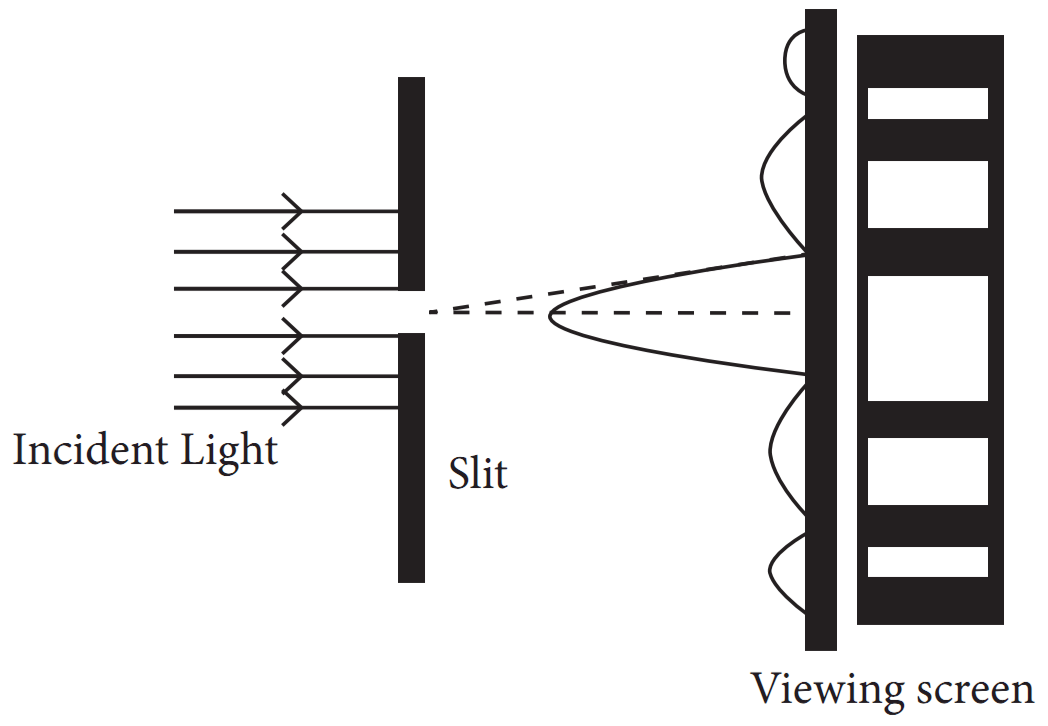
  1. Central bright fringe is of maximum intensity and the intensity of any secondary bright fringe decreases with increase in its order.
  2. Central bright fringe is twice as wide as any other secondary bright or dark fringe.
  1. A single slit of width $0.1\ mm$ is illuminated by a parallel beam oftight of wavelength $6000\mathring{\text{A}}$ and diffraction bands are observed on a screen $0.5\ m$ from the slit. The distance of the third dark band from the central bright band is:
  1. Should be $\frac{\lambda}{2}$, where $\lambda$, is the wavelength.
  2. Should be of the order of wavelength.
  3. Has no relation to wavelength.
  4. Should be much larger than the wavelength.
  5. To observe diffraction, the size of the obstacle.
  6. Bands disappear
  7. Bands become broader and farther apart
  8. No change will take place
  9. Diffraction bands become narrower and crowded together.
  10. A diffraction pattem is obtained by using a beam of red light. What will happen, if the red light is replaced by the blue light?
  11. $6 \times 10^{-3}$ rad
  12. $4 \times 10^{-3}$ rad
  13. $2.4 \times 10^{-3}$ rad
  14. $4.5 \times 10^{-3}$ rad
  15. Light of wavelength $600\ nm$ is incident normally on a slit of width $0.2mm$. The angular width of central maxima in the diffraction pattern is $($measured from minimum to minimum$).$
  16. $10^{-1}m$
  17. $10^{-2}m$
  18. $2 \times 10^{-2}m$
  19. $2 \times 10^{-1}m$
  20. ln Fraunhofer diffraction pattern, slit width is $0.2\ mm$ and screen is at $2\ m$ away from the lens. If wavelength of tight used is $5000\mathring{\text{A}}$ then the distance between the first minimum on either side the central maximum is:
  21. $3\ mm$
  22. $1.5\ mm$
  23. $9\ mm$
  24. $4.5\ mm$

Answer

  1.  $9\ mm$
Here, $\text{d} = 0.1 \text{ mm},\lambda= 6000 \mathring{\text{A}}, \text{D}=0.5\text{m}$
For third dark band, $\text{d}\sin\theta=3\lambda\ ;\ \sin\theta=\frac{3\lambda}{\text{d}}=\frac{\text{y}}{\text{D}}$
$\text{y}=\frac{3\text{D}\lambda}{\text{d}}=\frac{3\times0.5\times6\times10^{-7}}{0.1\times10^{-3}}$
$=9\times10^{-3}\text{m}=9\text{ mm}$
  1.  $10^{-2}m$
Given $d = 0.2\ mm = 0.2 \times 10^{-3}m, D = 2m$
$\lambda=5000\mathring{\text{A}}=5\times10^{-7}\text{m}$
The distance between the first minimum on other side of the central maximum
$\text{x}=\frac{2\lambda\text{D}}{\text{d}}=\frac{2\times5\times10^{-7}\times2}{0.2\times10^{-3}}$
$\Rightarrow\text{x}=10^{-2}\text{m}$
  1. $ 6 \times 10^{-3}$ rad
Here, $\lambda=600\text{ nm}=6\times10^{-7}\text{m}$
$\text{a}=0.2\text{ mm}=2\times10^{-4}\text{m},\theta=?$
Angular width of central maxima,
$\theta=\frac{2\lambda}{\text{a}}=\frac{2\times6\times10^{-7}}{2\times10^{-4}}=6\times10^{-3}\text{rad}$
  1.  Diffraction bands become narrower and crowded together.
When red light is replaced by blue light $(\lambda_\text{B}<\lambda_\text{R})$ the diffraction pattern bands becomes narrow and crowded together.
  1.  Should be of the order of wavelength.
To observe diffraction, the size of the obstacle should be of the order of wavelength.

Need a full question paper?

Generate a complete, print-ready paper with questions like this in minutes — across 16+ boards, with answer keys.

Start Generating Free

Similar questions

Plot a graph showing variation of de-Broglie wavelength $ \lambda $ versus $ 1/\sqrt{V} $ where V is accelerating potential for two particles A and B carrying same charge but of masses $ m_{1} $ and $ m_{2} $, where $ m_{1}>m_{2} $
At what angle should a ray of light be incident on the face of a prism of refracting angle 60° so that it just suffers total internal reflection at the other face? The refractive index of the material of the prism is 1.524.
No part of India is situated on the equator. Is it possible to have a geostationary satellite which always remains over New Delhi?
Complete the following table:
Car Model
Driver $X$
Reaction time $0.20s$
Driver $Y$
Reaction time $0.30s$
$A ($deceleration on hard braking $= 6.0m/s^2)$
Speed $= 54\ km/h$
Braking distance
$a = ...$
Total stopping distance
$b = ...$
Speed $= 72\ km/h$
Braking distance
$c = ...$
Total stopping distance
$d = ...$
$B ($deceleration on hard braking $= 7.5m/s^2)$
Speed $= 54\ km/h$
Breaking distance
$e = ...$
Total stopping distance
$f = ...$
Speed $72\ km/h$
Braking distance
$g = ...$
Total stopping distance
$h = ...$
 For the past some time, Aarti had been observing some erratic body movement, unsteadiness and lack of coordination in the activities of her sister Radha, who also used to complain of severe headache occasionally. Aarti suggested to her parents to get a medical check-up of Radha. The doctor thoroughly examined Radha and diagnosed that she has a brain tumour.
  1. What, according to you, are the values displayed by Aarti?
  2. How can radioisotopes help a doctor to diagnose brain tumour? 

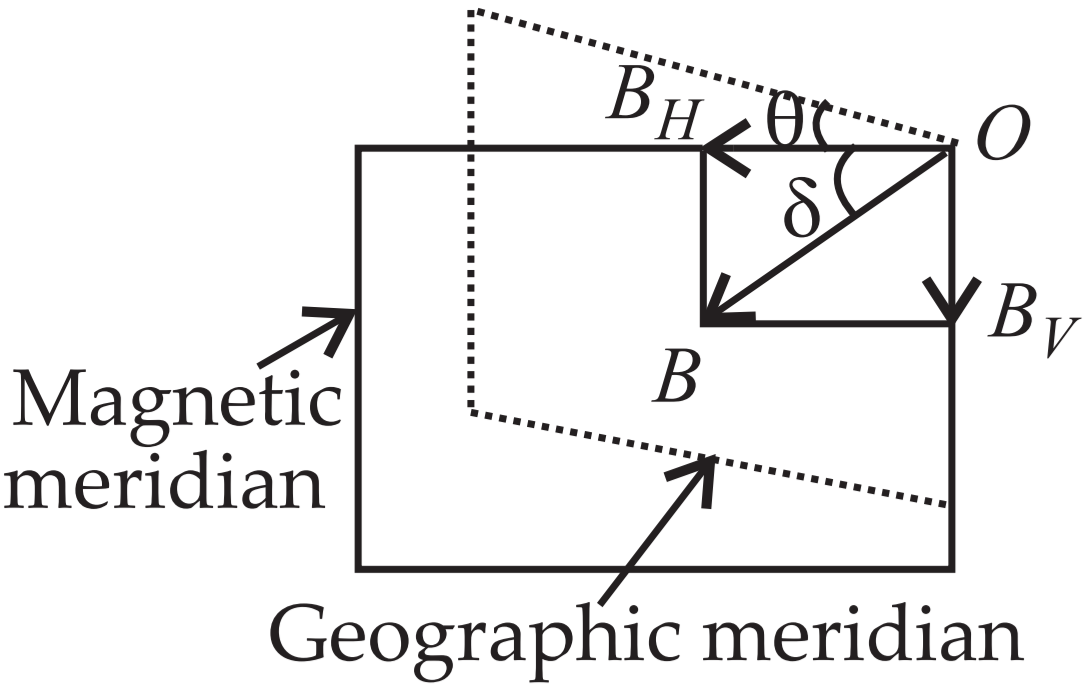
'Tile earth's magnetic field at a point on its surface is usually characterised by three quantities: (a) declination (bl inclination or dip and (cl horizontal component of the field. These are known as the elements of the earth's magnetic field. At a place, angle between geographic meridian and magnetic meridian is defined as magnetic declination, whereas angle made by the earth's magnetic field with the horizontal in magnetic meridian is known as magnetic dip.
  1. In a certain place, the horizontal component of magnetic field is $\frac{1}{\sqrt{3}}$ times the vertical component. 'Tile angle of dip at this place is:
  1. $\text{Zero}$
  2. $\frac{\pi}{3}$
  3. $\frac{\pi}{2}$
  4. $\frac{\pi}{6}$
  1. The angle between the true geographic north and the north shown by a compass needle is called as:
  1. Inclination.
  2. Magnetic declination.
  3. Angle of meridian.
  4. Magnetic pole.
  1. Tile angles of dip at the poles and the equator respectively are
  1. 30º, 30º
  2. 0º, 90º
  3. 45º, 90º
  4. 90º, 0º 
  1. A compass needle which is allowed to move in a horizontal plane is taken to a geomagnetic pole. It
  1. Will become rigid showing no movement.
  2. Will stay in any position.
  3. Will stay in north-south direction only.
  4. Will stay in east-west direction only. 
  1. Select the correct statement from the following.
  1. The magnetic dip is zero at the centre of the earth.
  2. Magnetic dip decreases as we move away from the equator towards the magnetic pole.
  3. Magnetic dip increases as we move away from the equator towards the magnetic pole.
  4. Magnetic dip does not vary from place to place. 
In a microwave oven, the food is kept in a plastic container and the microwave is directed towards the food. The food is cooked without melting or igniting the plastic container. Explain.
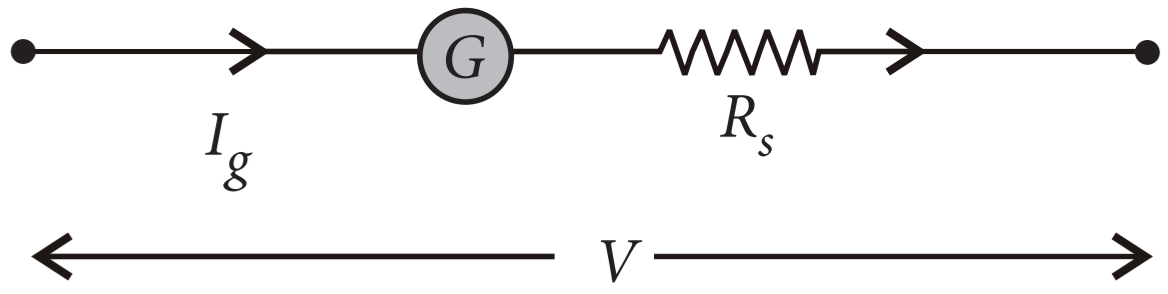
A galvanometer can be converted into voltmeter of given range by connecting a suitable resistance $R,$ in series with the galvanometer, whose value is given by, $\text{R}_\text{s}=\frac{\text{V}}{\text{I}_\text{g}}-\text{G}$
where vis the voltage to be measured, $lg$ is the current for full scale deflection of galvanometer and $G$ is the resistance of galvanometer.

Series resistor$(R,)$ increases range of voltmeter and the effective resistance of galvanometer. It also protects the galvanometer from damage due to large current. Voltmeter is a high resistance instrument and it is always connected in parallel with the circuit element across which potential difference is to be measured. An ideal voltmeter has infinite resistance. In order to increase the range of voltmeter $n$ times the value of resistance to be connected in series with galvanometer is $R_s = (n - 1)G.$
  1. $10\ mA$ current can pass through a galvanometer of resistance $25\Omega$ What resistance in series should be connected through it, so that it is converted into a voltmeter of $100V$?
  1. $0.975\Omega$
  2. $99.75\Omega$
  3. $975\Omega$
  4. $9975\Omega$
  1. There are $3$ voltmeter $A, B, C$ having the same range but their resistance are $15000\Omega,10000\Omega,$ and $5000\Omega$ respectively. 'Tile best voltmeter amongst them is the one whose resistance is
  1. $5000\Omega$
  2. $10000\Omega$
  3. $15000\Omega$
  4. all are equally good.
  1. A milliammeter of range 0 to $25\ mA$ and resistance of $10\Omega$ is to be converted into a voltmeter with a range of 0 to $25V.$ 'Tile resistance that should be connected in series will be:
  1. $930\Omega$
  2. $960\Omega$
  3. $990\Omega$
  4. $1010\Omega$
  1. To convert a moving coil galvanometer $\ce{(MCG)}$ into a voltmeter:
  1. $A$ high resistance $R$ is connected in parallel with $\ce{MCG}.$
  2. $A$ low resistance $R$ is connected in parallel with $\ce{MCG}.$
  3. $A$ low resistance $R$ is connected in series with $\ce{MCG}.$
  4. $A $ high resistance $R$ is connected in series with $\ce{MCG}.$
  1. To increase the current sensitivity of a moving coil galvanometer, we should decrease:
  1. Zero.
  2. Low.
  3. High.
  4. Infinity.
The mean free path of electrons in a gas in a discharge tube is inversely proportional to the pressure inside it. The Crookes dark space occupies half the length of the discharge tube when the pressure is 0.02mm of mercury. Estimate the pressure at which the dark space will fill the whole tube.
The weight Mg of an extended body is generally shown in a diagram to act through the centre of mass. Does it mean that the earth does not attract other particles?