Question
Establish the expression for equivalent resistance of series combination and parallel combination of resistance separately.

Answer

(a) Resistances in series combination : "A number of resistors are said to be connected in series combination if they are connected end to end."
In this combination when some potential difference is applied across the ends of the combination the same current flows through each of the resistors. But potential difference across each of the resistors is different and the sum of the potential difference across the individual resistors is equal to the potential difference applied across the combination.
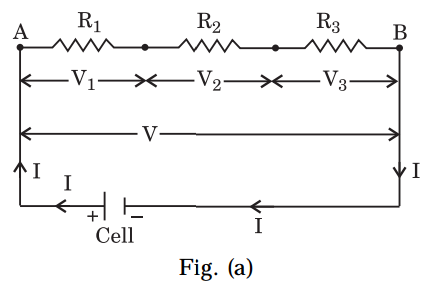
Image
In fig. (a) the series combination of three resistors having resistances $R _1, \quad R _2$ and $R _3$ is shown, when a potential difference V is applied across the ends A and B of the combination by connecting a cell between these points, let the current flowing through all the resistors be I. Suppose that the potential difference across the individual resistors of resistance $R _1, \ R _2$ and $R _3$ are $V _1, \  V _2$ and $V _3$ respectively. Then, according to Ohm's law,
$V _1= IR _1, V_2= IR _2$ and $V _3= IR _3$
Let the equivalent resistance of the combination be R, then according to Ohm's law,
V = IR.
But for series combination :
$V=V_1+V_2+V_3$
$\Rightarrow \quad IR = IR _1+ IR _2+ IR _3$
$\Rightarrow \quad R = R _1+ R _2+ R _3$
The same argument may be applied to the series combination of any number of resistors. Hence
$R = R _1+ R _2+ R _3+\ldots \ldots+ R _i \Rightarrow R =\sum_{i=1}^n R _i$
"Thus, equivalent resistance of series combination of any number of resistors is equal to the sum of their individual resistances and is always greater than the value of resistance of individual resistors."

Need a full question paper?

Generate a complete, print-ready paper with questions like this in minutes — across 16+ boards, with answer keys.

Start Generating Free

Similar questions

An electromagnetic wave transports linear momentum as it travels through space. If an electromagnetic wave transfers a total energy $U$ to a surface in time $t ,$ then total linear momentum delivered to the surface is $p =\frac{U}{c}$. When an electromagnetic wave falls on a surface, it exerts pressure on the surface. In $1903,$ the American scientists Nichols and Hull succeeded in measuring radiation pressures of visible light where other had failed, by making a detailed empirical analysis of the ubiquitous gas heating and ballistic effects.

$(i)$ The pressure exerted by an electromagnetic wave of intensity $I \left( W m ^{-2}\right)$ on a non $-$ reflecting surface is $( c $is the velocity of light$)$
$(a) \frac{I}{c}$
$(b) \frac{I}{c^2}$
$(c) Ic ^2$
$(d) IC$

$(ii)$ Light with an energy flux of $18 W / cm ^2$ falls on a non-reflecting surface at normal incidence.
The pressure exerted on the surface is:
$(a) 2 N / m ^2$
$(b) 6 \times 10^{-4} N / m ^2$
$(c) 2 \times 10^{-4} N / m ^2$
$(d) 6 N / m ^2$

$(iii)$ Radiation of intensity $0.5 W m ^{-2}$ are striking a metal plate. The pressure on the plate is
$(a) 0.212 \times 10^{-8} N m ^{-2}$
$(b) 0.132 \times 10^{-8} N m ^{-2}$
$(c) 0.166 \times 10^{-8} N m ^{-2}$
$(d) 0.083 \times 10^{-8} N m ^{-2}$
OR
The radiation pressure of the visible light is of the order of
$(a) 10^{-4} N / m$
$(b) 10^{-6} N / m ^2$
$(c) 10^{-8} N$
$(d) 10^{-2} N m ^2$

$(iv)$ A point source of electromagnetic radiation has an average power output of $1500 W$ .
The maximum value of electric field at a distance of $3 m$ from this source $($in $V m ^{-1})$ is
$(a) 500$
$(b) \frac{500}{3}$
$(c) \frac{250}{3}$
$(d)\ 100$
When the atomic dipoles are aligned partially or fully, there is a net magnetic moment in the direction of the field in any small volume of the material. The actual magnetic field inside material placed in magnetic field is the sum of the applied magnetic field and the magnetic field due to magnetisation. This field is called magnetic intensity $(H)$.
$\text{H}=\frac{\text{B}}{\mu_0}-\text{M}$
where Mis the magnetisation of the material, flo is the permittivity of vacuum and $B$ is the total magnetic field. The measure that tells us how a magnetic material responds to an external field is given by a dimensionless quantity is appropriately called the magnetic susceptibility: for a certain class of magnetic materials, intensity of magnetisation is directly proportional to the magnetic intensity.
  1. Magnetization of a sample is:
  1. Volume of sample per unit magnetic moment.
  2. Net magnetic moment per unit volume.
  3. Ratio of magnetic moment and pole strength.
  4. Ratio of pole strength to magnetic moment.
  1. Identify the wrongly matched quantity and unit pair.
  1. Pole strength $- Am$
  2. Magnetic susceptibility $-$ dimensionless number
  3. Intensity of magnetisation $- Am^{-1}$
  4. Magnetic permeability $-$ Henry $m$
  1. A closed surface $S$ encloses a magnetic dipole of magnetic moment $2\ ml$. The magnetic flux emerging from the surface is:
  1. $2 \times 10^5\ A/ m$
  2. $3 \times 10^5\ A/ m$
  3. $4 \times 10^5\ A/ m$
  4. $5 \times 10^5\ A/ m$
  1. A solenoid has core of a material with relative permeability $500$ and its windings carry a current of $1A$. The number of turns of the solenoid is $500$ per metre. The magnetization of the material is nearly,
  1. $2.5 \times 10^3Am^{-1}$
  2. $2.5 \times 10^5Am^{-1}$
  3. $2.0 \times 10^3Am^{-1}$
  4. $2.0 \times 10^5Am^{-1}$
  1. The relative penneability of iron is $6000$. Its magnetic susceptibility is:
  1. $5999$
  2. $6001$
  3. $6000 \times 10^{-7}$
  4. $6000 \times 10^7$
A sample contains a mixture of $^{108}Ag$ and $^{110}Ag$ isotopes each having an activity of $8.0 \times 10^8$ disintegration per second. $^{110}Ag$ is known to have larger half $-$ life than $^{108}Ag$. The activity $A $ is measured as a function of time and the following data are obtained.
Time $(s)$ Activity $(A) (10^8$ disinte $-$ grations $s^{-1})$ Time $(s)$ Activity $(A) (10^8$ disinte $-$ grations $s^{-1})$
$20$ $11.799$ $200$ $3.0828$
$40$ $9.1680$ $300$ $1.8899$
$60$ $7.4492$ $400$ $1.1671$
$80$ $6.2684$ $500$ $0.7212$
$100$ $5.4115$    
  1. Plot ln $\Big(\frac{\text{A}}{\text{A}_0}\Big)$ versus time.
  2. See that for large values of time, the plot is nearly linear.
  3. Deduce the half $-$ life of $^{110}Ag$ from this portion of the plot.
  4. Use the half $-$ life of $^{110}Ag$ to calculate the activity corresponding to $^{108}Ag$ in the first $50s$.
  5. Plot In $\Big(\frac{\text{A}}{\text{A}_0}\Big)$ versus time for $^{108}Ag$ for the first $50s$.
  6. Find the half $-$ life of $^{108}Ag.$
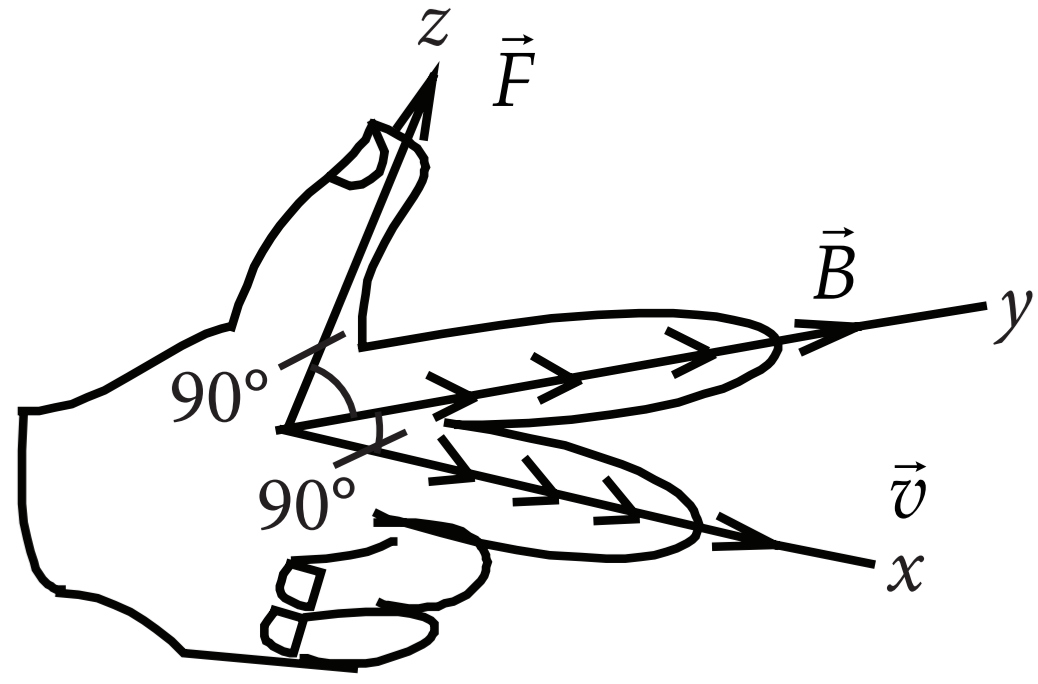
A charged particle moving in a magnetic field experiences a force that is proportional to the strength of the magnetic field, the component of the velocity that is perpendicular to the magnetic field and the charge of the particle. This force is given by $\vec{\text{F}}=\text{q}(\vec{\text{v}}\times\vec{\text{B}})$ where $q$ is the electric charge of the particle, $v$ is the instantaneous velocity of the particle, and Bis the magnetic field $($in tesla$).$ The direction of force is determined by the rules of cross product of two vectors. Force is perpendicular to both velocity and magnetic field. Its direction is same as $\vec{\text{v}}\times\vec{\text{B}}$ if $q$ is positive and opposite of $\vec{\text{v}}\times\vec{\text{B}}$ if $q$ is negative. The force is always perpendicular to both the velocity of the particle and the magnetic field that created it. Because the magnetic force is always perpendicular to the motion, the magnetic field can do no work on an isolated charge. It can only do work indirectly, via the electric field generated by a changing magnetic field.
  1. When a magnetic field is applied on a stationary electron, it:
  1. Electric field only.
  2. Magnetic field only.
  3. Both electric and magnetic field.
  4. None of these.
  5. Moving charge will produce.
  6. In $z-y$ plane.
  7. Along $-y$ axis.
  8. Along $+z$ axis.
  9. Along $-z$ axis.
  10. A charge $q$ moves with a velocity $2m s^{-1}$ along $x-$axis in a uniform magnetic field $\vec{\text{F}}=(\vec{\text{i}}+2\vec{\text{j}}+3\vec{\text{k}})\text{T,}$ charge will experience a force.
  11. The particle is stationary and magnetic field is perpendicular.
  12. The particle is moving and magnetic field is perpendicular to the velocity.
  13. The particle is stationary and magnetic field is parallel.
  14. The particle is moving and magnetic field is parallel to velocity.
  15. A charged particle experiences magnetic force in the presence of magnetic field. Which of the following statement is correct?
  16. The proton will be accelerated along the axis.
  17. The proton path will be circular about the axis.
  18. The proton moves along helical path.
  19. The proton will continue to move with velocity $v$ along the axis.
  20. A proton is projected with a uniform velocity $v$ along the axis of a current carrying solenoid, then,
  21. Remains stationary.
  22. Spins about its own axis.
  23. Moves in the direction of the field.
  24. Moves perpendicular to the direction of the field.
When a ferromagnetic material goes through a hysteresis loop, its thermal energy is increased. Where does this energy come from?
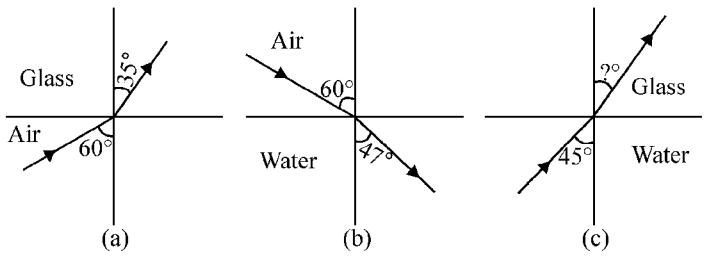
Figure (a) and (b) show refraction of a ray in air incident at 60 deg with the normal to a glass-air and water-air interface, respectively. Predict the angle of refraction in glass when the angle of incidence in water is 45 deg with the normal to a water-glass interface [Fig. (c)].
Image
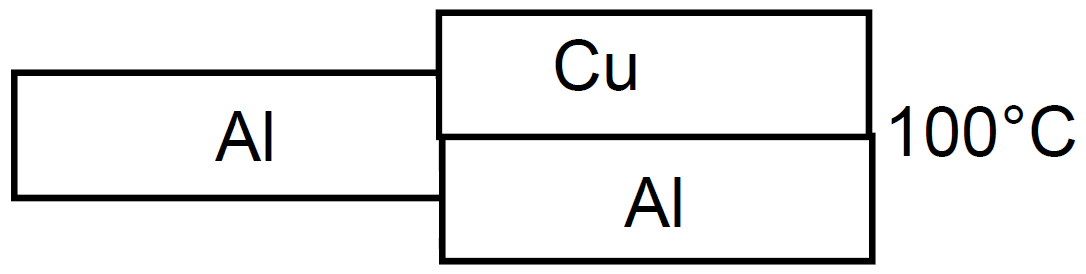
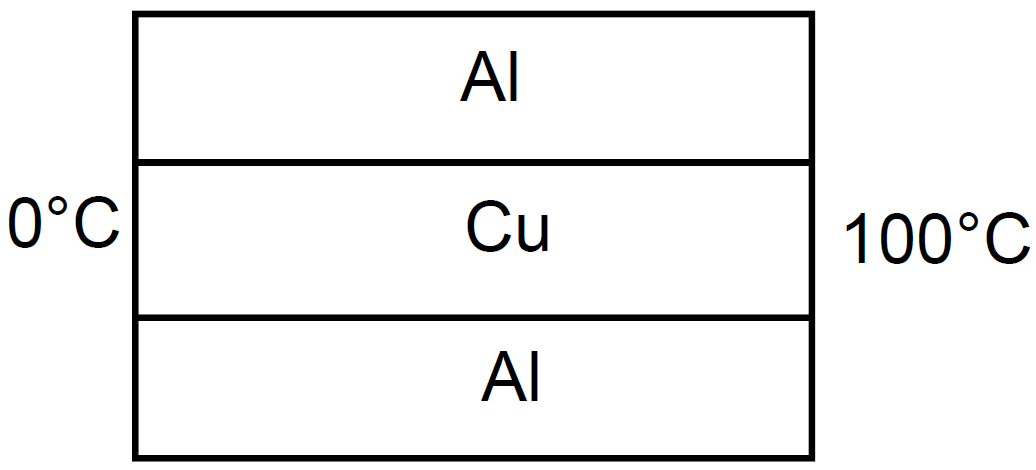
The three rods shown in figure, have identical geometrical dimensions. Heat flows from the hot end at a rate of $40$ Win the arrangement $(a)$ Find the rates of heat flow when the rods are joined as in arrangement $(b)$ and in $(c)$ Thermal conductivities of aluminium and copper are $200Wm^{-1^\circ }C^{-1}$ and $400Wm^{-1^\circ }C^{-1}$ respectively.
  1.  
  1.  
  1.  
Explain the reverse blas characteristics of $p-n$ junction diode with proper graph.
Refraction of light is the change in the path of light as it passes obliquely from one transparent medium to another medium. According to law of refraction $\frac{\sin\text{i}}{\sin\text{r}}=\ ^1\mu_2,$ where $^1\mu_2$ is called refractive index of second medium with respect to first medium. From refraction at a convex spherical surface, we have $\frac{\mu_2}{\text{v}}=\frac{\mu_1}{\text{u}}=\frac{\mu_2-\mu_1}{\text{R}}.$ Similarly from refraction at a concave spherical surface when object lies in the rarer medium, we have $\frac{\mu_2}{\text{v}}-\frac{\mu_1}{\text{u}}=\frac{\mu_2-\mu_1}{\text{R}}$ and when object lies in the denser medium, we have $\frac{\mu_1}{\text{v}}-\frac{\mu_2}{\text{u}}=\frac{\mu_1-\mu_2}{\text{R}}.$
  1. Refractive index of a medium depends upon:
  1. Nature of the medium.
  2. Wavelength of the tight used.
  3. Temperature.
  4. All of these.
  1. A ray of light of frequency $5 \times 10^{14}Hz$ is passed through a liquid. The wavelength of light measured inside the liquid is found to be $450 \times 10^{-9m.}$ The refractive index of the liquid is:
  1. $1.33$
  2. $2.52$
  3. $2.22$
  4. $0.75$
  1. A ray of light is incident at an angle of $60^\circ$ on one face of a rectangular glass slab of refractive index $1.5.$ The angle of refraction is:
  1. $\sin^-1 (0.95)$
  2. $\sin^-1 (0.58)$
  3. $\sin^-1 (0.79)$
  4. $\sin^-1 (0.86)$
  1. $A$
  2. point object is placed at the centre of a glass sphere of radius $6 \ cm$ and refractive index $1.5.$ The distance of the virtual image from the surface of sphere is:
  1. $2\ cm$
  2. $4\ cm$
  3. $6\ cm$
  4. $12\ cm$
  1. In refraction, light waves are bent on passing from one medium to the second medium because in the second medium:
  1. The frequency is different.
  2. The co$-$efficient of elasticity is different.
  3. The speed is different.
  4. The amplitude is smaller.
TV signals broadcast by Delhi studio cannot be directly received at Patna which is about 1000km away. But the same signal goes some 36000km away to a satellite, gets reflected and is then received at Patna. Explain.