Question
Explain the reverse blas characteristics of $p-n$ junction diode with proper graph.

Answer

Image


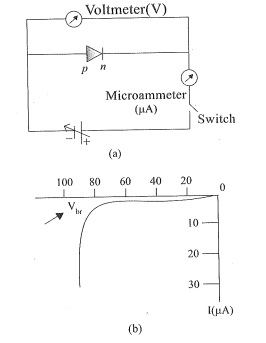
The circuit arrangement for studying the V-I characteristics of a diode in Reverse bias is shown in the figure.
As shown the battery is connected to the diode through a potentiometer (or rheostat) so that the applied voltage to the diode can be changed.
For different values of voltages, the value of the current is noted, and as shown in fig (b), a `graph of $V \rightarrow I$ is obtained. The current obtained in the reverse bias is of the order of micro ampere, $(\mu A )$. This current is known as reverse saturation current.
For the diode in reverse bias, the current is very small and almost remains constant (increases very slowly) with change in bias.
Beyond a particular value of characteristic voltage, diode current changes/increases suddenly with small change in voltage. The reverse voltage, at which this phenomenon is seen is called Breakdown voltage.
In reverse bias, after the breakdown occurs, voltage almost remains constant. Regulator circuits are prepared using this characteristic of a diode.
In reverse bias mode, the dynamic resistance of $p-n$ junction is of the order of $10^6 \Omega( M \Omega)$.

Need a full question paper?

Generate a complete, print-ready paper with questions like this in minutes — across 16+ boards, with answer keys.

Start Generating Free

Similar questions

The three rods shown in figure, have identical geometrical dimensions. Heat flows from the hot end at a rate of $40$ Win the arrangement $(a)$ Find the rates of heat flow when the rods are joined as in arrangement $(b)$ and in $(c)$ Thermal conductivities of aluminium and copper are $200Wm^{-1^\circ }C^{-1}$ and $400Wm^{-1^\circ }C^{-1}$ respectively.
  1.  
  1.  
  1.  
The mean free path of electrons in a gas in a discharge tube is inversely proportional to the pressure inside it. The Crookes dark space occupies half the length of the discharge tube when the pressure is 0.02mm of mercury. Estimate the pressure at which the dark space will fill the whole tube.
Two point charges $+3 \mu C$ and $-3 \mu C$ are kept at a distance of 20 cm from each other in vacuum. (i) What will be the electric field at the mid-point of the line joining the two charges? (ii) If a charge of $1.5 \times 10^{-9} C$ is placed at this mid-point, then how much force will be applied on this charge?
When white radiation is passed through a sample of hydrogen gas at room temperature, absorption lines are observed in Lyman series only. Explain.
In a plane electromagnetic wave, the electric field oscillates sinusoidally at a frequency of $2.0 \times 10^{10} Hz$ and amplitude $48 V m ^{-1}$.
(a) What is the wavelength of the wave?
(b) What is the amplitude of the oscillating magnetic field?
(c) Show that the average energy density of the E field equals the average energy density of the B field $\left[ c =3 \times 10^8 m s ^{-1}\right]$.
What are different kinds of modulation ? Explain.
Maxwell showed that the speed of an electromagnetic wave depends on the permeability and permittivity of the medium through which it travels. The speed of an electromagnetic wave in free space is given by  $C=\frac{1}{\sqrt{\mu_0 \varepsilon_0}}$ The fact led Maxwell to predict that light is an electromagnetic wave. The emergence of the speed of light from purely electromagnetic considerations is the crowning achievement of Maxwell’s electromagnetic theory. The The fact led Maxwell to predict that light is an electromagnetic wave. The emergence of the speed of light from purely electromagnetic considerations is the crowning achievement of Maxwell’s electromagnetic theory. The speed of an electromagnetic wave in any medium of permeability $\mu$ and permittivity $\varepsilon$ will be$\frac{c}{\sqrt{K \mu_r}}$ where K is the dielectric constant of the medium and $\mu_r$ is the relative permeability.

(i) The dimensions of $\frac{1}{2} \varepsilon_0 E^2$ ( $\varepsilon_0$ : permittivity of free space; $E =$ electric field $)$ is
(a) $MLT ^{-1}$ (b) $ML ^{-1} T^{-2}$ (c) $ML ^2 T^{-2}$ (d) $ML ^2 T^{-1}$

(ii) Let $\left[\varepsilon_0\right]$ denote the dimensional formula of the permittivity of the vacuum. If $M =$ mass, $L =$ length, $T =$ time and $A =$ electric current, then
(a) $\left[\varepsilon_0\right]= ML ^2 T^{-1}$
(b) $\left[\varepsilon_0\right]= MLT ^{-2} A^{-2}$
(c) $\left[\varepsilon_0\right]= M ^{-1} L^{-3} T^4 A^2$
(d) $\left[\varepsilon_0\right]= M ^{-1} L^{-3} T^2 A$

(iii) An electromagnetic wave of frequency 3 MHz passes from vacuum into a dielectric medium with permittivity $\varepsilon=4$. Then
(a) wavelength is halved and the frequency remains unchanged.
(b) wavelength and frequency both remain unchanged
(c) wavelength is doubled and the frequency remains unchanged
(d) wavelength is doubled and the frequency becomes half

OR

The electromagnetic waves travel with
(a) the speed of light $c =3 \times 10^8 m s ^{-1}$ in
(b) the speed of light $c =3 \times 10 m s ^{-1}$ in fluid medium. solid medium
(c) the speed of light $c =3 \times 10^8 m s ^{-1}$ in
(d) the same speed in all media free space

(iv) Which of the following are not electromagnetic waves?
cosmic rays, $\gamma$-rays, $\beta$-rays, X-rays
(a) $\beta$-rays (b) X-rays (c) $\gamma$-rays (d) cosmic rays
Two cations with equal charge repel each other with a force of $3.7 \times 10^{-9}$ Newton while the distance between them is $5 A$. How many electrons are less in each ion than in the normal state?
A dielectric slab is a substance which does not allow the flow of charges through it but permits them to exert electrostatic forces on one another. When a dielectric slab is placed between the plates, the field $E_0$ polarises the dielectric. This induces charge $-Q_P$ on the upper surface and $+ Q_P$ on the lower surface of the dielectric. These induced charges set up a field $E_P$ inside the dielectric in the opposite direction of $\vec{\text{E}_0}$ as shown.
  1. ln a parallel plate capacitor, the capacitance increases from $4\mu\text{F}$ to $80\mu\text{F},$ on introducing a dielectric medium between the plates. What is the dielectric constant of the medium?
  1. $10$
  2. $20$
  3. $50$
  4. $100$
A parallel plate capacitor with air between the plates has a capacitance of $8pE$  The separation between the plates is now reduced half and the space between them is filled with a medium of dielectric constant $5$. Calculate the value of capacitance of the capacitor in second case.
  1. $8pF$
  2. $10pF$
  3. $80pF$
  4. $100pF$
A dielectric introduced between the plates of a parallel plate condenser:
  1. Decreases the electric field between the plates.
  2. Increases the capacity of the condenser.
  3. Increases the charge stored in the condenser.
  4. Increases the capacity of the condenser.
A parallel plate capacitor of capacitance $1 pF$ has separation between the plates is $d$. When the distance of separation becomes $2d$ and wax of dielectric constant $x$ is inserted in it the capacitance becomes $ 2pE$  What is the value of $x$?
  1. $2$
  2. $4$
  3. $6$
  4. $8$
A parallel plate capacitor having area $A$ and separated by distanced is filled by copper plate of thickness $b$. The new capacity is:
  1. $\frac{\epsilon_0\text{A}}{\text{d}+\frac{\text{b}}{2}}$
  2. $\frac{\epsilon_0\text{A}}{\text{2d}}$
  3. $\frac{\epsilon_0\text{A}}{\text{d-b}}$
  4. $\frac{2\epsilon_0\text{A}}{\text{d}+\frac{\text{b}}{2}}$
A heavy nucleus breaks into comparatively lighter nuclei, which are more stable compared to the original heavy nucleus. When a heavy nucleus like uranium is bombarded by slow moving neutrons, it splits into two parts, releasing large amount of energy. The typical fission reaction of $_{92}\text{U}^{235}$.
$_{92}\text{U}^{235}+\ _0\text{n}^1\rightarrow\ _{56}\text{Ba}^{141}+\ _{36}\text{kr}^{92}+\ 3_0\text{n}^1+\ 200\text{ MeV}$
The fission of $_{92}\text{U}^{235}$ approximately released $200 MeV$ of energy.
  1. If $200 MeV$ energy is released in the fission of a single nucleus of $_{92}^{235}\text{U}$, the fissions which are required to produce a power of $1kW$ is.
  1. $3.125 \times 10^{13}$
  2. $1.52 \times 10^6$
  3. $3.125 \times 10^{12}$
  4. $3.125 \times 10^{14}$
  1. The release in energy in nuclear fission is consistent with the fact that uranium has
  1. More mass per nucleon than either of the two fragments.
  2. More mass per nucleon as the two fragment.
  3. Exactly the same mass per nucleon as the two fragments.
  4. Less mass per nucleon than either of two fragments.
  1. When $_{92}\text{U}^{235}$ undergoes fission, about $0.1\%$ of the original mass is converted into energy. The energy released when $1\ kg$ of $_{92}\text{U}^{235}$ undergoes fission is.
  1. $9 \times 10^{11}J$
  2. $9 \times 10^{13}J$
  3. $9 \times 10^{15}J$
  4. $9 \times 10^{18}J$
  1. A nuclear fission is said to be critical when multiplication factor or $K$.
  1. $K = 1$
  2. $K > 1$
  3. $K < 1$
  4. $K = 0$
  1. Einstein's mass-energy conversion relation $E = mc^2$ is illustrated by.
  1. Nuclear fission
  2. $\beta-$ decay
  3. Rocket propulsion
  4. Steam engine