Question
Establish the following vector inequalities geometrically or otherwise:
$|\text{a}-\text{b}|\le|\text{a}|+|\text{b}|$
When does the equality sign above apply?
Answer

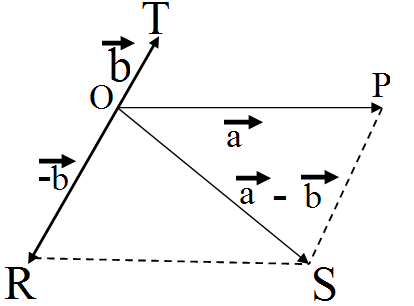
Let two vectors $\vec{\text{a}}$ and $\vec{\text{b}}$ be represented by the adjacent sides of a parallelogram PORS, as shown in the given figure.

$|\vec{\text{OR}}|=|\vec{\text{PS}}|=|\vec{\text{b}}|\ ...(\text{i})$

$|\vec{\text{OP}}|=|\vec{\text{a}}|\ ...(\text{ii})$

In a triangle, each side is smaller than the sum of the other two sides.

Therefore, in $\triangle\text{OPS},$

$\text{OS}<\text{OP}+\text{PS}$

$|\vec{\text{a}}-\vec{\text{b}}|<|\vec{\text{a}}|+|-\vec{\text{b}}|$

$|\vec{\text{a}}-\vec{\text{b}}|<|\vec{\text{a}}|+|\vec{\text{b}}|\ ...(\text{iii})$

If the two vectors act in a straight line but in opposite directions, then we can write:

$|\vec{\text{a}}-\vec{\text{b}}|=|\vec{\text{a}}|+|\vec{\text{b}}|\ ...(\text{iv})$

Combining equations (iii) and (iv), we get:

$|\vec{\text{a}}-\vec{\text{b}}|\le|\vec{\text{a}}|+|\vec{\text{b}}|$

Need a full question paper?

Generate a complete, print-ready paper with questions like this in minutes — across 16+ boards, with answer keys.

Start Generating Free

Similar questions

The difference in the frequencies of series limit of Lyman series and Balmer series is equal to the frequency of the first line of the Lyman series. Explain.
A train, standing at the outer signal of a railway station blows a whistle of frequency 400Hz in still air.
  1. What is the frequency of the whistle for a platform observer when the train (a) approaches the platform with a speed of 10m s–1, (b) recedes from the platform with a speed of 10m s–1?
  2. What is the speed of sound in each case? The speed of sound in still air can be taken as 340m s–1.
Find the acceleration of the block of mass M in the situation of figure. The coefficient of friction between the two blocks is $\mu_1$ and that between the bigger block and the ground is $\mu_2.$

Four particles having masses m, 2m, 3m and 4m are placed at the four corners of a square of edge a. Find the gravitational force acting on a particle of mass m placed at the centre.
Two identical billiard balls strike a rigid wall with the same speed but at different angles, and get reflected without any change in speed, as shown in Fig. 4.6. What is (i) the direction of the force on the wall due to each ball? (ii) the ratio of the magnitudes of impulses imparted to the balls by the wall ?
Image
A pendulum clock gives correct time at 20°C at a place where g = 9.800m s-2. The pendulum consists of a light steel rod connected to a heavy ball. It is taken to a different place where g = 9.788m s-2. At what temperature will it give correct time ? Coefficient of linear expansion of steel = 12 × 10-6 °C-1.
An adiabatic vessel of total volume V is divided into two equal parts by a conducting separator. The separator is fixed in this position. The part on the left contains one mole of an ideal gas (U = 1.5nRT) and the part on the right contains two moles of the same gas. Initially, the pressure on each side is p. The system is left for sufficient time so that a steady state is reached. Find,
  1. The work done by the gas in the left part during the process.
  2. The temperature on the two sides in the beginning.
  3. The final common temperature reached by the gases.
  4. The heat given to the gas in the right part.
  5. The increase in the internal energy of the gas in the left part.
Calculate the increase in the internal energy of 10g of water when it is heated from 0°C to 100°C and converted into steam at 100kPa. The density of steam= 0.6kg/ m-3. Specific heat capacity of water = 4200J/ kg-1°C-1 and the Jatent heat of vaporization of water = 2.25 × 10⁶J/kg-1.
A stream of water flowing horizontally with a speed of 15ms-1 gushes out of a tube of cross-sectional area 10-2m2, and hits a vertical wall nearby. What is the force exerted on the wall by the impact of water, assuming it does not rebound?
Find the mutual inductance between the straight wire and the square loop of figure.