Question
Establish the following vector inequalities:
i. $|\vec{a}+\vec{b}| \leq|\vec{a}|+|\vec{b}|$
ii. $|\vec{a}-\vec{b}| \leq|\vec{a}|+|\vec{b}|$
When does the equality sign apply?
Answer

i. If $\theta$ be the angle between $\vec{a}$ and $\vec{b}$, then
$
|\vec{a}+\vec{b}|=\sqrt{|\vec{a}|^2+|\vec{b}|^2+2|\vec{a}||\vec{b}| \cos \theta}
$
Now $|\vec{a}+\vec{b}|$ will be maximum when
$
\begin{aligned}
& \cos \theta=1 \text { or } \theta=0 \\
& \therefore|\vec{a}+\vec{b}|_{\max }=\sqrt{|\vec{a}|^2+|\vec{b}|^2+2|\vec{a}||\vec{b}| \cos 0^{\circ}} \\
& =\sqrt{(|\vec{a}|+|\vec{b}|)^2}=|\vec{a}|+|\vec{b}|
\end{aligned}
$
Hence $|\vec{a}+\vec{b}| \leq|\vec{a}|+|\vec{b}|$
The equality sign in applicable when $\theta=0^{\circ}$ i.e., when $\vec{a}$ and $\vec{b}$ are in the same direction.
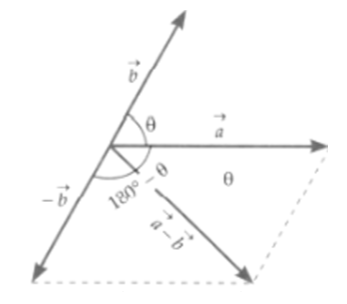
ii. If $\theta$ is the angle between $\vec{a}$ and $\vec{b}$, then the angle between $\vec{a}$ and $-\vec{b}$ will be $\left(180^{\circ}-\theta\right)$, as shown in figure.
Image
$
\begin{aligned}
& \therefore|\vec{a}-\vec{b}|=|\vec{a}+(-\vec{b})| \\
& =\sqrt{|\vec{a}|^2+|-\vec{b}|^2+2|\vec{a}||-\vec{b}| \cos \left(180^{\circ}-\theta\right)} \\
& =\sqrt{|\vec{a}|^2+|\vec{b}|^2-2|\vec{a}||\vec{b}| \cos \theta} \\
& {\left[\because|-\vec{b}|=|\vec{b}|, \cos \left(180^{\circ}-\theta\right)=-\cos \theta\right]}
\end{aligned}
$
$|\vec{a}-\vec{b}|$ will be maximum when $\cos \theta=-1$ or $\theta=180^{\circ}$
$
\begin{aligned}
& \therefore|\vec{a}-\vec{b}|_{\max }=\sqrt{|\vec{a}|^2+|\vec{b}|^2-2|\vec{a}||\vec{b}| \cos 180^{\circ}} \\
& =\sqrt{(|\vec{a}|+|\vec{b}|)^2}=|\vec{a}|+|\vec{b}|
\end{aligned}
$
Hence $|\vec{a}-\vec{b}| \leq|\vec{a}|+|\vec{b}|$
The equality sign is applicable when $\theta=180^{\circ}$

Need a full question paper?

Generate a complete, print-ready paper with questions like this in minutes — across 16+ boards, with answer keys.

Start Generating Free

Similar questions

A uniform rod of mass m and length l is struck at an end by a force F perpendicular to the rod for a short time interval t. Calculate:
  1. The speed of the centre of mass.
  2. The angular speed of the rod about the centre of mass.
  3. The kinetic energy of the rod.
  4. The angular momentum of the rod about the centre of mass after the force has stopped to act. Assume that t is so small that the rod does not appreciably change its direction while the force acts.
Identical springs of steel and copper are equally stretched. On which, more work will have to be done?
A circular disc made of iron is rotated about its axis at a constant velocity to $\omega$. Calculate the percentage change in the linear speed of a particle of the rim as the disc is slowly heated from 20°c to 50°C keeping the angular velocity constant. Coefficient of linear expansion of iron = 1.2 × 10⁻⁵ °C-1.
  1. What is beat phenomenon?
  2.  

A whistle revolve in a circle with angular velocity of o = 20 rad s-1. If the frequency of the sound is 385Hz and speed is 340ms-1, than find the frequency heard by the observer when the whistle is at B.

In the following two exercises, choose the correct answer from among the given ones: The gravitational intensity at the centre of a hemispherical shell of uniform mass density has the direction indicated by the arrow (see Fig.) (i) a, (ii) b, (iii) c, (iv) 0.

Figure. shows a large closed cylindrical tank containing water. Initially the air trapped above the water surface has a height h0 and pressure 2p0 where p0 is the atmospheric pressure. There is a hole in the wall of the tank at a depth h1 below the top from which water comes out. A long vertical tube is connected as shown.
  1. Find the height h2 of the water in the long tube above the top initially.
  2. Find the speed with which water comes out of the hole.
  3. Find the height of the water in the long tube above the top when the water stops coming out of the hole.

An object is placed at a distance of 30cm from a converging lens of focal length 15cm. A normal eye (near point 25cm, far point infinity) is placed close to the lens on the other side.
  1.  Can the eye see the object clearly?
  2.  What should be the minimum separation between the lens and the eye so that the eye can clearly see the object?
  3.  Can a diverging lens, placed in contact with the converging lens, help in seeing the object clearly when the eye is close to the lens?
Write the boundary conditions of dimensional equations.
Two particles, each with mass m are placed at a separation d in a uniform magnetic field B, as shown in the figure. They have opposite charges of equal magnitude q. At time t = 0, the particles are projected towards each other, each with a speed v. Suppose the Coulomb force between the charges is switched off.
  1. Find the maximum value vm of the projection speed, so that the two particles do not collide.
  2. What would be the minimum and maximum separation between the particles if $\text{v}=\text{v}_{\text{m}}\sqrt{2}?$
  3. At what instant will a collision occur between the particles if v = 2vm?
  4. Suppose v = 2vm and the collision between the particles is completely inelastic. Describe the motion after the collision.

A uniform chain of mass M and length L is held vertically in such a way that its lower end just touches the horizontal floor. The chain is released from rest in this position. Any portion that strikes the floor comes to rest. Assuming that the chain does not form a heap on the floor, calculate the force exerted by it on the floor when a length x has reached the floor.