Establish the following vector inequalities: i. $|\vec{a}+\vec{b}| \leq|\vec{a}|+|\vec{b}|$ ii. $|\vec{a}-\vec{b}| \leq|\vec{a}|+|\vec{b}|$ When does the equality sign apply?
Answer
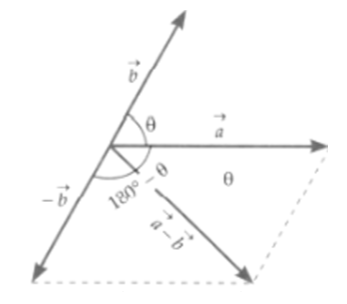
i. If $\theta$ be the angle between $\vec{a}$ and $\vec{b}$, then $ |\vec{a}+\vec{b}|=\sqrt{|\vec{a}|^2+|\vec{b}|^2+2|\vec{a}||\vec{b}| \cos \theta} $ Now $|\vec{a}+\vec{b}|$ will be maximum when $ \begin{aligned} & \cos \theta=1 \text { or } \theta=0 \\ & \therefore|\vec{a}+\vec{b}|_{\max }=\sqrt{|\vec{a}|^2+|\vec{b}|^2+2|\vec{a}||\vec{b}| \cos 0^{\circ}} \\ & =\sqrt{(|\vec{a}|+|\vec{b}|)^2}=|\vec{a}|+|\vec{b}| \end{aligned} $ Hence $|\vec{a}+\vec{b}| \leq|\vec{a}|+|\vec{b}|$ The equality sign in applicable when $\theta=0^{\circ}$ i.e., when $\vec{a}$ and $\vec{b}$ are in the same direction. ii. If $\theta$ is the angle between $\vec{a}$ and $\vec{b}$, then the angle between $\vec{a}$ and $-\vec{b}$ will be $\left(180^{\circ}-\theta\right)$, as shown in figure. $ \begin{aligned} & \therefore|\vec{a}-\vec{b}|=|\vec{a}+(-\vec{b})| \\ & =\sqrt{|\vec{a}|^2+|-\vec{b}|^2+2|\vec{a}||-\vec{b}| \cos \left(180^{\circ}-\theta\right)} \\ & =\sqrt{|\vec{a}|^2+|\vec{b}|^2-2|\vec{a}||\vec{b}| \cos \theta} \\ & {\left[\because|-\vec{b}|=|\vec{b}|, \cos \left(180^{\circ}-\theta\right)=-\cos \theta\right]} \end{aligned} $ $|\vec{a}-\vec{b}|$ will be maximum when $\cos \theta=-1$ or $\theta=180^{\circ}$ $ \begin{aligned} & \therefore|\vec{a}-\vec{b}|_{\max }=\sqrt{|\vec{a}|^2+|\vec{b}|^2-2|\vec{a}||\vec{b}| \cos 180^{\circ}} \\ & =\sqrt{(|\vec{a}|+|\vec{b}|)^2}=|\vec{a}|+|\vec{b}| \end{aligned} $ Hence $|\vec{a}-\vec{b}| \leq|\vec{a}|+|\vec{b}|$ The equality sign is applicable when $\theta=180^{\circ}$
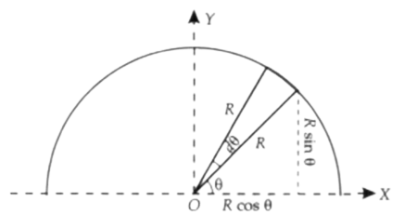
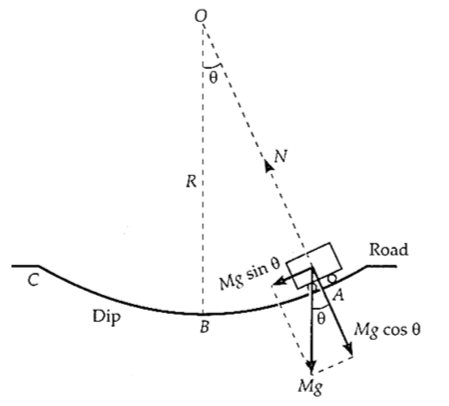
The bottom of a dip on a road has a radius of curvature $R$. A rickshaw of mass $M$ left a little away from the bottom oscillates about the dip. Deduce an expression for the period of oscillation.
A bird is at a point P whose coordinates are $(4 m,-1 m, 5 m)$. The bird observes two points $P _1$ and $P _2$ having coordinates $(-1 m, 2 m, 0 m)$ and $(1 m, 1 m, 4 m)$ respectively. At time $t =0$, it starts flying in a plane of three positions, with a constant speed of $5 ms^{-1}$ in a direction perpendicular to the straight line $P _1 P _2$ till it sees $P _1$ and $P _2$ collinear at time $t$. Calculate $t$.
Answer
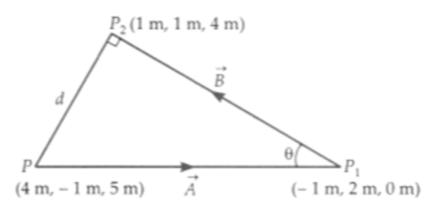
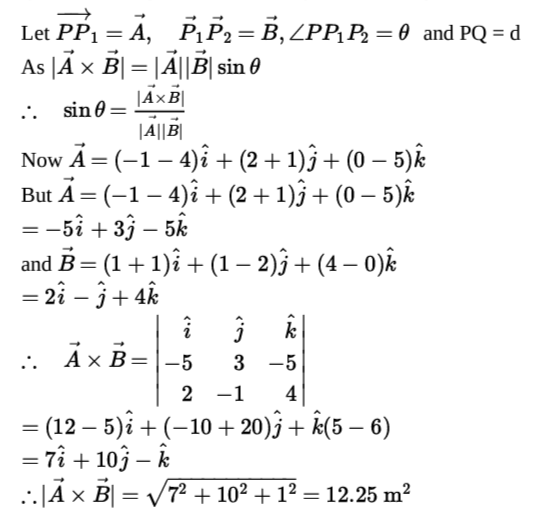
The situation is shown in figure. The bird flies in a direction perpendicular to line $P_1 P_2$. Suppose it reaches the point $Q$ in time $t$ (after starting from point P ) where it sees $P _1$ and $P _2$ as collinear.
$ \begin{aligned} & \text { and }|\vec{B}|=\sqrt{2^2+1^2+4^2}=4.583 m \\ & \therefore \quad d=\frac{12.25}{4.583}=2.67 m \end{aligned} $ Time taken by bird to reach the point Q will be $ t=\frac{d}{v}=\frac{2.67}{5}=0.5346 s $
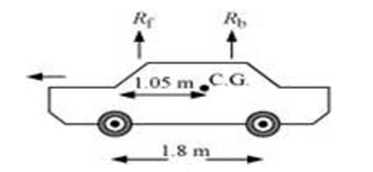
A car weighs 1800 kg . The distance between its front and back axles is 1.8 m . Its centre of gravity is 1.05 m behind the front axle. Determine the force exerted by the level ground on each front wheel and each back wheel.
The motion of a particle executing simple harmonic motion is described by the displacement function, $x ( t )= A$ $\cos \left(\omega_t+\omega\right)$. If the initial $(t=0)$ position of the particle is 1 cm and its initial velocity is $\omega cm / s$, what are its amplitude and initial phase angle? The angular frequency of the particle is $\pi s ^{-1}$. If instead of the cosine function, we choose the sine function to describe the $SHM : x = B \sin (\omega t+a)$, what are the amplitude and initial phase of the particle with the above initial conditions.
Answer
Displacement of the particles is given by - $ y=a \sin w t $ Here $a$ is the amplitude of oscillation and $2 \pi / \omega$ is the period of oscillation and $\omega$ is the angular frequency of the wave. Initially, at $t =0$ : Displacement, $x =1 cm$ Initial velocity, $v =\omega cm / sec$. Angular frequency, $\omega=\pi rad / s ^{-1}$ It is given that: $ \begin{aligned} & x(x)=A \cos (\omega t+\phi) \\ & 1=A \cos (\omega \times 0+\phi)=A \cos \phi \\ & A \cos \phi=1 \ldots \text { (i) } \end{aligned} $ Velocity, $v=\frac{d x}{d t}$ $ \begin{aligned} & \omega=-A \omega \sin (\omega t+\phi) \\ & 1=A \sin (\omega \times 0+\phi)=A \sin \phi \\ & A \sin \phi=-1 \ldots \text {...(ii) } \end{aligned} $ Squaring and adding equations (i) and (ii), we get: $ \begin{aligned} & A^2\left(\sin ^2 \phi+\cos ^2 \phi\right)=1+1 \\ & A^2=2 \\ & \therefore A=\sqrt{2} cm \end{aligned} $ Dividing equation (ii) by equation (i), we get: $ \begin{aligned} & \tan \phi=-1 \\ & \therefore \phi=\frac{3 \pi}{4}, \frac{7 \pi}{4}, \ldots \ldots \end{aligned} $ SHM is given as: $ x=B \sin (\omega t+a) $ Putting the given values in this equation, we get: $ 1=B \sin [\omega \times 0+a] $ B $\sin a =1 \ldots$ (iii) Velocity, $v=\omega B \cos (\omega t+a)$ Substituting the given values, we get: $ \pi=\pi B \sin a $ B $\sin a =1$...(iv) Squaring and adding equations (iii) and (iv), we get: $ \begin{aligned} & B^2\left[\sin ^2 a+\cos ^2 a\right]=1+1 \\ & B^2=2 \\ & \therefore B=\sqrt{2} cm \end{aligned} $ Dividing equation (iii) by equation (iv), we get: $ \begin{aligned} & \frac{B \sin a}{B \cos a}=\frac{1}{1} \\ & \tan a=1=\tan \frac{\pi}{4} \\ & a=\frac{\pi}{4}, \frac{5 \pi}{4}, \ldots \ldots \end{aligned} $