Question
Establish the kinematic equation v2 - u2 = 2as from velocity-time graph for a uniformly accelerated motion.

Answer


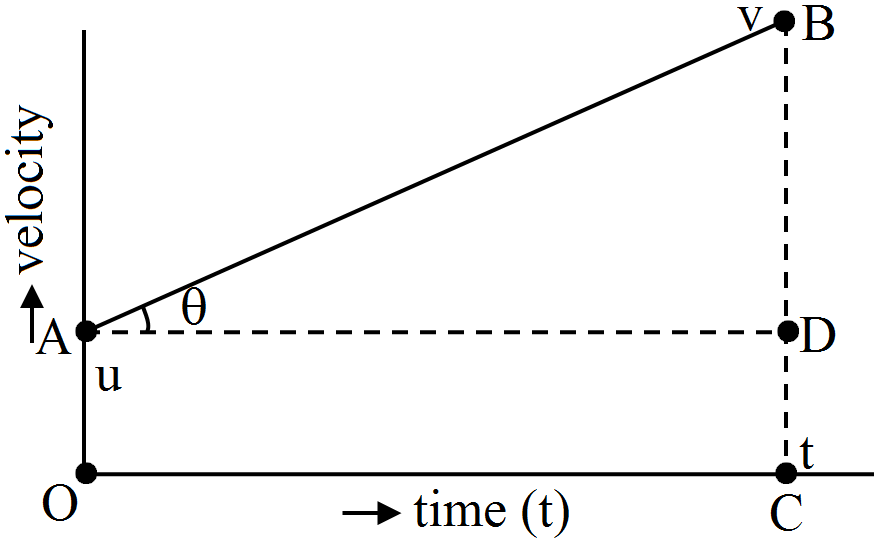
The velocity-time graph for uniformly accelerated motion has been shown in Fig. with initial velocity at t = 0 as u and final velocity at time t as v. Then area under the v-t graph gives the value of total displacement in the given time.
Hence, displacement of moving particle in time t = area of trapezium $\Delta \text{ABC}$
$\text{s}=\frac{1}{2}(\text{OA}+\text{CB})\times\text{OC}$
$=\frac{1}{2}(\text{u}+\text{v})\times\text{t}$
However, from definition of acceleratiory we know that
$\text{a}=\frac{\text{v}-\text{u}}{\text{t}}$ or $\text{t}=\frac{\text{v}-\text{u}}{\text{a}}$
Substituting this value of time t in equation (i), we get
Displacemen $\text{s}=\frac{1}{2}(\text{u}+\text{v})\times\frac{\text{v}-\text{u}}{\text{a}}$
$\frac{(\text{v}^2-\text{u}^2)}{2\text{a}}$
$\Rightarrow 2\text{as}=\text{v}^2-\text{u}^2$
$\text{v}^2=\text{u}^2+2\text{as}$

Need a full question paper?

Generate a complete, print-ready paper with questions like this in minutes — across 16+ boards, with answer keys.
Start Generating Free

Similar questions

Give example of a situation in which an applied force does not result in a change in kinetic energy.
A cubical box of volume 216cm3 is made up of 0.1cm thick wood. The inside is heated electrically by a 100W heater. It is found that the temperature difference between the inside and the outside surface is 5°C in steady state. Assuming that the entire electrical energy spent appears as heat, find the thermal conductivity of the material of the box.
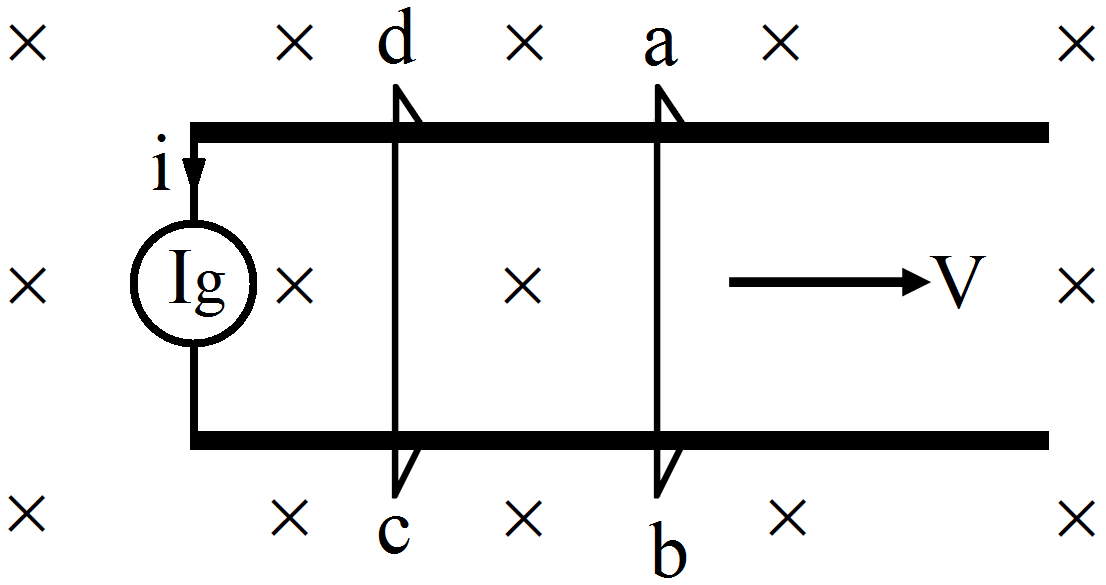
The current generator Ig shown in figure, sends a constant current i through the circuit. The wire cd is fixed and ab is made to slide on the smooth, thick rails with a constant velocity v towards right. Each of these wires has resistance r. Find the current through the wire cd.

A particle of mass in is attatched to three springs A, B and C of equal force constants k as shown in figure If the particle is pushed slightly against the spring C and released, find the time period of oscillation.

A block weighing 10N travels down a smooth curved track AB joined to a rough horizontal surface (figure). The rough surface has a friction coefficient of 0.20 with the block. If the block starts slipping on the track from a point 1.0m above the horizontal surface, how far will it move on the rough surface?

The moment of inertia of a uniform rod of mass 0.50kg and length 1m is 0.10kg-m2 about a line perpendicular to the rod. Find the distance of this line from the middle point of the rod.
Calculate the energy that can be obtained from 1kg of water through the fusion reaction
2H + 2H → 3H + p.
Assume that 1.5 × 10⁻²% of natural water is heavy water D2O (by number of molecules) and all the deuterium is used for fusion.
A door is hinged at one end and is free to rotate about a vertical axis. Does its weight cause any torque about this axis? Give reason for your answer.

What is Einstein's energy-mass equivalence? Explain the energy output of a mass on the basis of this relationship. Give two situations where this relationship can be employed. Also calculate energy released from complete annihilation of 1g matter.
List down the properties required by a function to represent a travelling wave.