Questions · Page 1 of 2

3 Marks Question

🎯

Test yourself on this topic

50 questions · timed · auto-graded

Question 13 Marks
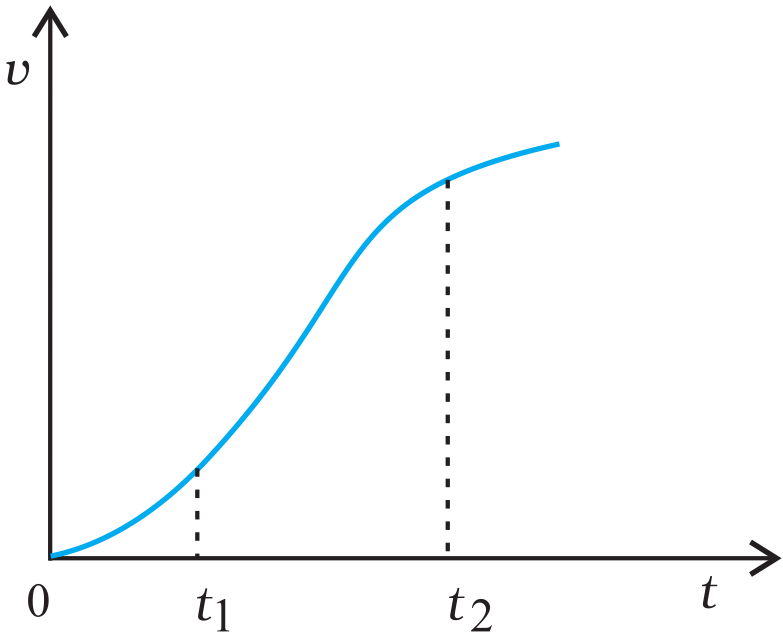
 The velocity-time graph of a particle in one-dimensional motion is shown in:
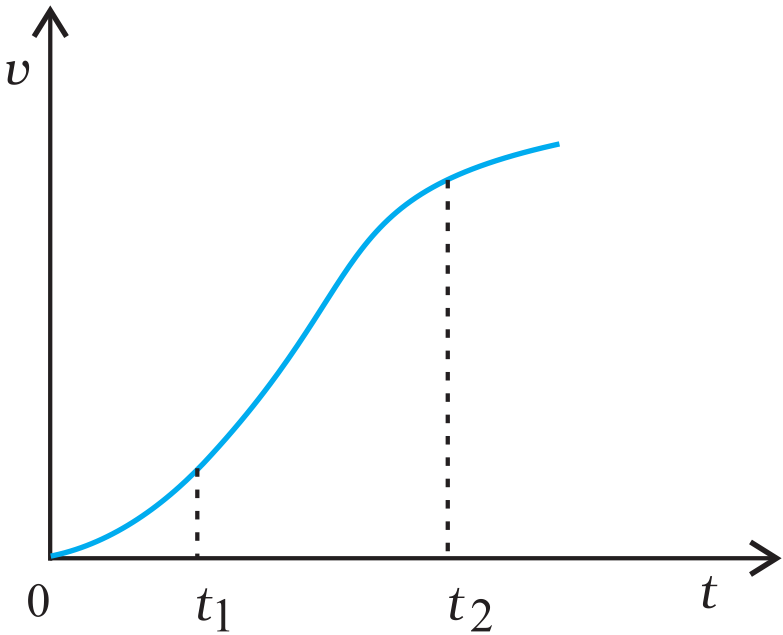
Which of the following formulae are correct for describing the motion of the particle over the time-interval t1 to t2:

  1. x(t2) = x(t1) + v(t1) (t2 – t1) + (1/2) a(t2 – t1)2

  2. v(t2) = v(t1) + a(t2 – t1)

  3. vaverage = (x(t2) –x(t1))/(t2 – t1)

  4. aaverage = (v(t2) –v(t1))/(t2 – t1)

  5. x(t2) = x(t1) + vaverage (t2 – t1) + (1/2) aaverage (t2 – t1)2

  6. x(t2) – x(t1) = area under the v-t curve bounded by the t-axis and the dotted line shown. 

Answer
The correct formulae describing the motion of the particle are (c), (d) and, (f),
The given graph has a non-uniform slope. Hence, the formulae given in (a), (b), and (e) cannot describe the motion of the particle. Only relations given in (c), (d), and (f) are correct equations of motion.
View full question & answer
Question 23 Marks
Explain clearly, with examples, the distinction between:
Magnitude of average velocity over an interval of time, and the average speed over the same interval. [Average speed of a particle over an interval of time is defined as the total path length divided by the time interval]. Show in both (a) and (b) that the second quantity is either greater than or equal to the first. When is the equality sign true? [For simplicity, consider one-dimensional motion only]
Answer
Magnitude of average velocity = Magnitude of displacement/Time interval
For the given particle,
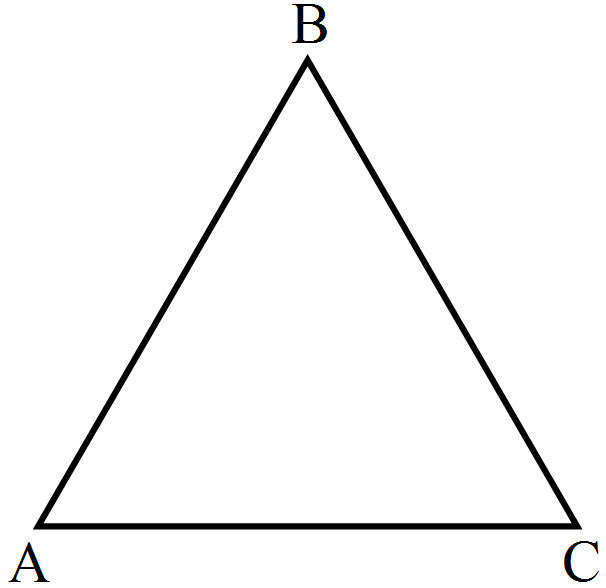
Average velocity = AC/t
Average speed = Total path length/Time interval
= (AB + BC)/t
Since (AB + BC) > AC, average speed is greater than the magnitude of average velocity. The two quantities will be equal if the particle continues to move along a straight line
View full question & answer
Question 33 Marks
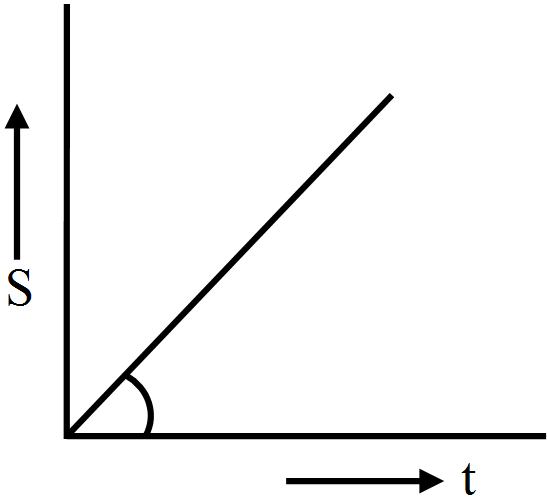
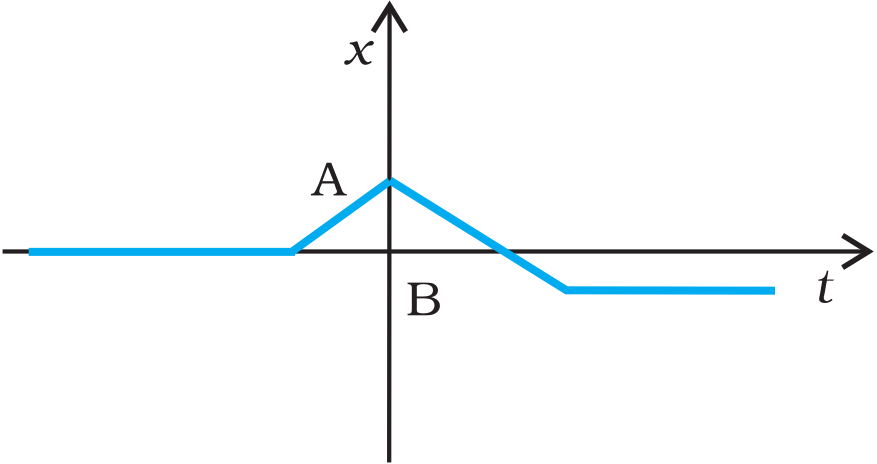
Suggest a suitable physical situation for of the following graphs.

Answer
The given x-t graph shows that initially a body was at rest. Then, its velocity increases with time and attains an instantaneous constant value. The velocity then reduces to zero with an increase in time. Then, its velocity increases with time in the opposite direction and acquires a constant value. A similar physical situation arises when a football (initially kept at rest) is kicked and gets rebound from a rigid wall so that its speed gets reduced. Then, it passes from the player who has kicked it and ultimately gets stopped after sometime.
View full question & answer
Question 43 Marks
A player throws a ball upwards with an initial speed of 29.4m s–1.
Choose the x = 0m and t = 0s to be the location and time of the ball at its highest point, vertically downward direction to be the positive direction of x-axis, and give the signs of position, velocity and acceleration of the ball during its upward, and downward motion.
Answer
During upward motion, the sign of position is positive, sign of velocity is negative, and sign of acceleration is positive. During downward motion, the signs of position, velocity, and acceleration are all positive.
View full question & answer
Question 53 Marks
A jet airplane travelling at the speed of 500 km h–1 ejects its products of combustion at the speed of 1500km h–1 relative to the jet plane. What is the speed of the latter with respect to an observer on the ground?
Answer
Speed of the jet airplane, Vjet = 500km/ h
Relative speed of its products of combustion with respect to the plane,
Vsmoke = – 1500km/ h
Speed of its products of combustion with respect to the ground = V′smoke
Relative speed of its products of combustion with respect to the airplane,
Vsmoke = V′smoke – Vjet
–1500 = V′smoke – 500
V′smoke = –1000km/ h
The negative sign indicates that the direction of its products of combustion is opposite to the direction of motion of the jet airplane.
View full question & answer
Question 63 Marks
A player throws a ball upwards with an initial speed of 29.4m s–1.
To what height does the ball rise and after how long does the ball return to the player’s hands? (Take g = 9.8ms–2 and neglect air resistance).
Answer
Initial velocity of the ball, u = 29.4m/s
Final velocity of the ball, v = 0 (At maximum height, the velocity of the ball becomes zero)
Acceleration, a = –g = –9.8m/s2
From third equation of motion, height (s) can be calculated as:
v– u2 = 2gs
s = (v2 – u2)/2g
= ((0)2 – (29.4)2)/2 × (-9.8) = 3s
Time of ascent = Time of descent
Hence, the total time taken by the ball to return to the player’s hands = 3 + 3 = 6s.
View full question & answer
Question 73 Marks
In Exercises 3.13 and 3.14, we have carefully distinguished between average speed and magnitude of average velocity. No such distinction is necessary when we consider instantaneous speed and magnitude of velocity. The instantaneous speed is always equal to the magnitude of instantaneous velocity. Why?
Answer
Instantaneous velocity is given by the first derivative of distance with respect to time i.e.,
Vin = dx/dt
Here, the time interval dt is so small that it is assumed that the particle does not change its direction of motion. As a result, both the total path length and magnitude of displacement become equal is this interval of time.
Therefore, instantaneous speed is always equal to instantaneous velocity.
View full question & answer
Question 83 Marks
A police van moving on a highway with a speed of 30km h–1 fires a bullet at a thief’s car speeding away in the same direction with a speed of 192km h–1. If the muzzle speed of the bullet is 150m s–1, with what speed does the bullet hit the thief’s car?
(Note: Obtain that speed which is relevant for damaging the thief’s car).
Answer
Speed of the police van, Vp = 30km/ h = 8.33m/s
Muzzle speed of the bullet, Vb = 150m/s
Speed of the thief’s car, V= 192km/ h = 53.33m/s
Since the bullet is fired from a moving van, its resultant speed can be obtained as:
= 150 + 8.33 = 158.33m/s
Since both the vehicles are moving in the same direction, the velocity with which the bullet hits the thief’s car can be obtained as:
Vbt = Vb – Vt
= 158.33 – 53.33 = 105m/s
View full question & answer
Question 93 Marks
Explain clearly, with examples, the distinction between:
magnitude of displacement (sometimes called distance) over an interval of time, and the total length of path covered by a particle over the same interval;
Answer
The magnitude of displacement over an interval of time is the shortest distance (which is a straight line) between the initial and final positions of the particle.
The total path length of a particle is the actual path length covered by the particle in a given interval of time.
For example, suppose a particle moves from point A to point B and then, comes back to a point, C taking a total time t, as shown below. Then, the magnitude of displacement of the particle = AC.

Whereas, total path length = AB + BC
It is also important to note that the magnitude of displacement can never be greater than the total path length. However, in some cases, both quantities are equal to each other.
View full question & answer
Question 103 Marks
A man walks on a straight road from his home to a market 2.5km away with a speed of 5km h–1. Finding the market closed, he instantly turns and walks back home with a speed of 7.5km h–1. What is the
Average speed of the man over the interval of time
  1. 0 to 30 min,
  2. 0 to 50 min,
  3. 0 to 40 min?
[Note: You will appreciate from this exercise why it is better to define average speed as total path length divided by time, and not as magnitude of average velocity. You would not like to tell the tired man on his return home that his average speed was zero!]
Answer
  1. 0 to 30 min,

Average velocity = Displacement/Time = 2.5/(1/2) = 5km/ h

Average speed = Distance/Time = 2.5/(1/2) = 5km/ h

  1. 0 to 50 min

Time = 50 min = 50/60 = 5/6h

Net displacement = 0

Total distance = 2.5 + 2.5 = 5km

Average velocity = Displacement/Time = 0

Average speed = Distance/Time = 5/(5/6) = 6km/ h

  1. 0 to 40 min

Speed of the man = 7.5km/ h

Distance travelled in first 30 min = 2.5km

Distance travelled by the man (from market to home) in the next 10 min

= 7.5 × 10/60 = 1.25km

Net displacement = 2.5 – 1.25 = 1.25km

Total distance travelled = 2.5 + 1.25 = 3.75km

Average velocity = Displacement/Time = 1.25/(40/60) = 1.875km/ h

Average speed = Distance/Time = 3.75/(40/60) = 5.625km/ h

View full question & answer
Question 113 Marks
Stopping distance of vehicles : When brakes are applied to a moving vehicle, the distance it travels before stopping is called stopping distance. It is an important factor for road safety and depends on the initial velocity $\left(v_0\right)$ and the braking capacity, or deceleration, $-a$ that is caused by the braking. Derive an expression for stopping distance of a vehicle in terms of $v_0$ and $a$.
Answer
Let the distance travelled by the vehicle before it stops be $d_s$. Then, using equation of motion $v^2=v_0^2+2 a x$, and noting that $v=0$, we have the stopping distance
$
d_s=\frac{-v_0^2}{2 a}
$
Thus, the stopping distance is proportional to the square of the initial velocity. Doubling the initial velocity increases the stopping distance by a factor of 4 (for the same deceleration).
For the car of a particular make, the braking distance was found to be $10 m , 20 m , 34 m$ and $50 m$ corresponding to velocities of $11,15,20$ and $25 m / s$ which are nearly consistent with the above formula.
Stopping distance is an important factor considered in setting speed limits, for example, in school zones.
View full question & answer
Question 123 Marks
Galileo's law of odd numbers: "The distances traversed, during equal intervals of time, by a body falling from rest, stand to one another in the same ratio as the odd numbers beginning with unity [namely. 1: 3: 5: 7.......]" Prove it.
Answer
Let us divide the time interval of motion of an object under free fall into many equal intervals $\tau$ and find out the distances traversed during successive intervals of time. Since initial velocity is zero, we have
$
y=-\frac{1}{2} g t^2
$
Using this equation, we can calculate the position of the object after different time intervals, $0, \tau, 2 \tau, 3 \tau \ldots$ which are given in second column of Table 2.2. If we take $(-1 / 2) g \tau^2$ as $y_0$ - the position coordinate after first time interval $\tau$, then third column gives the positions in the unit of $y_0$. The fourth column gives the distances traversed in successive $\tau$ s. We find that the distances are in the simple ratio $1: 3: 5: 7: 9: 11 \ldots$ as shown in the last column. This law was established by Galileo Galilei (1564-1642) who was the first to make quantitative studies of free fall.
View full question & answer
Question 133 Marks
  1. Explain clearly with examples the distinction between magnitude of displacement over an interval of time and the total length of the path covered by a particle over the same interval.
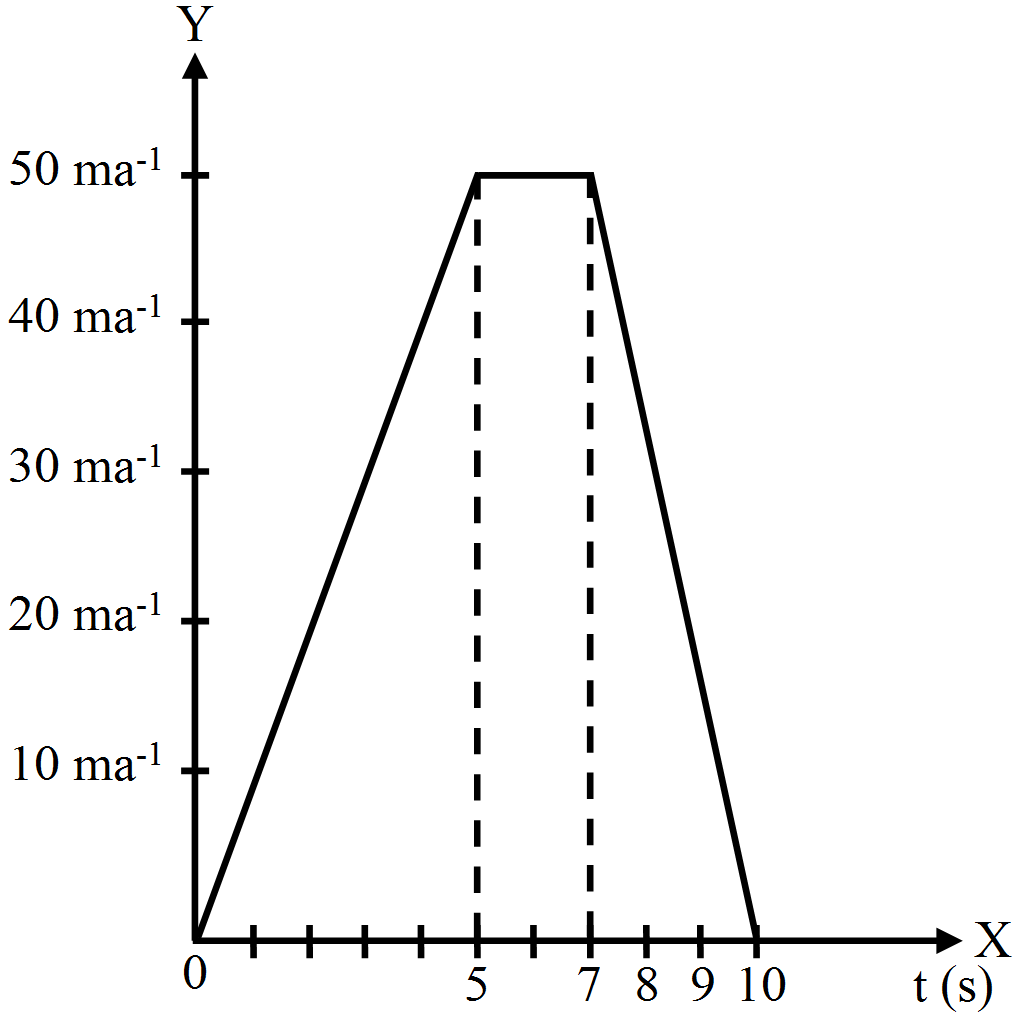
  2. A body starting from rest accelerates uniformly along a straight line at the rate of 10ms-2 for 5s. It moves for 2s with uniform velocity of 50ms-1. Then it retards uniformly and comes to rest in 3s. Draw velocity-time graph of the body and find the total distance travelled by it.
Answer
  1. Magnitude of displacement of a particle in motion force given time is the shortest distance between the initial and final positions, while total length of path or (path length) is the length of actual path traversed by the particle in the given time.

Suppose an object goes from A to C following the path ABC, in a certain time t

Total length of path = AB + BC

When an object goes on the path ABC, then the displacement of the object is $(\overrightarrow{\text{AC}}).$ The arrow head at AC shows that the object is displaced from A to C.

  1. Given: a = 10ms-2, u = 0

t = 5

$\therefore$ v = 0 + 10 × 5

v = 50 = ms-1

Area below v-t graph gives distance travelled in the straight line

$\therefore$ Distance $=\frac{1}{2}(50)\times(10+2)=300\text{m}$

View full question & answer
Question 143 Marks
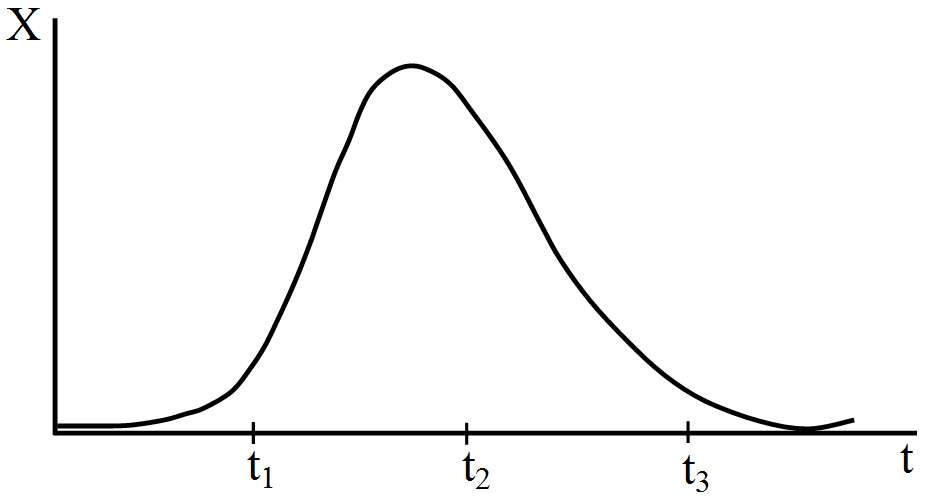
Figure shows the x coordinate of a particle as a function of time. Find the signs of vx and ax at t = t1, t = t2 and t = t3.

Answer
  1. As slope is positive velocity is positive.

As slope is increasing acceleration is positive.

  1. As slope is zero velocity is zero.

As slope is decreasing acceleration is negative.

  1. As slope is negative velocity is negative.

As slope is increasing acceleration is positive.

View full question & answer
Question 153 Marks
A man walks on a straight road from his home to a market 2.5km away with a speed of 5km h–1. Finding the market closed, he instantly turns and walks back home with a speed of 7.5km h–1. What is the
Average speed of the man over the interval of time
  1. 0 to 30 min,
  2. 0 to 50 min,
  3. 0 to 40 min?
[Note: You will appreciate from this exercise why it is better to define average speed as total path length divided by time, and not as magnitude of average velocity. You would not like to tell the tired man on his return home that his average speed was zero!]
Answer
  1. 0 to 30 min,

Average velocity = Displacement/Time = 2.5/(1/2) = 5km/ h

Average speed = Distance/Time = 2.5/(1/2) = 5km/ h

  1. 0 to 50 min

Time = 50 min = 50/60 = 5/6h

Net displacement = 0

Total distance = 2.5 + 2.5 = 5km

Average velocity = Displacement/Time = 0

Average speed = Distance/Time = 5/(5/6) = 6km/ h

  1. 0 to 40 min

Speed of the man = 7.5km/ h

Distance travelled in first 30 min = 2.5km

Distance travelled by the man (from market to home) in the next 10 min

= 7.5 × 10/60 = 1.25km

Net displacement = 2.5 – 1.25 = 1.25km

Total distance travelled = 2.5 + 1.25 = 3.75km

Average velocity = Displacement/Time = 1.25/(40/60) = 1.875km/ h

Average speed = Distance/Time = 3.75/(40/60) = 5.625km/ h

View full question & answer
Question 163 Marks
Give three important characteristics of displacement.
Answer
Three important characteristics of displacement are:
  1. Displacement is a vector quantity having both magnitude as well as direction.
  2. Displacement of a particle between two given positions is unique and is the shortest path through which particle may go from its initial to final position.
  3. Displacement is independent of the choice of origin to the co-ordinate system.
View full question & answer
Question 173 Marks
Two cars A and B are running at velocities of 60km/ hr and 45km/ hr respectively. Calculate the relative velocity of car A if:
  1. They are both travelling eastwards.
  2. Car A is travelling eastwards and car B is travelling westwards.
Answer
Let us take eastern direction as positive, then the western direction is negative.

  1. vA = +60 km/ hr. VB = +45km/ hr.

The relative velocity of the car A w.r.t. car B = vA - vB

$\therefore$ vAB = 60 - 45 = 15km/ hr.

$\therefore$ vAB is km/ hr. estward.

  1. vA = +60km/ hr

vB = -45km/ hr

vAB = vA - vB

= 60 - (-45)

= 105km/ hr eastwards.

View full question & answer
Question 183 Marks
 The velocity-time graph of a particle in one-dimensional motion is shown in:

Which of the following formulae are correct for describing the motion of the particle over the time-interval t1 to t2:

  1. x(t2) = x(t1) + v(t1) (t2 – t1) + (1/2) a(t2 – t1)2

  2. v(t2) = v(t1) + a(t2 – t1)

  3. vaverage = (x(t2) –x(t1))/(t2 – t1)

  4. aaverage = (v(t2) –v(t1))/(t2 – t1)

  5. x(t2) = x(t1) + vaverage (t2 – t1) + (1/2) aaverage (t2 – t1)2

  6. x(t2) – x(t1) = area under the v-t curve bounded by the t-axis and the dotted line shown. 

Answer
The correct formulae describing the motion of the particle are (c), (d) and, (f),
The given graph has a non-uniform slope. Hence, the formulae given in (a), (b), and (e) cannot describe the motion of the particle. Only relations given in (c), (d), and (f) are correct equations of motion.

View full question & answer
Question 193 Marks
A body starts accelerating uniformly with a from a velocity ‘u' and travels in a straight line. Prove that it covers a length of $\text{u}+\frac{\text{a}}{2}(2\text{t}-1)$ in the tth second of motion.
Answer
Initial velocity = u and acceleration = a.
Length covered in t seconds $=\text{ut}+\frac{1}{2}\text{at}^2\ \dots\text{(i)}$
$=\text{u}(\text{t}-1)+\frac{1}{2}\text{a}(\text{t}-1)^2\ \dots{(\text{ii})}$
Subtracting (i) and (ii), we get
Length covered in tth second $=\text{u}+\frac{\text{a}}{2}(2\text{t}-1).$
View full question & answer
Question 203 Marks
In Exercises 3.13 and 3.14, we have carefully distinguished between average speed and magnitude of average velocity. No such distinction is necessary when we consider instantaneous speed and magnitude of velocity. The instantaneous speed is always equal to the magnitude of instantaneous velocity. Why?
Answer
Instantaneous velocity is given by the first derivative of distance with respect to time i.e.,
Vin = dx/dt
Here, the time interval dt is so small that it is assumed that the particle does not change its direction of motion. As a result, both the total path length and magnitude of displacement become equal is this interval of time.
Therefore, instantaneous speed is always equal to instantaneous velocity.
View full question & answer
Question 213 Marks
The distance x travelled by a body in a straight line is directly proportional to t2. Decide on the type of motion associated. If $\text{x}\propto\text{t}^3$ what change will you observe?
Answer
$\text{x}\propto\text{t}^2\therefore \text{v}\propto\text{t}$ and $\text{a}\propto \text{t}^0$
So the motion is with uniform acceleration.
If $\text{x}\propto \text{t}^3,$ then $\text{v}\propto \text{t}^2$ and $\text{a}\propto\text{t}.$
The motion becomes non-uniform acceleration.
View full question & answer
Question 223 Marks
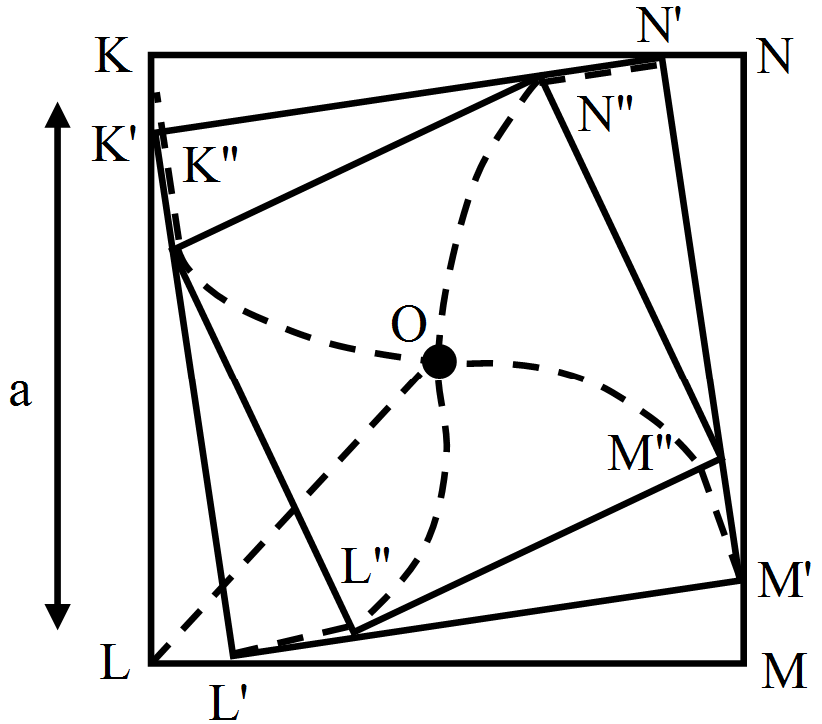
Four persons K, L, M and N start from the vertices of a square of side 'a', simultaneously and move towards the neighbour in order always with the same speed of v. When and where do they meet?
Answer
As K, L, M and N move towards the next person in order after a short time they will be at K', L', M' and N' respectively. The size to the square reduces. It indicates that they have come closer. After next short interval if they are at K", L", M" and N", the size of the square further reduces. Finally, they will follow a curvi-linear path and meet at 0, the centre of the square.

We know, the time taken $=\frac{\text{displacement}}{\text{Velocity in the direction of displacement}}$
$\therefore \text{t}=\frac{\text{LO}}{\text{v}\cos40^\circ}$
since v $\cos 45^\circ$ is the component of the velocity of L towards the destination.
$\therefore \text{t}=\frac{\text{LO}}{\Big(\frac{\text{v}}{\sqrt{2}}\Big)}$
$=\frac{\frac{\text{a}}{\sqrt{2}}}{\frac{\text{v}}{\sqrt{2}}}=\frac{\text{a}}{\text{v}}$
View full question & answer
Question 233 Marks
A jet airplane travelling at the speed of 500 km h–1 ejects its products of combustion at the speed of 1500km h–1 relative to the jet plane. What is the speed of the latter with respect to an observer on the ground?
Answer
Speed of the jet airplane, Vjet = 500km/ h
Relative speed of its products of combustion with respect to the plane,
Vsmoke = – 1500km/ h
Speed of its products of combustion with respect to the ground = V′smoke
Relative speed of its products of combustion with respect to the airplane,
Vsmoke = V′smoke – Vjet
–1500 = V′smoke – 500
V′smoke = –1000km/ h
The negative sign indicates that the direction of its products of combustion is opposite to the direction of motion of the jet airplane.
View full question & answer
Question 243 Marks
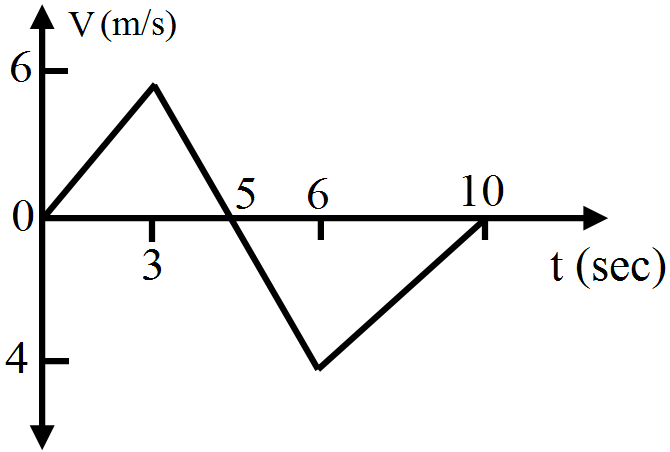
Find the displacement and distance travelled by a body in 10 seconds, using the v - t graph given below:

Answer
Area below v - t graph gives idea of distance travelled.
+ve displacement $=\frac{1}{2}\times6\times5=15\text{m}$
-ve displacement $=\frac{1}{2}\times5\times4=10\text{m}$
Net displacement $=15-10=5\text{m}$
Distance travelled = 25m
View full question & answer
Question 253 Marks
A highway motorist travels at a constant velocity of 45km/ h-1 in a 30km/ h-1 zone. A motor-cyclist police officer has been watching from behind a bill board and at the same moment the speeding motorist passes the bill board, the police officer accelerates uniformly from rest to overtake her. If the acceleration of the police officer is 10km/ h-2, how long does he take to reach the motorist?
Answer
Let the bill board be taken as the origin. Let t be the required time. Let P represent the position where the police officer reaches the motorist.
 For the motorist. (a case of uniform motion)
when t = 0, x(0) = 0, v = 45km h-1
x(t) = x(0) + vt. or x(t) = vt
⇒ 45km h-1 × t = 45t km ...(i)
For the police officer. (a case of accelerated motion)
when $\text{t}=0,\text{x}(0),=\text{v}(0)=0,\text{a}=10\text{km/h}^2$
Now, $\text{x(t)}=\text{x}(0)+\text{v}(0)\text{t}+\frac{1}{2}\text{at}^2$
$\text{x(t)}=0+0+\frac{1}{2}\times10\times\text{t}^2$
$=5\text{t}^2\text{km}\ \dots(\text{ii})$
Comparing (i) and (ii), we get
5t2 = 45t
t = 9 hour.
View full question & answer
Question 263 Marks
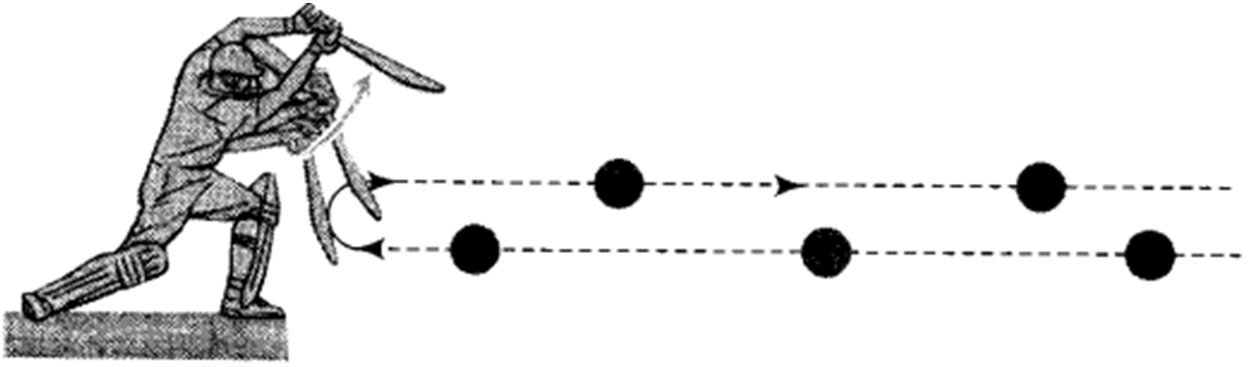
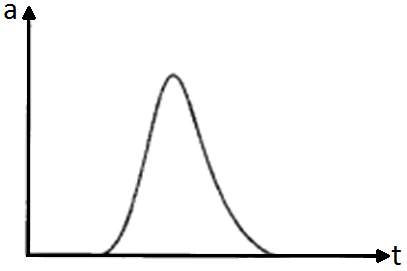
A uniformly moving cricket ball is turned back by hitting it with a bat for a very short time interval. Show the variation of its acceleration with time. (Take acceleration in the backward direction as positive).
Answer
Impulsive Force is generated by the bat: If we ignore the effect of gravity just by analyzing the motion of ball in horizontal direction only, then ball moving uniformly will return back with the same speed when a bat hits it.
Acceleration of the ball is zero just before it strikes the bat. When the ball strikes the bat, it gets accelerated due to the applied impulsive force by the bat.

The variation of acceleration with time is shown in the graph.

View full question & answer
Question 273 Marks
If the initial velocity of a particle is u and collinear acceleration at any time t is $\text{a}\propto\text{t}.$ calculate the final velocity of the particle after time t.
Answer
Acceleration $\text{a}\propto \text{t}$
⇒ a = Kt where K is a constant.
$\therefore$ Equations of motion cannot be applied.
$\therefore \frac{\text{dv}}{\text{dt}}=\text{Kt}$
$\Rightarrow\text{dv}=\text{Kt dt}$
Integrating, $\text{v}=\frac{\text{Kt}^2}{2}+\text{c}$
If v = 0 at t = 0 then, c = 0
$\therefore \text{v}=\frac{\text{Kt}^2}{2}$
View full question & answer
Question 283 Marks
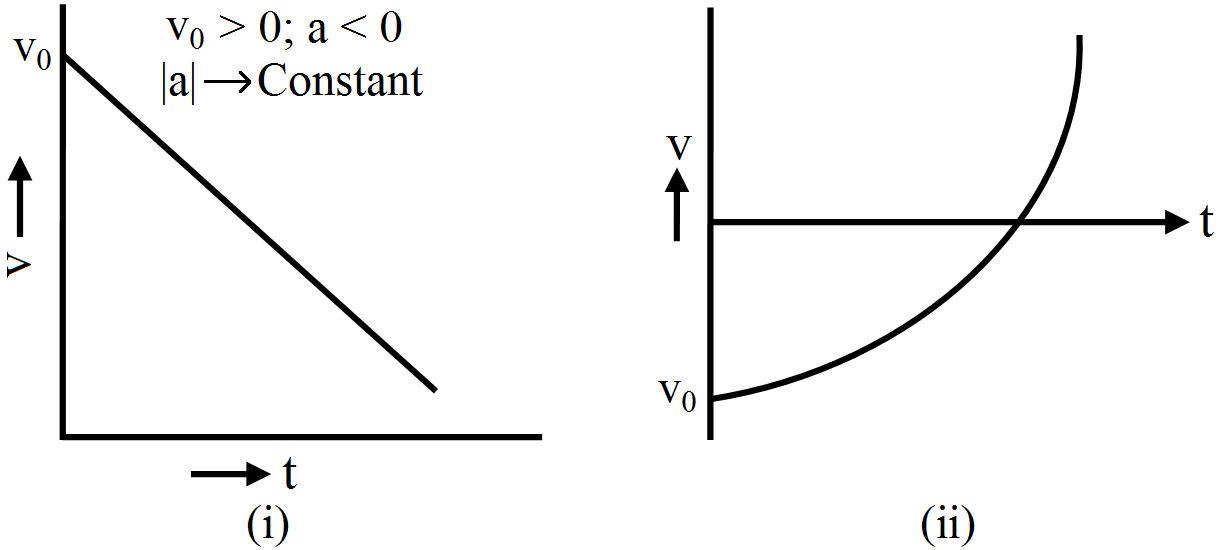
Sketch velocity-time graph in following situations:

  1. v0 >0; a < 0 |al → constant
  2. v0 < 0; a > 0 |a| → is increasing uniformly.

a : acceleration, v0 : initial velocity

OR

  1. Displacement-time graph of any object is shown in the figure:

Draw the velocity-time graph for this motion.

  1. What does the area under acceleration-time graph represent?
Answer

OR

  1.  


  1. Represents change in velocity.
View full question & answer
Question 293 Marks
How does the velocity-time graph for uniform motion give a geometrical way of calculating the displacement covered during a given time t?
Answer
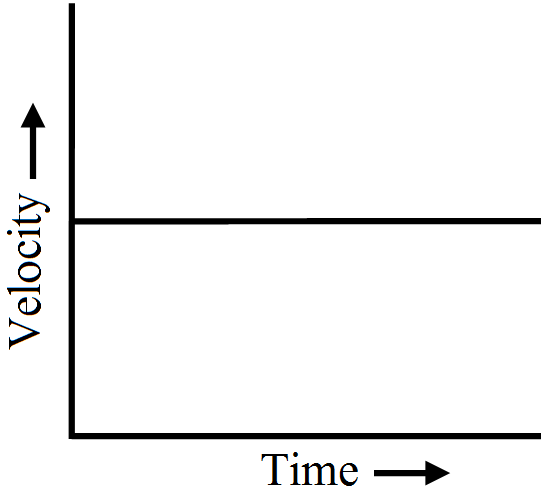
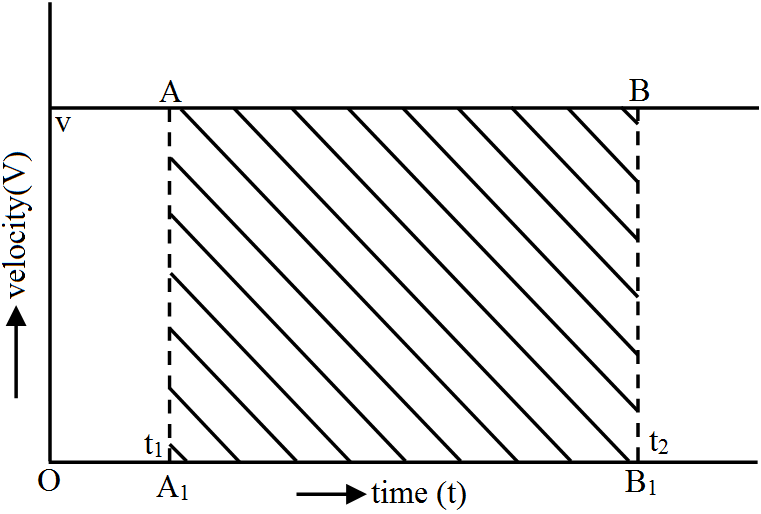
Consider velocity-time graph for uniform motion along a straight path. The graph is a straight line parallel to the time axis as shown in following Fig.

Let A and B be two points on velocity-time graph corresponding to the instants t1 and t2. As the motion is uniform, hence, AA1 = BB1 = v.
$\therefore$ Area under v-t gaph between t1 and t2 = area ABB1A1
= AA1 × A1B1 = v(t2 - t1)
But velocitv is defined as v $=\frac{\text{Displacement}}{\text{Time}}=\frac{\text{x}_2-\text{x}_1}{\text{t}_2-\text{t}_1}$
$\therefore \text{v}(\text{t}_2-\text{t}_1)=\text{x}_2-\text{x}_1$
$\therefore $ area ABB1A1 = (x2 - x1)
Hence, displacement of a particle in time intervel (t2 - t1) is numerically equal to the area under velocity-time graph between the instants t1 and t2.
View full question & answer
Question 303 Marks
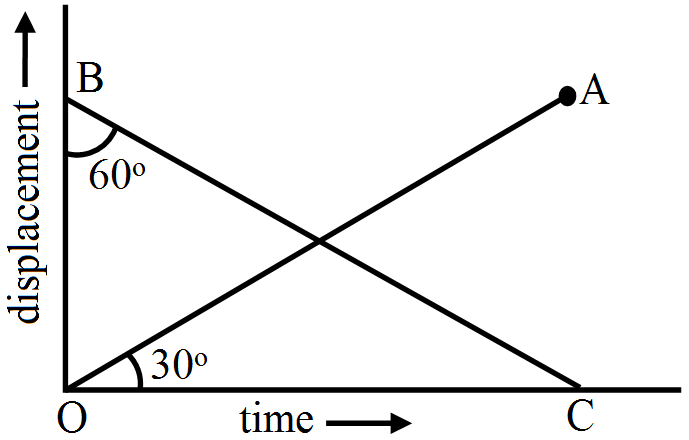
The displacement-time graph of two bodies P and Q are represented by OA and BC respectively. What is the ratio of velocities of P and Q?
$\angle \text{OBC}=60^\circ$ and $\angle \text{AOC}=30^\circ.$

Answer
Velocity of P, v$=\tan30^\circ=\frac{1}{\sqrt{3}}$
Velocity of Q, vQ $=-\tan 30^\circ=-\frac{1}{\sqrt{3}}$
RAtio of velocities of P and Q is 1 : -1
View full question & answer
Question 313 Marks
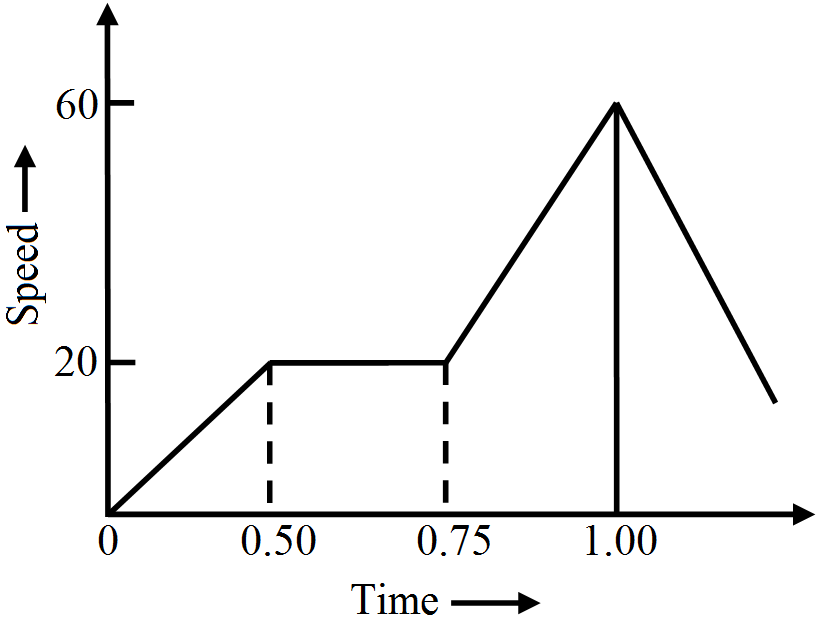
A train moves from one station to another in two hours time. Its speed during the motion is shown in the graph. Determine the maximum acceleration during the journey. Also calculate the distance covered during the time interval from 0.75h to 1 hour.

Answer
We know that the slope of the velocity-time graph gives acceleration.
Change in velocity in this interval (0.75 h to 1 hour) = (60 - 20)km/ h-1 = 40km/ h-1
$\therefore$ Acceleration in this interval
$=\frac{40\text{km/ h}^{-1}}{\frac{1}{4}\text{h}}=160\text{km/ h}^{-2}$
Distance covered during the time interval from 0.75h to 1h = Area under the corresponding v - t graph
$=\frac{1}{1}(20+60)0.25=10\text{km}.$
View full question & answer
Question 323 Marks
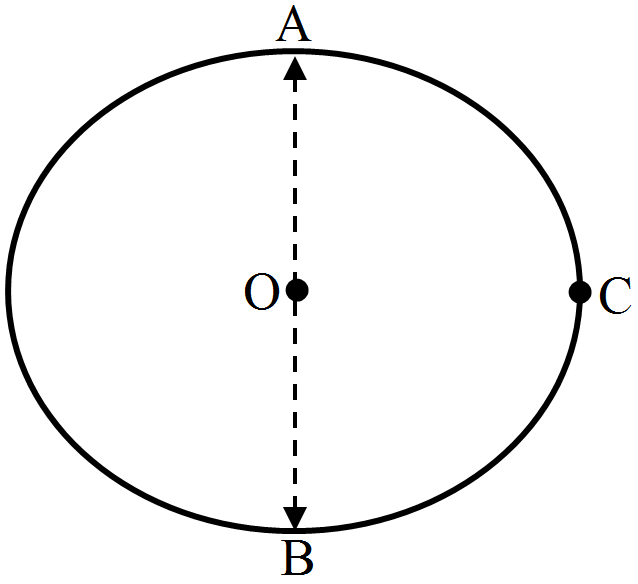
The minute hand of a wall clock is 10cm long. Find its displacement and the distance covered from 12:00 noon to 12:30 p.m.
Answer
Length of minute hand = radius of circle described by minute hand r = 10cm = 0.1m.

From 12:00 noon to 12:30 p.m., the tip of minute hand covers a net displacement equal to the diameter of circle. Hence,
Displacement AOB = 2 × r
= 2 × 0.1m = 0.2m
During the same time total distance covered by tip of minute hand = semicircular path ACB $=\pi=3.14\times0.1=0.31\text{m}$
View full question & answer
Question 333 Marks
A player throws a ball upwards with an initial speed of 29.4m s–1.
To what height does the ball rise and after how long does the ball return to the player’s hands? (Take g = 9.8ms–2 and neglect air resistance).
Answer
Initial velocity of the ball, u = 29.4m/s
Final velocity of the ball, v = 0 (At maximum height, the velocity of the ball becomes zero)
Acceleration, a = –g = –9.8m/s2
From third equation of motion, height (s) can be calculated as:
v– u2 = 2gs
s = (v2 – u2)/2g
= ((0)2 – (29.4)2)/2 × (-9.8) = 3s
Time of ascent = Time of descent
Hence, the total time taken by the ball to return to the player’s hands = 3 + 3 = 6s.
View full question & answer
Question 343 Marks
A monkey climbs up a slippery pole for 3 seconds and subsequently slips for 3 seconds. Its velocity at time t is given by v(t) = 2t(3 - t); 0 < t < 3 and v(t) = -(t - 3)(6 - t) for 3 < t < 6s in m/s. It repeats this cycle till it reaches the height of 20m.
How many cycles (counting fractions) are required to reach the top?
Answer
Given velocity
$\text{v}(\text{t})=2\text{t}(3-\text{t})=6\text{t}-2\text{t}^2$
Distance covered in 0 to 3s = 9m
Distance covered in 3 to 6s
$=\int_3^6(18-9\text{t}+\text{t}^2)\text{dt}=\Big(18\text{t}-\frac{9\text{t}^2}{2}+\frac{\text{t}^3}{3}\Big)^6$
$=18\times6-\frac{9}{2}\times6^2+\frac{6^3}{3}-\Big(18\times3-\frac{9\times3^2}{2}+\frac{3^3}{3}\Big)$
$=108-9\times18+\frac{6^3}{3}-18\times3+\frac{9}{2}\times9-\frac{27}{3}$
$=-4.5\text{m}$
$\therefore$ Total distance travelled in one cycle
$=\text{s}_1+\text{s}_2=9-4.5=4.5\text{m}$
Number of cycles to be covered in total distance $=\frac{20}{4.5}\approx4.44\approx5$
View full question & answer
Question 353 Marks
An electron travelling with a speed of 5 × 10³ms-1 passes through an electric field with an acceleration of 1012ms-2. How long will it take for the electron to double its speed?
Answer
$\text{v}(0)=5\times10^3\text{ms}^{-1},\text{a}=10^{12}\text{ms}^{-2}$
$\text{v(t)}=2\times\text{v}(0)=2\times5\times10^3\text{ms}^{-1},\text{t}=?$
Now, $\text{v(t)}=\text{v}(0)+\text{at}$
$\therefore 2\times5\times10^3=5\times10^3+10^{12}\times\text{t}$
$\Rightarrow 10^{12}\text{t}=5\times10^3$
$\Rightarrow\text{t}=\frac{5\times10^3}{10^{12}}$
$\text{t}=5\times10^{-9}\text{s}$
View full question & answer
Question 363 Marks
Two parallel rail tracks run north-south. Train A moves due north with a speed of 54km/ h-1 and train B moves due south with a speed of 90km/ h-1. What is the relative velocity of B with respect to A in m s-1?
Answer
VA = 54km/ hr
VB = 90km/ hr
 let due north direction be taken as + ve direction
VBA = VB - VA
= -90 - 54
= -144km/ hr
= -40m/s due to south.
View full question & answer
Question 373 Marks
Two trains A and B of length 400m each are moving on two parallel tracks with a uniform speed of 72km/ h-1 in the same direction, with A ahead of B. The driver of B desires to overtake A and accelerates by 1ms-2. If, after 50s, the guard of B just brushes past driver of A, calculate the original distance between the two trains.
Answer
Originally, both the trains have the same velocities.
So, the relative velocity of B w.r.t. A is zero.
Now, for train B,
$\text{v}(0)=0,\text{a}=1\text{ms}^{-2}$
$\text{t}=50\text{s},\text{x(t)}-\text{x}(0)=?$
$\text{x(t)}=\text{v}(0)+\text{v}(0)\text{t}+\frac{1}{2}\text{at}^2$
$\text{x(t)}-\text{x}(0)=(0)\text{t}+\frac{1}{2}\text{at}^2$
$=0\times50+\frac{1}{2}\times1\times50\times50$
$=1250\text{m}$
View full question & answer
Question 383 Marks
Differentiate between average and instantaneous velocity.
Answer
Average velocity: Average velocity is the displacement divided by the time interval in which the displacement occurs.
$\vec{\text{v}}_{\text{av}}=\frac{\Delta\vec{\text{x}}}{\Delta\text{t}}$
Instantaneous velocity: Instantaneous velocity is defined as the limit of the average velocity as the time interval $\Delta\text{t}$ becomes infinitesimally small.
$\vec{\text{v}}=\lim\limits_{\Delta\text{t} \rightarrow 0}\frac{\Delta\vec{\text{x}}}{\Delta\text{t}}=\frac{\text{dx}}{\text{dt}}$
View full question & answer
Question 393 Marks
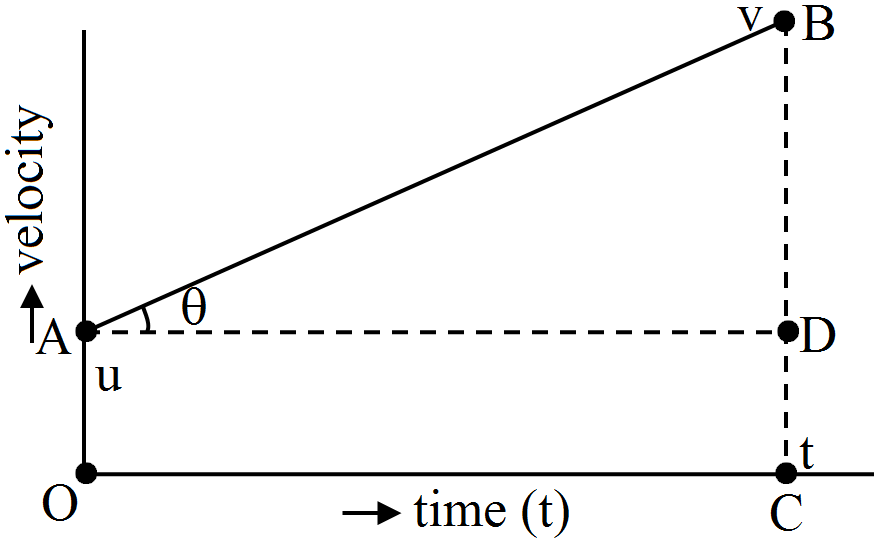
Establish the kinematic equation v2 - u2 = 2as from velocity-time graph for a uniformly accelerated motion.
Answer

The velocity-time graph for uniformly accelerated motion has been shown in Fig. with initial velocity at t = 0 as u and final velocity at time t as v. Then area under the v-t graph gives the value of total displacement in the given time.
Hence, displacement of moving particle in time t = area of trapezium $\Delta \text{ABC}$
$\text{s}=\frac{1}{2}(\text{OA}+\text{CB})\times\text{OC}$
$=\frac{1}{2}(\text{u}+\text{v})\times\text{t}$
However, from definition of acceleratiory we know that
$\text{a}=\frac{\text{v}-\text{u}}{\text{t}}$ or $\text{t}=\frac{\text{v}-\text{u}}{\text{a}}$
Substituting this value of time t in equation (i), we get
Displacemen $\text{s}=\frac{1}{2}(\text{u}+\text{v})\times\frac{\text{v}-\text{u}}{\text{a}}$
$\frac{(\text{v}^2-\text{u}^2)}{2\text{a}}$
$\Rightarrow 2\text{as}=\text{v}^2-\text{u}^2$
$\text{v}^2=\text{u}^2+2\text{as}$
View full question & answer
Question 403 Marks
A motor boat covers the distance between two spots on the river in time of 8hrs. and 12hrs. downstream and upstream respectively. What is the time required for the boat to cover this distance in still water?
Answer
Time taken in downstream,
$8=\frac{\text{S}}{\text{v}_\text{r}+\text{v}_\text{b}}$
Time taken for upstream,
$12=\frac{\text{S}}{\text{v}_\text{b}-\text{v}_\text{r}}$
We have, $\text{v}_\text{r}+\text{v}_\text{b}=\frac{\text{S}}{8},\text{v}_\text{b}-\text{v}_\text{r}=\frac{8}{12}$
Solving, $\text{v}_\text{b}=\frac{\text{S}}{2}\Big(\frac{1}{8}+\frac{1}{12}\Big)$
$=\frac{\text{S}}{2}\Big(\frac{20}{96}\Big)=\frac{10\text{S}}{96}$
$\text{v}_\text{r}=\frac{10\text{S}}{96}-\frac{\text{S}}{12}$
$=\frac{2\text{S}}{96}$
In still water, only the velocity of boat is to be considered.
$\therefore$ Time taken in still water for covering length S is,
$\text{t}=\frac{\text{S}}{\text{v}_\text{b}}=\frac{\text{S}\times96}{10\text{S}}$
$=9.6\text{hrs.}$
View full question & answer
Question 413 Marks
A 100m sprinter uniformly increases his speed from rest at the rate of 1ms-2 up to $\frac{3}{4}\text{th}$ of the total run and then covers the balance $\frac{1}{4}\text{th}$ run with uniform speed. How much time does he take to complete the race?
Answer
Here total distance covered s = 100m, u = 0
For first $\frac{3}{4}\text{th}$ of the run i.e., $\text{s}_1=\frac{3}{4}\text{s}=\frac{3}{4}\times100\text{m}=75\text{m},$ a = +1 ms-2. If time for this part of run be t1, then using the equation s $=\text{ut}+\frac{1}{2}\text{at}^2,$ we have
$75=0+\frac{1}{2}\times1\times\text{t}^2_1$
$\text{t}^2_1=75\times2=150$
$\Rightarrow\text{t}_1=\sqrt{150}=12.25\text{s}$
and final velocity v = u + at1
= 0 + 1 × 12.25 = 12.25ms-1.
For remaining run i.e., s2 = s - s1 = 100 - 75 = 25m, uniform velocity v = 12.25ms-1
$\therefore$ Time for this run $\text{t}_2=\frac{\text{s}_2}{\text{v}}=\frac{25}{12.25}=2.04\text{s}$
$\therefore $ Total time taken by the sprinter to complere the race
t = t1 + t2
= 12.25s + 2.04s = 14.29s
View full question & answer
Question 423 Marks
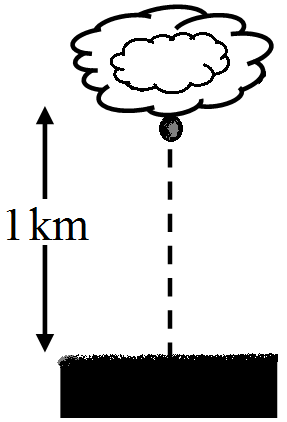
It is a common observation that rain clouds can be at about a kilometre altitude above the ground.
If a rain drop falls from such a height freely under gravity, what will be its speed? Also calculate in km/h. (g = 10m/s2)
Answer
Key concept: This problem can be solved by kinematic equations of motion and Newton’s second law that $\text{F}_\text{ext}=\frac{\text{dp}}{\text{dt}}$ will be used, where dp is change in momentum over time dt.

According to the problem (h) = 1km = 1000m and we know that the initial velocity of the ball is zero. And displacement covered by rain drop in downward direction, so we will taking h as negative. (We are neglecting the air resistance.)

Velocity attaind by the rain drop in falling through a height h is

$\text{v}^2=\text{u}^2-2\text{g}(-\text{h})$

As u = 0

So, $\text{v}=\sqrt{2\text{gh}}=\sqrt{2\times10\times1000}=100\sqrt{2}\text{m/s}$

$=100\sqrt{2}\times\frac{60\times60}{1000}\text{km/h}=360\sqrt{2}\text{km/h}=510\text{km/h}$

View full question & answer
Question 433 Marks
A police van moving on a highway with a speed of 30km h–1 fires a bullet at a thief’s car speeding away in the same direction with a speed of 192km h–1. If the muzzle speed of the bullet is 150m s–1, with what speed does the bullet hit the thief’s car?
(Note: Obtain that speed which is relevant for damaging the thief’s car).
Answer
Speed of the police van, Vp = 30km/ h = 8.33m/s
Muzzle speed of the bullet, Vb = 150m/s
Speed of the thief’s car, V= 192km/ h = 53.33m/s
Since the bullet is fired from a moving van, its resultant speed can be obtained as:
= 150 + 8.33 = 158.33m/s
Since both the vehicles are moving in the same direction, the velocity with which the bullet hits the thief’s car can be obtained as:
Vbt = Vb – Vt
= 158.33 – 53.33 = 105m/s
View full question & answer
Question 443 Marks
The displacement (in metre) of a particle moving along x-axis is given by x = 18t + 5r2. Calculate:
  1. The instantaneous velocity at t = 2s.
  2. Average velocity between t = 2s and t = 3s.
  3. Instantaneous acceleration.
Answer
$\text{x}=18\text{t}+5\text{t}^2$

  1. $\text{v}=\frac{\text{dx}}{\text{dt}}=18+10\text{t}$

At $\text{t}=2\text{s, v}=18+10\times2$

$=38\text{ms}^{-1}$

  1. $\text{a}=\frac{\text{dv}}{\text{dt}}=10$ (a constant)

$\therefore \text{v}_{\text{av}}=\frac{\text{v}_\text{i}+\text{v}_\text{f}}{2}$

i.e., $\text{v}_\text{av}=\frac{\text{v}_{\text{t}=2}+\text{v}_{\text{t}=3}}{2}$

$=\frac{38+48}{2}=43\text{ms}^{-1}$

  1. Acceleration = 10ms-2.
View full question & answer
Question 453 Marks
A particle executes the motion described by $\text{x}(\text{t})=\text{x}_0(1-\text{e}^{-\gamma\text{t}});\text{t}\ge0,\text{x}_0>0.$
Where does the particle start and with what velocity?
Answer
$\text{x}(\text{t})=\text{x}_0[1-\text{e}^{-\gamma\text{t}}]\ \ \ ...(\text{i})$
$\text{v}(\text{t})=\frac{\text{dx(t)}}{\text{dt}}=\frac{\text{d}}{\text{dt}}[\text{x}_0(1-\text{e}^{\gamma\text{t}})]=+\text{x}_0\gamma\text{e}^{-\gamma\text{t}}\ \ \ ...(\text{ii})$
$\text{a}(\text{t})=\frac{\text{dv}}{\text{dt}}=\frac{\text{d}[+\text{x}_0\gamma^2\text{e}^{-\gamma^4}]}{2}=-\text{x}_0\gamma^2\text{e}^{-\gamma\text{t}}\ \ \ ..(\text{iii})$
$(\text{i})\text{At, t}=0\ \ \text{x}(0)=\text{x}_0[1-\text{e}^0]=\text{x}_0(1-1)=0$
$\text{v}(0)=\text{x}_0\gamma\text{e}^0=\text{x}_0\gamma$
Hence, the particle start from x = 0 with velocity $\text{v}_0=\text{x}_0\gamma.$
View full question & answer
Question 463 Marks
A bus starts with a constant acceleration 1ms-2. At the same time a car moving with a constant velocity of 5ms-1 overtakes the bus.
  1. How far from the starting point, the bus overtakes the car.
  2. How fast the bus was moving at the time of overtake?
Answer
Initial velocity of bus, u = 0. Let the bus overtakes the car after time t.
$\therefore$ Distance travelled by bus in time t,
$\text{S}_\text{b}=\text{ut}+\frac{1}{2}\text{at}^2$
$=0+\frac{1}{1}\text{t}^2=\frac{\text{t}^2}{2}$ ($\because$ a = 1ms-2)
Distance travelled by car moving with constant velocity (a = 0),
$\text{S}_\text{c}=\text{ut}+\frac{1}{2}\text{at}^2=5\text{t}$ ($\because$ u = 5ms-1 and a = 0)
Since $\text{S}_\text{b}=\text{S}_c$
$\therefore \frac{\text{t}^2}{2}=5\text{t}$
$\text{t}=10\text{s}$
$\therefore$ Distance travelled by bus when it overtakes car,
$\text{S}_\text{b}=\text{ut}+\frac{1}{2}\text{at}^2$
$=0\times10+\frac{1}{2}\times(10)^2\text{s}=50\text{m}.$
Speed of bus, v = u + at
= 0 + 1 × 10
= 10ms-1.
View full question & answer
Question 473 Marks
A body is moving in a straight line along x-axis. Its distance from the origin is given by the equation x = at2 - bt3, where x is in metre and t is in second. Find:
  1. The average speed of the body in the interval t = 0 and t = 2s.
  2. its instantaneous speed at t = 2s.
Answer
The given equation x = at2 - bt3
If t =, x0 = 0
If t = 2s, x2 = 4a - 8b
$\because \Delta \text{x}=\text{x}_2-\text{x}_0$
$=4\text{a}-8\text{b}-0=4\text{a}-8\text{b}$
$\therefore$ Average speed in the given interval of time,
$\text{v}_{\text{av}}=\frac{\Delta \text{x}}{\Delta \text{t}}=\frac{4\text{a}-8\text{b}}{2}$
$=2\text{a}-4\text{b}$
Instantaneous speed
$\text{v}=\frac{\text{dx}}{\text{dt}}=\frac{\text{d}}{\text{dt}}(\text{at}^2-\text{bt}^3)$
$=2\text{at}-3\text{bt}^2$
At t = 2s. v = 4a - 12bm/s
View full question & answer
Question 483 Marks
In a car race, car A takes a time t seconds less than the car B and passes the finishing point with a velocity v more than that of the car B. If the cars start from rest and travel with constant acceleration a1 and a2 respectively, show that $\text{v}=\text{t}\sqrt{\text{a}_1\text{a}_2}.$
Answer
For A: a1, t2 - t and v2 + v be the acceleration, time taken and final velocity.
For B: a2, t2 and v2 be the acceleration, time and final velocity.
But length travelled is same.
$\Rightarrow\text{a}_1(\text{t}_2-\text{t})^2=\text{a}_2\text{t}_2^ 2$
Solve for $\text{t}=\text{t}_2\Big(1-\sqrt{\frac{\text{a}_2}{\text{a}_1}}\Big)$
Using, $\text{v}=\text{u}+\text{at}$
we have, $\text{v}_2+\text{v}=\text{a}_1(\text{t}_2-\text{t})$
and $\text{v}_2=\text{a}_2\text{t}_2$
$\text{v}=\text{a}_1(\text{t}_2-\text{t})-\text{a}_2\text{t}_2$
$=(\text{a}_1-\text{a}_2)\text{t}_3-\text{a}_1\text{t}$
Using value of t in $\text{v}=(\text{a}_1-\text{a}_2)\text{t}_2-\text{a}_1\text{t}$
we have, $\text{v}=\text{t}\sqrt{\text{a}_1\text{a}_2}.$
View full question & answer
Question 493 Marks
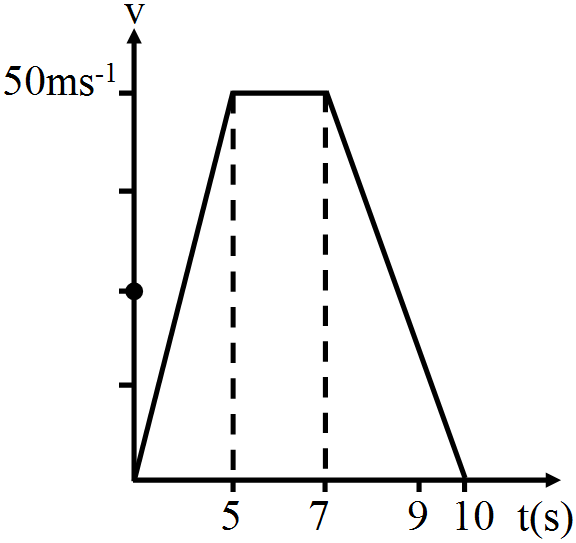
A body starting from rest accelerates uniformly along a straight line at the rate of 10ms-2? for 5 seconds. It moves for 2 seconds with uniform velocity of 50ms-1. Then it retards uniformly and comes to rest in 3s. Draw velocity-time graph of the body and find the total distance travelled by the body.
Answer
a = 10ms-2,
t = 5 sec,
v = 0 + 10 × 5 = 50m s-1
Area below v-t graph gives distance travelled in the straight line.
$\therefore$ Distance $=\frac{1}{2}(50)\times(10+2)$
$=300\text{m}$

View full question & answer
Question 503 Marks
A particle located at x = 0 at time t = 0 starts moving along the positive x direction with a velocity v that varies as $\text{v}=\alpha\sqrt{\text{x}}.$ How do the displacement, velocity and acceleration of the particle vary with time? What is the average velocity of the particle over the first s metres of its path?
Answer
We know that the instantaneous velocity of the particle is given by
$\text{v}=\frac{\text{dx}}{\text{dt}}$
Since $\text{v}=\alpha\sqrt{\text{x}}$
we have $\frac{\text{dx}}{\text{dt}}=\alpha\sqrt{\text{x}}$
$\frac{\text{dx}}{\sqrt{\text{x}}}=\alpha\text{ dt}$
Integrating from t = 0 (x = 0) to t = t (x = x)
we have $\int \limits^\text{x}_0\text{x}^{\frac{-1}{2}}\text{dxs}=\alpha\int\limits^\text{t}_0\text{dt}$
$\therefore \Bigg|\frac{\text{x}^{\frac{1}{2}}}{\frac{1}{2}}\Bigg|^\text{x}_0=\alpha\text{ t}$
$\text{x}=\frac{\alpha^2\text{t}^2}{4}$
The time dependence of the velocity is obtained by differentiating both sides of this relation w.r.t. time t. Thus
$\text{v}=\frac{\text{dx}}{\text{dt}}=\frac{\alpha.2\text{ t}}{4}$
$=\frac{\alpha^2}{2}\text{t}$
The velocity x of the particle is thus increasing in direct proportion to time. Similarly the time dependence of acceleration is obtained by differentiating both sides of this relation w.r.t.'t'. Thus
$\text{a}=\frac{\text{dv}}{\text{dt}}=\frac{\alpha^2}{2}$
The particle is thus moving with a constant acceleration. To find the average velocity over the first s metre, we assume that the time taken to cover this distance is T. Using
$\text{x}=\frac{\alpha^2\text{t}^2}{4}$
we get $\text{s}=\frac{\alpha^2\text{T}^2}{4}$
$\text{T}=\frac{2\sqrt{\text{s}}}{\alpha}$
The average velocity $\text{v}_{\text{av}}\Big(=\frac{\text{s}}{\text{T}}\Big)$ is, therefore
$\text{v}_{\text{av}}=\Big(\frac{\alpha}{2}\sqrt{\text{s}}\Big)$
View full question & answer
3 Marks Question - Physics STD 11 Science Questions - Vidyadip