Question
Establish the relation between electric field and potential gradient.

Answer

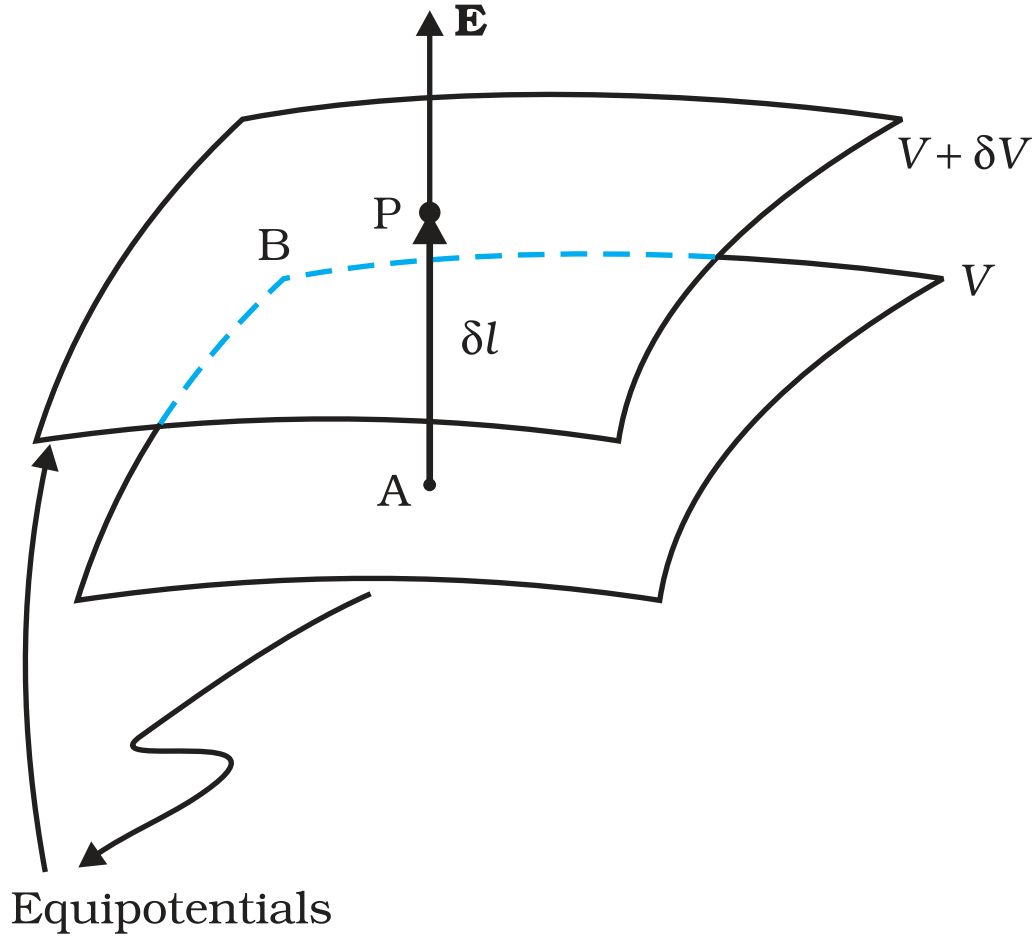
Let us consider two closely spaced equipotential surfaces $ A$ and $B$ as shown in figure.
Let the potential of $A$ be $V_A = V$ and potential of $B$ be $V_B = V - dV$ where $dV$ is decrease in potential in the direction of electric field $\vec{\text{E}}$ normal to $A$ and $B$.
Let dr be the perpendicular distance between the two equipotential surfaces.
When a unit positive charge is moved along this perpendicular from the surface $B$ to surface $A$ against the electric field, the work done in this process is:
$\text{W}_{\text{BA}}=-\vec{\text{E}}(\text{dr})$ This work done equals the potentail difference $V_A - V_B,$
$\therefore\text{W}_{\text{BA}}=\text{V}_{\text{A}}-\text{V}_{\text{B}}=\text{V}-(\text{V}-\text{dV})=\text{dV}$
$\therefore-\vec{\text{E}}=\text{dV}$ Or, $\vec{\text{E}}=-\frac{\text{dV}}{\text{dr}} = $ negative of potential gradlant.

Need a full question paper?

Generate a complete, print-ready paper with questions like this in minutes — across 16+ boards, with answer keys.
Start Generating Free

Similar questions

  1. Estimate the speed with which electrons emitted from a heated emitter of an evacuated tube impinge on the collector maintained at a potential difference of $500 V$ with respect to the emitter. Ignore the small initial speeds of the electrons. The specific charge of the electron, i.e., its $e/m$ is given to be $1.76 \times 10^{11} C \ kg^{–1}.$
  2. Use the same formula you employ in $(a)$ to obtain electron speed for an collector potential of $10 MV.$ Do you see what is wrong? In what way is the formula to be modified?
A metal ball of mass $1\ kg $is heated by means of a $20W$ heater in a room at $20^\circ C$. The temperature of the ball becomes steady at $50^\circ C.$
A small piece of cesium metal $(\phi = 1 ·9 eV)$ is kept at a distance of $20\ cm$ from a large metal plate having a charge density of $1.0 \times 10^{-9}C/m^2$ on the surface facing the cesium piece. A monochromatic light of wavelength $400\ nm$ is incident on the cesium piece. Find the minimum and the maximum kinetic energy of the photoelectrons reaching the large metal plate. Neglect any change in electric field due to the small piece of cesium present.
Find the equation of the equipotentials for an infinite cylinder of radius $r_0,$ carrying charge of linear density $\lambda$.
The electric field at a point associated with a light wave is $\text{E}=\big(100\frac{\text{v}}{\text{m}}\big)\sin[(3.0\times10^{15}\text{s}^{-1})\text{t]sin[(6.0}\times10^{15}\text{s}^{-1})\text{t}].$ If this light falls on a metal surface having a work function of $2.0eV,$ what will be the maximum kinetic energy of the photoelectrons?
Answer the following questions:
  1. Define electric flux. Write its $SI $ unit.
  2. Using Gauss’s law, prove that the electric field at a point due to a uniformly charged infinite plane sheet is independent of the distance from it.
  3. How is the field directed if:
  • The sheet is positively charged.
  • Negatively charged?
Is the formula you employ in $(a)$ valid for calculating radius of the path of a $20 MeV$ electron beam? If not, in what way is it modified?
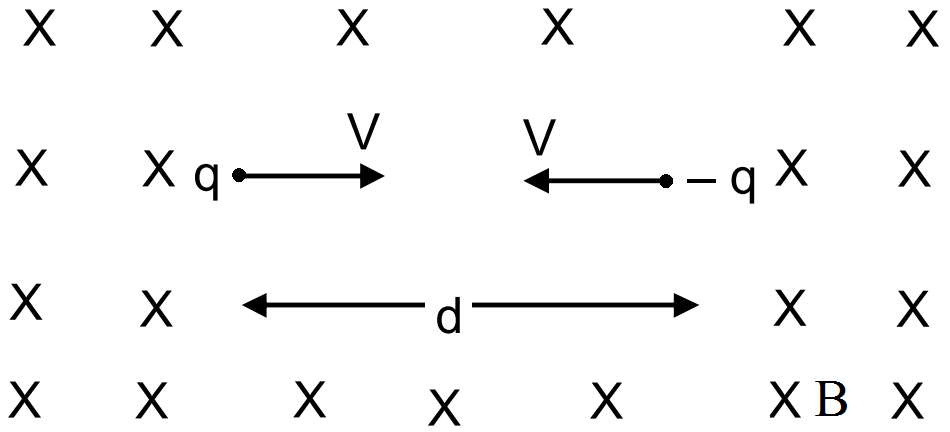
Two particles, each with mass $m$ are placed at a separation $d$ in a uniform magnetic field $B,$ as shown in the figure. They have opposite charges of equal magnitude $q$. At time $t = 0,$ the particles are projected towards each other, each with a speed $v$. Suppose the Coulomb force between the charges is switched off.
  1. Find the maximum value $v_m$ of the projection speed, so that the two particles do not collide.
  2. What would be the minimum and maximum separation between the particles if $\text{v}=\text{v}_{\text{m}}\sqrt{2}?$
  3. At what instant will a collision occur between the particles if $v = 2v_m$ ?
  4. Suppose $v = 2v_m$ and the collision between the particles is completely inelastic. Describe the motion after the collision.
A reference frame attached to the earth:
  1. Is an inertial frame by definition.
  2. Cannot be an inertial frame because the earth is revolving around the sun.
  3. Is an inertial frame because Newton's laws are applicable in this frame.
  4. Cannot be an inertial frame because the earth is rotating about its axis.
In semiconductors, thermal collisions are responsible for taking a valence electron to the conduction band. Why does the number of conduction electrons not go on increasing with time as thermal collisions conμnuously take place?