Question
Establish the relation between mean value and peak value of AC.

Answer

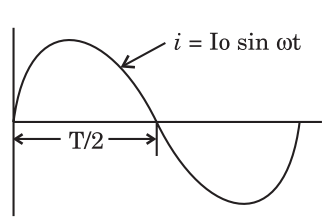
Let the instantenous value of alternating current be
$i=I_{0} sin \omega t$
$I_{0}=$ peak value of current,
$t=$ time at any instant.
Also, $\omega=\frac{2\pi}{T}$, $T=$ Time period.
$i=\frac{dQ}{dt}\Rightarrow dQ=idt$
$\int_{0}^{Q}dQ=\int_{0}^{T/2}idt$
$Q|_{0}^{Q}=\int_{0}^{T/2}I_{0}sin \omega tdt$
$Q=\frac{-I_{0}}{\omega}|cos\frac{2\pi}{T}.t|_{0}^{T/2}$
$Q=-\frac{I_{0}}{\omega}|cos\frac{2\pi}{T}\times\frac{T}{2}-cos\frac{2\pi}{T}.0|$
$Q=-\frac{I_{0}}{\omega}(cos \pi-cos 0) = -\frac{I_{0}}{\omega}\times-2 = \frac{2I_{0}}{\omega}$
Also, $Q=I_{m}\times\frac{T}{2}$
from (1) and (2)
$I_{m}\times\frac{T}{2}=\frac{2I_{0}}{2\pi} \times T$
$I_{m}\times\frac{1}{2}=\frac{2I_{0}}{2\pi} \times T$
Image
$I_{m}=\frac{2I_{0}}{\pi}= 0.637 I_{0}$
Mean value of current, $I_{m}=0.637$ times peak value of current.

Need a full question paper?

Generate a complete, print-ready paper with questions like this in minutes — across 16+ boards, with answer keys.
Start Generating Free

Similar questions

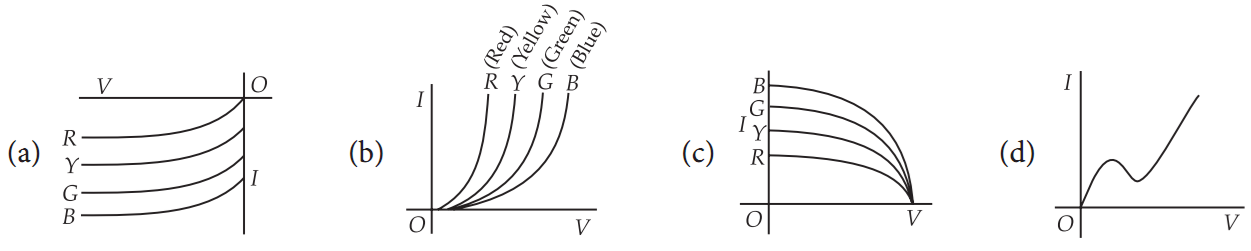
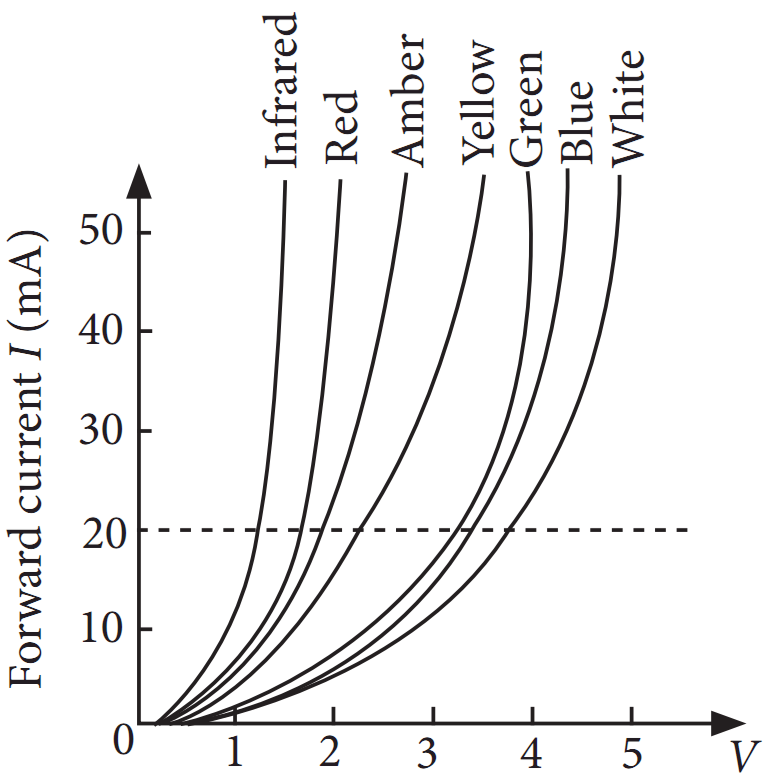
Light emitting diode is a photoelectric device which converts electrical energy into light energy. It is a heavily doped $p-n$ junction diode which under forward biased emits spontaneous radiation. The general shape of the $I-V$ characteristics of an $\text{LED}$ is similar to that of a normal $p-n$ junction diode, as shown. The barrier potentials are much higher and slightly different for each colour.
  1. The $I-V$ characteristic of an $\text{LED}$ is:
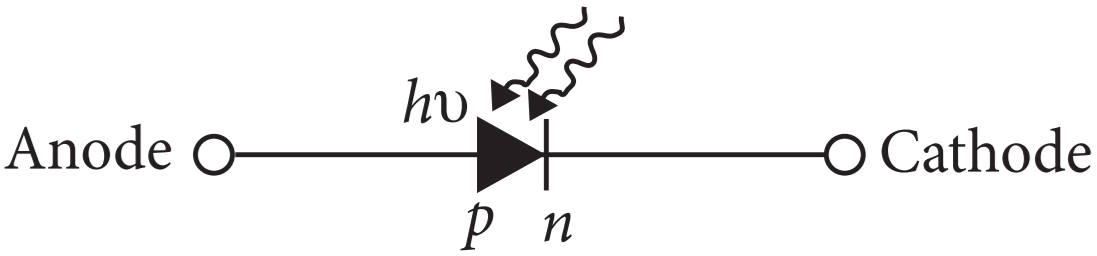
  1. The schematic symbol of light emitting diode is $\text{(LED)}.$
  1. An $\text{LED}$ is constructed from a p-n junction based on a certain $Ga-$ As $-P$ semiconducting material whose energy gap is $1.9eV$. Identify the colour of the emitted light.
  1. Blue.
  2. Red.
  3. Violet.
  4. Green.
  1. Which one of the following statement is not correct in the case of light emitting diodes?
  1. It is a heavily doped $p-n$ junction.
  2. It emits light only when it is forward biased.
  3. It emits light only when it is reverse biased.
  4. The energy of the tight emitted is less than the energy gap of the semiconductor used.
  1. The energy of radiation emitted by $\text{LED}$ is:
  1. Greater than the band gap of the semiconductor used.
  2. Always less than the band gap of the semiconductor used.
  3. Always equal to the band gap of the semiconductor used.
  4. Equal to or less than the band gap of the semiconductor used.

The field of a hollow wire with constant current is homageneous.
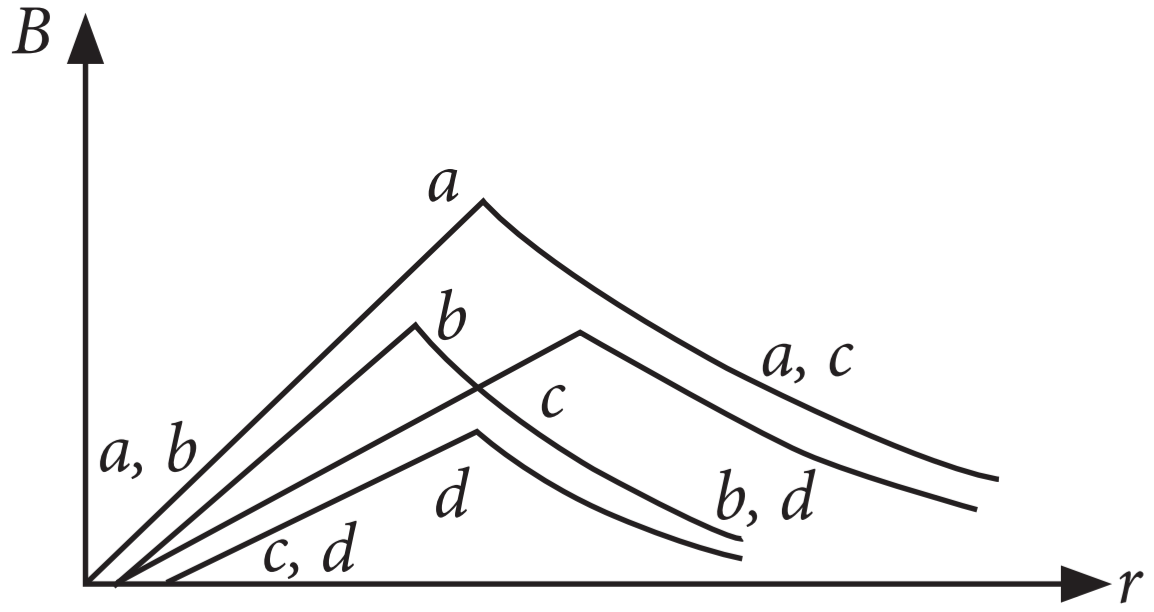
Curves in the graph shown give, as functions of radius distance r, the magnitude B of the magnetic field inside and outside four long wires a, b, c and d, carrying currents that are uniformly distributed across the cross sections of the wires. Overlapping portions of the plots are indicated by double labels.
  1. Which wire has the greatest magnitude of the magnetic field on the surface?
  1. a
  2. b
  3. c
  4. d
  1. The current density in a wire a is:
  1. Greater than in wire c.
  2. Less than in wire c.
  3. Equal to that in wire c.
  4. Not comparable to that of in wire c due to lack of information.
  1. Which wire has the greatest radius?
  1. a
  2. b
  3. c
  4. d
  1. A direct current I flows along the length of an infinitely long straight thin walled pipe, then the magnetic field is:
  1. Uniform throughout the pipe but not zero.
  2. Zero only along the axis of the pipe.
  3. Zero at any point inside the pipe.
  4. Maximum at the centre and minimum at the edges.
  1. In a coaxial, straight cable, the central conductor and the outer conductor carry equal currents in opposite direction. The magnetic field is zero.
  1. Outside the cable.
  2. Inside the inner conductor.
  3. Inside the outer conductor.
  4. In between the two conductor.
A container contains water upto a height of 20cm and there is a point source at the centre of the bottom of the container. A rubber ring of radius r floats centrally on the water. The ceiling of the room is 2.0m above the water surface.
  1. Find the radius of the shadow of the ring formed on the ceiling if r = 15cm.
  2. Find the maximum value of r for which the shadow of the ring is formed on the ceiling. Refractive index of water $\frac{4}{3}.$
Out of the two magnetic materials, 'A' has relative permeability slightly greater than unity while 'B' has less than unity. Identify the nature of the materials 'A' and 'B'. Will their susceptibilities be positive or negative?
A silver ball of radius $4.8\ cm$ is suspended by a thread in a vacuum chamber. Ultraviolet light of wavelength $200$ run is incident on the ball for some time during which a total light energy of $1.0 \times 10^{-7}J$ falls on the surface. Assuming that on the average one photon out of every ten thousand is able to eject a photoelectron, find the electric potential et the surface of the bell assuming zero potential at infinity. What is the potential at the centre of the bell?
When the electron orbiting in hydrogen atom in its ground state moves to the third excited state, show how the de Broglie wavelength associated with it would be affected.
A photodiode is an optoelectronic device in which current carriers are generated by photons through photo $-$ excitation i.e., photo conduction by light. It is a $p-n$ junction fabricated from a photosensitive semiconductor and provided with a transparent window so as allow light to fall on its function. A photodiode can turn its current $ON$ and $\text{OFF}$ in nanoseconds. So, it can be used as a fastest photo $-$ detector.
  1. A $p-n$ photodiode is fabricated from a semiconductor with a band gap of $2.5\ eV$. It can detect a signal of wavelength:
  1. $4000\ nm.$
  2. $6000\ nm.$
  3. $4000Â.$
  4. $6000Â.$
  1. Three photo diodes $D_1 ,D_2$ and $D_3$ are made of semiconductors having band gap of $2.5\ eV, 2\ eV,$ and $3 \ eV ,$ respectively. Which one will be able to detect light of wavelength $6000Â$?
  1. $D_1$
  2. $D_2$
  3. $D_3$
  4. $D_1$ and $D_2$ both.
  1. Photodiode is a device:
  1. Which is always operated in reverse bias.
  2. Which of always operated in forward bias.
  3. In which photo current is independent of intensity of incident radiation.
  4. Which may be operated in forward or reverse bias.
  1. To detect light of wavelength $500\ nm,$ the photodiode must be fabricated from a semiconductor of minimum bandwidth of:
  1. $1.24\ eV$
  2. $0.62\ eV$
  3. $2.48\ eV$
  4. $3.2eV$
  1. Photodiode can be used as a photodetector to detect :
  1. Optical signals.
  2. Electrical signals.
  3. Both $(a)$ and $(b)$.
  4. None of these.
In a $TV$ picture tube electrons are ejected from the cathode with negligible speed and reach a velocity of $5 \times 10^6m/s$ in travelling one centimeter. Assuming straight line motion, find the constant force exerted on the electron. The mass of the electron is $9.1 \times 10^{-31}kg.$
Wavefront is a locus of points which vibratic in same phase. A ray of light is perpendicular to the wavefront. According to Huygens principle, each point of the wavefront is the source of a secondary disturbance and the wavelets connecting from these points spread out in all directions with the speed of wave.
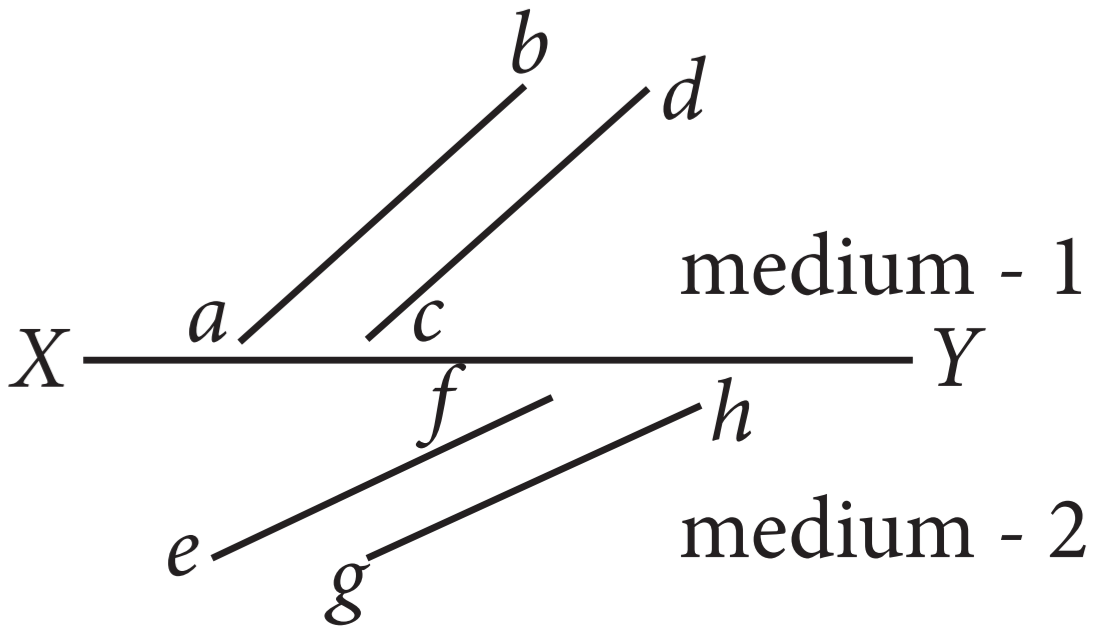
The figure shows a surface XY separating two transparent media, medium-I and medium-2. The lines ab and cd represent wavefronts of a light wave travelling in medium- 1 and incident on XY. The lines ef and gh represent wavefronts of the light wave in medium-2 after refraction.
  1. Light travels as a:
  1. Parallel beam in each medium.
  2. Convergent beam in each medium.
  3. Divergent beam in each medium.
  4. Divergent beam in one medium and convergent beam in the other medium.
  1. The phases of the light wave at c, d, e and f are $\phi_\text{c},\phi_\text{d},\phi_\text{e}$ and $\phi_\text{f}$ respectively. It is given that $\phi_\text{c}\not=\phi_\text{f}$
  1. $\phi_\text{c}$ cannot be equal $\phi_\text{d}$
  2. $\phi_\text{d}$ cannot be equal $\phi_\text{e}$
  3. $(\phi_\text{d}-\phi_\text{f})$ is equal to $(\phi_\text{c}-\phi_\text{e})$
  4. $(\phi_\text{d}-\phi_\text{c})$ is not equal to $(\phi_\text{f}-\phi_\text{e})$
  1. Wavefront is the locus of all points, where the particles of the medium vibrate with the same.
  1. Phase
  2. Amplitude
  3. Frequency
  4. Period
  1. A point source that emits waves uniformly in all directions, produces wavefronts that are:
  1. Spherical
  2. Elliptical
  3. Cylindrical
  4. Planar
  1. What are the types of wavefronts?
  1. Spherical
  2. Cylindrical
  3. Plane
  4. All of these.
The saturation current from a thoriated$-$tungsten cathode at $2000K$ is $100mA.$ What will be the saturation current for a pure$-$tungsten cathode of the same surface area operating at the same temperature? The constant $A$ in the Richardson$-$Dushman equation is $60 \times 10^4Am^{-2}K^{-2}$ for pure tungsten and $3.0 \times 10^4Am^{-2}k^{-2}$ for thoriated tungsten. The work function of pure tungsten is $4.5eV$ and that of thoriated tungsten is $2.6eV.$