Question
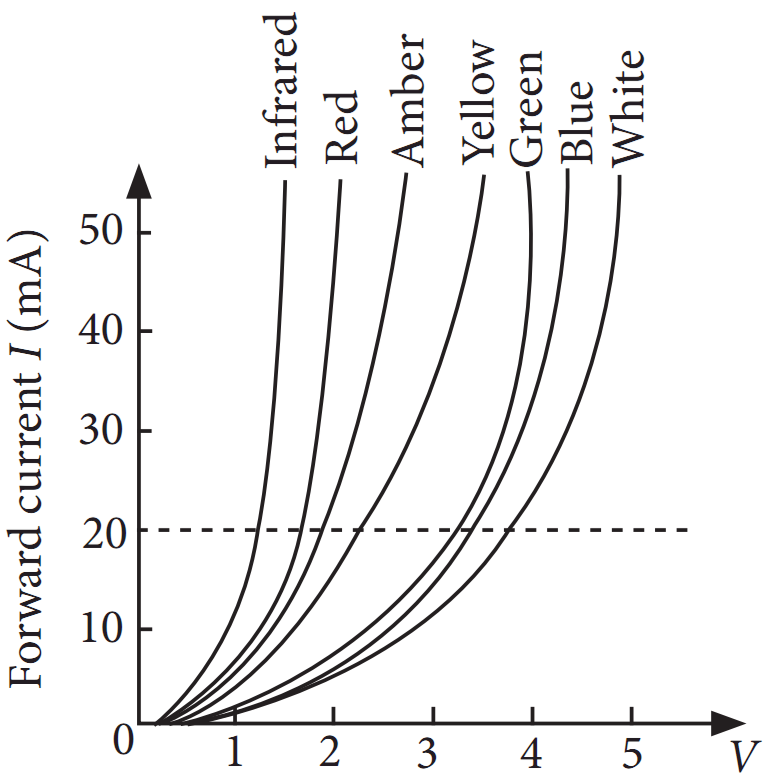
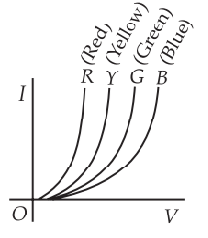
Light emitting diode is a photoelectric device which converts electrical energy into light energy. It is a heavily doped $p-n$ junction diode which under forward biased emits spontaneous radiation. The general shape of the $I-V$ characteristics of an $\text{LED}$ is similar to that of a normal $p-n$ junction diode, as shown. The barrier potentials are much higher and slightly different for each colour.
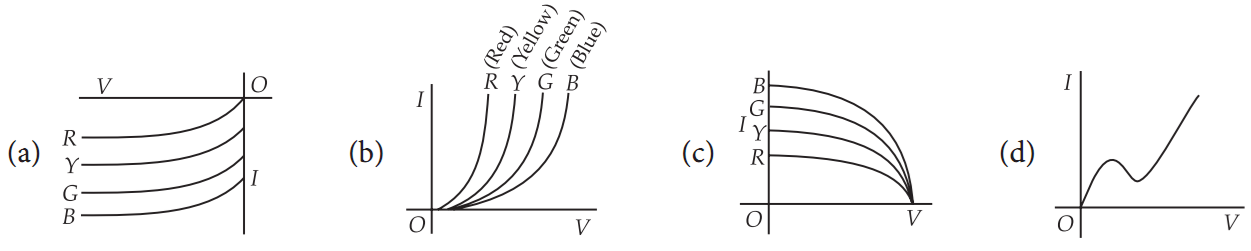
  1. The $I-V$ characteristic of an $\text{LED}$ is:
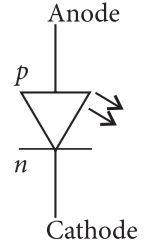
  1. The schematic symbol of light emitting diode is $\text{(LED)}.$
  1. An $\text{LED}$ is constructed from a p-n junction based on a certain $Ga-$ As $-P$ semiconducting material whose energy gap is $1.9eV$. Identify the colour of the emitted light.
  1. Blue.
  2. Red.
  3. Violet.
  4. Green.
  1. Which one of the following statement is not correct in the case of light emitting diodes?
  1. It is a heavily doped $p-n$ junction.
  2. It emits light only when it is forward biased.
  3. It emits light only when it is reverse biased.
  4. The energy of the tight emitted is less than the energy gap of the semiconductor used.
  1. The energy of radiation emitted by $\text{LED}$ is:
  1. Greater than the band gap of the semiconductor used.
  2. Always less than the band gap of the semiconductor used.
  3. Always equal to the band gap of the semiconductor used.
  4. Equal to or less than the band gap of the semiconductor used.

Answer

  1. $(b)$

The $I-V$ characteristics of an $\text{LED}$ is similar to that of a $Si$ junction diode.
But the threshold voltages are much higher and slightly different for each colour.
  1. $(b)$
  1. $(b)$ Red.
As $\text{E}_\text{g}=\frac{\text{hc}}{\lambda}$
$\therefore\lambda=\frac{\text{hc}}{\text{E}_\text{g}}$
Here $, E_{g }= 1.9ev, hc = 1240eVnm$
$\therefore\lambda=\frac{1240\text{eVnm}}{1.9\text{eV}}=652.6\text{ nm}$
Hence, the emitted light is of red colour.
  1. $(c)$ It emits light only when it is reverse biased.
A light emitting diode is a heavily doped $p-n$ junction diode which emits light only when it is forward biased.
  1. $(d)$ Equal to or less than the band gap of the semiconductor used.
Need a full question paper?

Generate a complete, print-ready paper with questions like this in minutes — across 16+ boards, with answer keys.

Start Generating Free

Similar questions

Draw the graph of deviation angle $(\delta)$ versus incidence angle $(i)$ and derive the formula for refractive index $n_{21}=\frac{\sin \left(\frac{A+D_m}{2}\right)}{\sin \left(\frac{A}{2}\right)}$ for the material of prism.
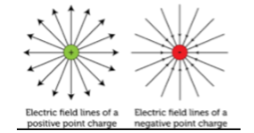
A charge is a property associated with the matter due to which it experiences and produces an electric and magnetic field. Charges are scalar in nature and they add up like real numbers. Also, the total charge of an isolated system is always conserved. When the objects rub against each other charges acquired by them must be equal and opposite.
Image
(i) The cause of charging is:
(a) the actual transfer of atoms
(b) the actual transfer of protons
(c) the actual transfer of electrons
(d) the actual transfer of neutrons

(ii) Pick the correct statement.
i. The glass rod gives protons to silk when they are rubbed against each other.
ii. The glass rod gives electrons to silk when they are rubbed against each other.
iii. The glass rod gains protons from silk when they are rubbed against each other.
iv. The glass rod gains electrons when they are rubbed against each other.
(a) Option (i) (b) Option (iv) (c) Option (iii) (d) Option (ii)

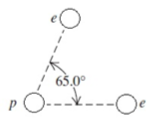
(iii) If two electrons are each $1.5 \times 10^{-10} m$ from a proton, as shown in Figure, magnitude of the net electric force they will exert on the proton is
Image

(a) $1.97 \times 10^{-8} N$
(b) $3.83 \times 10^{-8} N$
(c) $4.63 \times 10^{-8} N$
(d) $2.73 \times 10^{-8} N$

(iv) A charge is a property associated with the matter due to which it produces and experiences:
(a) electric effects only
(b) magnetic effects only
(c) both electric and magnetic effects
(d) non magnetic effects only

OR

The cause of quantization of electric charges is:
(a) transfer of an integral number of electrons
(b) transfer of an integral number of neutrons
(c) transfer of an integral number of protons
(d) transfer of an integral number of Atom
Draw a block diagram of a generalized communication system. Write the functions of each of the following:
(a) Transmitter, (b) Channel, (c) Receiver.
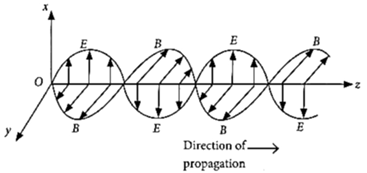
A stationary charge produces only an electrostatic field while a charge in uniform motion produces a magnetic field, that does not change with time. An oscillating charge is an example of accelerating charge. It produces an oscillating magnetic field, which in turn produces an oscillating electric fields and so on. The oscillating electric and magnetic fields regenerate each other as a wave which propagates through space.
Image
$(i).$ Magnetic field in a plane electromagnetic wave is given by $\vec{B}= B _0 \sin ( kx +\omega t ) \hat{j} T$Expression for corresponding electric field will be (Where c is speed of light.)
$(a) \ \vec{E}= B _0 c \sin ( kx +\omega t ) \hat{k} V / m$
$(b) \ \vec{E}=- B _0 c \sin ( kx -\omega t ) \hat{k} V / m$
$(c) \ \vec{E}=- B _0 c \sin ( kx +\omega t ) \hat{k} V / m$
$(d) \ \vec{E}=\frac{B_0}{c} \sin ( kx +\omega t ) \hat{k} V / m$
$(ii)$ The electric field component of a monochromatic radiation is given by $\vec{E}=2 E _0 \hat{i} \cos kz \cos \omega t$. Its magnetic field $\vec{B}$ is then given by
$(a) \ -\frac{2 E_0}{c} \hat{j} \sin kz \sin \omega t$
$(b) \ \frac{2 E_0}{c} \hat{j} \sin kz \sin \omega t$
$(c) \ \frac{2 E_0}{c} \hat{j} \sin kz \cos \omega t$
$(d) \ \frac{2 E_0}{c} \hat{j} \cos kz \cos \omega t$
$(iii)$ A plane em wave of frequency $25 MHz$ travels in a free space along $x -$direction. At a particular point in space and time, $E =(6.3 \hat{j}) V / m$. What is magnetic field at that time?
$(a) \ 0.089 \mu T$
$(b) \ 0.124 \mu T$
$(c) \ 0.021 \mu T$
$(d) \ 0.095 \mu T$
OR
A plane electromagnetic wave travels in free space along $x-$axis. At a particular point in space, the electric field along $y-$axis is $9.3 V m ^{-1}$. The magnetic induction $(B)$ along $z -$axis is
$(a) \ 3.1 \times 10^{-8} T$
$(b) \ 3 \times 10^{-5} T$
$(c) \ 3 \times 10^{-6} T$
$(d) \ 9.3 \times 10^{-6} T$
$(iv)$ A plane electromagnetic wave travelling along the $x-$direction has a wavelength of $3 \ mm$ . The variation in the electric field occurs in the $y-$direction with an amptitude $66 V m ^{-1}$. The equations for the electric and magnetic fields as a function of $x$ and $t$ are respectively
$ \text { a) } E_y =11 \cos 2 \pi \times 10^{11}\left(t-\frac{x}{c}\right), \text { b) } E_y =66 \cos 2 \pi \times 10^{11}\left(t-\frac{x}{c}\right),$
$B_y =11 \times 10^{-7} \cos 2 \pi \times 10^{11}\left(t-\frac{x}{c}\right) B_z =2.2 \times 10^{-7} \cos 2 \pi \times 10^{11}\left(t-\frac{x}{c}\right)$
$\text { c) } E_x =33 \cos \pi \times 10^{11}\left(t-\frac{x}{c}\right), \text { d) } E_y =33 \cos \pi \times 10^{11}\left(t-\frac{x}{c}\right),$
$B_x =11 \times 10^{-7} \cos \pi \times 10^{11}\left(t-\frac{x}{c}\right) B_z =1.1 \times 10^{-7} \cos \pi \times 10^{11}\left(t-\frac{x}{c}\right)$
Two friends $A$ and $B$ are standing a distance $x$ apart in an open field and wind is blowing from $A$ to $B$. $A$ beats a drum and $B$ hears the sound $t_1$ time after he sees the event. $A$ and $B$ interchange their positions and the experiment is repeated. This time $B$ hears the drum $t_2$ time after he sees the event. Calculate the velocity of sound in still air $v$ and the velocity of wind $u$. Neglect the time light takes in travelling between the friends.
Suppose the density of air at Madras is $P_0$ and atomospheric pressure is $P_0.$ If we go up, the density and the pressure both decrease. Suppose we wish to calculate the pressure at a height $10\ km$ above Madras. If we use the equation $P_{0 }- P = pogz,$ will we get a pressure more than the actual or less than the actual? Neglect the variation in $g.$ Does your answer change if you also consider the variation in $g$?
A sample contains a mixture of $^{108}Ag$ and $^{110}Ag$ isotopes each having an activity of $8.0 \times 10^8$ disintegration per second. $^{110}Ag$ is known to have larger half$-$life than $^{108}Ag$. The activity A is measured as a function of time and the following data are obtained.
Time $(s)$ $Activity (A) (10^8 disinte- grations s^{-1})$ Time $(s)$ $Activity (A) (10^8 disinte-grations s^{-1})$
$20$ $11.799$ $200$ $3.0828$
$40$ $9.1680$ $300$ $1.8899$
$60$ $7.4492$ $400$ $1.1671$
$80$ $6.2684$ $500$ $0.7212$
$100$ $5.4115$    
  1. Plot ln $\Big(\frac{\text{A}}{\text{A}_0}\Big)$ versus time.
  2. See that for large values of time, the plot is nearly linear. Deduce the half-life of $^{110}Ag$ from this portion of the plot.
  3. Use the half-life of $^{110}Ag$ to calculate the activity corresponding to $^{108}Ag$ in the first $50s.$
  4. Plot In $\Big(\frac{\text{A}}{\text{A}_0}\Big)$ versus time for $^{108}Ag$ for the first 50s.
  5. Find the half-life of $^{108}Ag.$
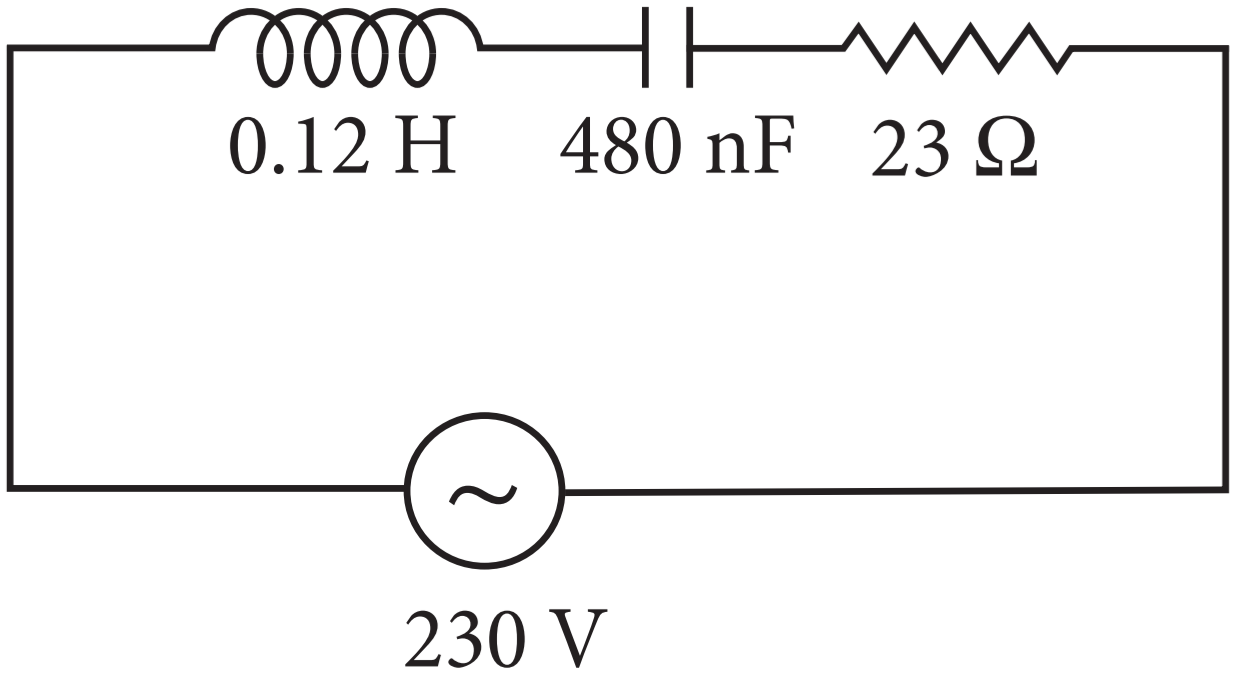
When the frequency of ac supply is such that the inductive reactance and capacitive reactance become equal, the impedance of the series $\text{LCR}$ circuit is equal to the ohmic resistance in the circuit. Such a series $\text{LCR}$ circuit is known as resonant series $\text{LCR}$ circuit and the frequency of the ac supply is known as resonant frequency. Resonance phenomenon is exhibited by a circuit only if both Land Care present in the circuit. We cannot have resonance in a $\text{RL}$ or $\text{RC}$ circuit.
A series $\text{LCR}$ circuit with $L = 0.12H, C = 480\ nF, \text{R} = 23\Omega$ is connected to a $230V$ variable frequency supply.
  1. Find the value of source frequency for which current amplitude is maximum.
  1. $222.32\ Hz$
  2. $550.52\ Hz$
  3. $663.48\ Hz$
  4. $770\ Hz$
  1. The value of maximum current is:
  1. $14.14A$
  2. $22.52A$
  3. $50.25A$
  4. $47.41A$
  1. The value of maximum power is:
  1. $2200W$
  2. $2299.3W$
  3. $5500W$
  4. $4700W$
  1. What is the $Q-$factor of the given circuit?
  1. $25$
  2. $42.21$
  3. $35.42$
  4. $21.74$
  1. At resonance which of the following physical quantity is maximum?
  1. Impedance
  2. Current
  3. Both $(a)$ and $(b)$
  4. Neither $(a)$ nor $(b)$
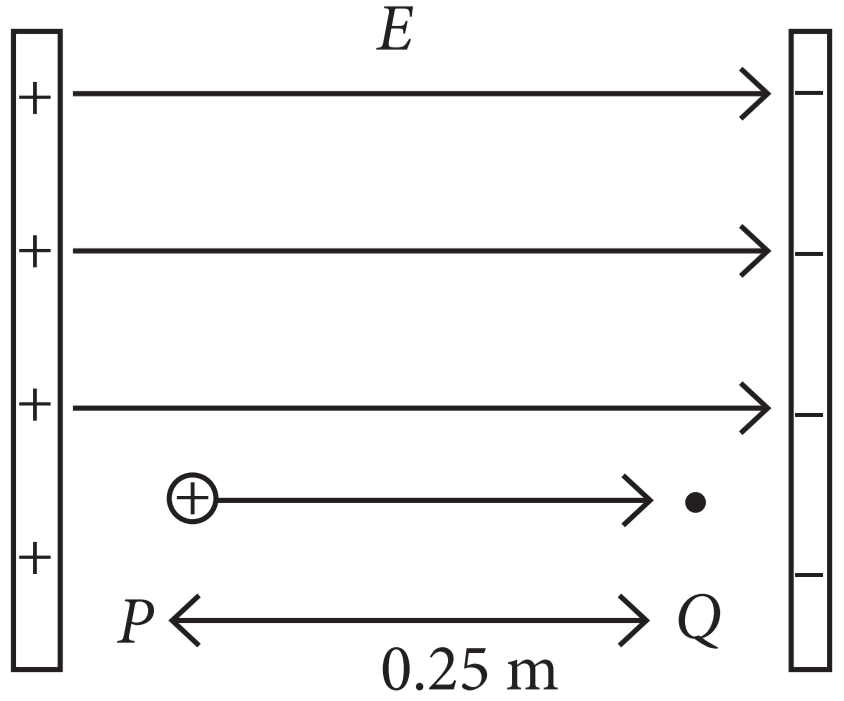
Potential difference $(\triangle\text{V})$ between two points $A$ and $B$ separated by a distance $x,$ in a uniform electric field $E$ is given by $\triangle\text{V}=-\text{Ex},$ where xis measured parallel to the field lines. If a charge $q_0$ moves from $P$ to $Q,$ the change in potential energy $(\triangle\text{U})$ is given as $\triangle\text{U}=-\text{q}_0\triangle\text{V}.$ A proton is released from rest in uniform electric field of magnitude $4.0 \times 10^8Vm^{-1}$ directed along the positive $X-$ axis. The proton undergoes a displacement of $0.25m$ in the direction of $E$. Mass of a proton $= 1.66 \times 10^{-27}kg$ and charge of proton $ = 1.6 \times 10^{-19}C$.
  1. The change in electric potential of the proton between the points $A$ and $B$ is:
  1. The potential energy of proton decreases.
  2. The potential energy of proton increases.
  3. The proton loses kinetic energy.
As the proton moves from $P$ to $Q,$ then:
  1. $-1.1J$
  2. $2J$
  3. $2.5J$
  4. $3J$
If a system consistsoftwocharges $4mC$ and $-3mC$ with no external field placed at $(-5\ cm, 0, 0)$ and $(5\ cm, 0, 0)$ respectively.The amount of work required to separate the two charges infinitely away from each other is:
  1. $1.56 \times 10^{-14}J$
  2. $5.5 \times 10^{-14}J$
  3. $2.56 \times 10^{-14}J$
  4. $4.56 \times 10^{-14}J$
The mutual electrostatic potential energy between two protons which are at a distance of $9 \times 10^{-15}m, in _{92}U^{235 }$ nucleus is:
  1. $1.6 \times 10^{11}J$
  2. $0.5 \times 10^{23}J$
  3. $-1.6 \times 10^{-11}J$
  4. $3.2 \times 10^{22}J$
The change in electric potential energy of the proton for displacement from $A$ to $B$ is:
  1. $-1 \times 10^8V$
  2. $1 \times 10^8V$
  3. $6.4 \times 10^{-19}V$
  4. $-6.4 \times 10^{-19}V$
Total energy of the proton increases.
The lens maker's formula relates the focallength of a lens to the refractive index of the lens material and the radii of curvature of its two surfaces. This formula is called so because it is used by manufacturers to design lenses of required focal length from a glass of given refractive index.
If the object is placed at infinity, the image will be fanned at focus for both double convex lens and double concave lens.
Therefore, lens maker's formula is, $\frac{1}{\text{f}}=[\frac{\mu_2-\mu_1}{\mu_1}][\frac{1}{\text{R}_1}-\frac{1}{\text{R}_2}]$
When lens is placed in air, $\mu_1=1$ and $\mu_2=\mu.$ The lens maker formula takes the form, $\frac{1}{\text{f}}=(\mu-1)[\frac{1}{\text{R}_1}-\frac{1}{\text{R}_2}]$
  1. The radius of curvature of each face of biconcave lens with refractive index 1.5 is 30cm. The focal length of the lens in air is:
  1. 12cm
  2. 10cm
  3. 20cm
  4. 30cm
  1. The radii of curvature of the faces of a double convex lens are 10cm and 15cm. If focal length is 12cm, then refractive index of glass is:
  1. 1.5
  2. 1.78
  3. 2.0
  4. 2.52
  1. An under-water swinuner cannot see very clearly even in absolutely clear water because of:
  1. Absorption of light in water.
  2. Scattering of light in water.
  3. Reduction of speed of light in water.
  4. Change in the focal length of eye-lens.
  1. A thin lens of glass $(\mu=1.5)$ of focal length 10cm is immersed in water $(\mu=1.33).$ The new focal length is:
  1. 20cm
  2. 40cm
  3. 48cm
  4. 12cm
  1. An object is immersed in a fluid. In order that the object becomes invisible, it should,
  1. Behave as a perfect reflector.
  2. Absorb all light falling on it.
  3. I have refractive index one.
  4. Have refractive index exactly matching with that of the surrounding fluid.