Question
Establish the relation between mean value and peak value of AC.
Answer

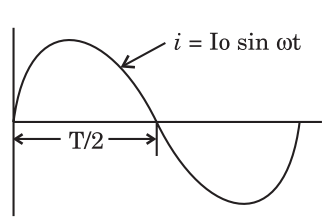
Let the instantenous value of alternating current be
$i=I_{0} sin \omega t$
$I_{0}=$ peak value of current,
$t=$ time at any instant.
Also, $\omega=\frac{2\pi}{T}$, $T=$ Time period.
$i=\frac{dQ}{dt}\Rightarrow dQ=idt$
$\int_{0}^{Q}dQ=\int_{0}^{T/2}idt$
$Q|_{0}^{Q}=\int_{0}^{T/2}I_{0}sin \omega tdt$
$Q=\frac{-I_{0}}{\omega}|cos\frac{2\pi}{T}.t|_{0}^{T/2}$
$Q=-\frac{I_{0}}{\omega}|cos\frac{2\pi}{T}\times\frac{T}{2}-cos\frac{2\pi}{T}.0|$
$Q=-\frac{I_{0}}{\omega}(cos \pi-cos 0) = -\frac{I_{0}}{\omega}\times-2 = \frac{2I_{0}}{\omega}$
Also, $Q=I_{m}\times\frac{T}{2}$
from (1) and (2)
$I_{m}\times\frac{T}{2}=\frac{2I_{0}}{2\pi} \times T$
$I_{m}\times\frac{1}{2}=\frac{2I_{0}}{2\pi} \times T$
Image
$I_{m}=\frac{2I_{0}}{\pi}= 0.637 I_{0}$
Mean value of current, $I_{m}=0.637$ times peak value of current.

Need a full question paper?

Generate a complete, print-ready paper with questions like this in minutes — across 16+ boards, with answer keys.

Start Generating Free

Similar questions

By mistake, an eye surgeon puts a concave lens in place of the lens in the eye after a cataract operation. Will the patient be able to see clearly any object placed at any distance?
The magnetic field at a point, 10cm away from a magnetic dipole, is found to be 2.0 × 10⁻⁴ T. find the magnetic moment of the dipole if the point is.
  1. In end-on position of the dipole.
  2. In broadside-onposition of the dipole.
The lens maker's formula relates the focallength of a lens to the refractive index of the lens material and the radii of curvature of its two surfaces. This formula is called so because it is used by manufacturers to design lenses of required focal length from a glass of given refractive index.
If the object is placed at infinity, the image will be fanned at focus for both double convex lens and double concave lens.
Therefore, lens maker's formula is, $\frac{1}{\text{f}}=[\frac{\mu_2-\mu_1}{\mu_1}][\frac{1}{\text{R}_1}-\frac{1}{\text{R}_2}]$
When lens is placed in air, $\mu_1=1$ and $\mu_2=\mu.$ The lens maker formula takes the form, $\frac{1}{\text{f}}=(\mu-1)[\frac{1}{\text{R}_1}-\frac{1}{\text{R}_2}]$
  1. The radius of curvature of each face of biconcave lens with refractive index 1.5 is 30cm. The focal length of the lens in air is:
  1. 12cm
  2. 10cm
  3. 20cm
  4. 30cm
  1. The radii of curvature of the faces of a double convex lens are 10cm and 15cm. If focal length is 12cm, then refractive index of glass is:
  1. 1.5
  2. 1.78
  3. 2.0
  4. 2.52
  1. An under-water swinuner cannot see very clearly even in absolutely clear water because of:
  1. Absorption of light in water.
  2. Scattering of light in water.
  3. Reduction of speed of light in water.
  4. Change in the focal length of eye-lens.
  1. A thin lens of glass $(\mu=1.5)$ of focal length 10cm is immersed in water $(\mu=1.33).$ The new focal length is:
  1. 20cm
  2. 40cm
  3. 48cm
  4. 12cm
  1. An object is immersed in a fluid. In order that the object becomes invisible, it should,
  1. Behave as a perfect reflector.
  2. Absorb all light falling on it.
  3. I have refractive index one.
  4. Have refractive index exactly matching with that of the surrounding fluid.
Complete the following table:
Car Model
Driver X
Reaction time 0.20s
Driver Y
Reaction time 0.30s
A (deceleration on hard braking = 6.0m/s2)
Speed = 54km/h
Braking distance
a = ...
Total stopping distance
b = ...
Speed = 72km/h
Braking distance
c = ...
Total stopping distance
d = ...
B (deceleration on hard braking = 7.5m/s2)
Speed = 54km/h
Breaking distance
e = ...
Total stopping distance
f = ...
Speed 72km/h
Braking distance
g = ...
Total stopping distance
h = ...
  1. A small compass needle of magnetic moment ‘m’ is free to turn about an axis perpendicular to the direction of uniform magnetic field ‘B’. The moment of inertia of the needle about the axis is ‘I’. The needle is slightly disturbed from its stable position and then released. Prove that it executes simple harmonic motion. Hence deduce the expression for its time period.
  2. A compass needle, free to turn in a vertical plane orients itself with its axis vertical at a certain place on the earth. Find out the values of (i) horizontal component of earth’s magnetic field and (ii) angle of dip at the place.
In pair annihilation, an electron and a positron destroy each other to produce gamma radiation. How is the momentum conserved?
Maxwell showed that the speed of an electromagnetic wave depends on the penneability and pennittivity of the medium through which it travels. The speed of an electromagnetic wave in free space is given by $\text{c}=\frac{1}{\sqrt{\mu_0\in_0}}.$ The fact led Maxwell to predict that light is an electromagnetic wave. The emergence of the speed of light from purely electromagnetic considerations is the crowning achievement of Maxwell's electromagnetic theory. The speed of an electromagnetic wave in any medium of permeability $\mu$ and pennittivity $\in$ will be $\frac{\text{c}}{\sqrt{\text{K}\mu_\text{r}}}$ where K is the dielectric constant of the medium and $\mu,$ is the relative permeability.
  1. The dimensions of $\frac{1}{2}\in_0\text{E}^2$ ($\in:$ pennittivity of free space; E = electric field) is:
  1. MLT-1
  2. ML2T-2
  3. ML-1T-2
  4. ML2T-1
  1. Let $[\in_0]$ denote the dimensional formula of the permittivity of the vacuum. UM = mass, L = length, T = time and A = electric current, then
  1. $[\in_0]=\text{M}^{-1}\text{L}^{-3}\text{T}^2\text{A}$
  2. $[\in_0]=\text{M}^{-1}\text{L}^{-3}\text{T}^4\text{A}^2$
  3. $[\in_0]=\text{MLT}^{-2}\text{A}^{-2}$
  4. $[\in_0]=\text{ML}^{2}\text{A}^{-1}$
  1. An electromagnetic wave offrequency 3MHz passes from vacuum into adielectricmedium with permittivity $\in=4.$ Then
  1. Wavelength and frequency both remain unchanged.
  2. Wavelength is doubled and the frequency remains unchanged.
  3. Wavelength is doubled and the frequency becomes half.
  4. Wavelength is halved and the frequency remains unchanged.
  1. Which of the following are not electromagnetic waves?
  1. Cosmic rays
  2. $\gamma-\text{rays}$
  3. $\beta-\text{rays}$
  4. X-rays
  1. The electromagnetic waves travel with,
  1. The same speed in all media.
  2. The speed oflight c = 3 × 108ms-1 in free space.
  3. The speed oflight c = 3 × 10⁸ms-1 in solid medium
  4. The speed of light c = 3 × 10⁸ms-1 in fluid medium.
What do you mean by diffraction of light? The light of wavelength 5000 Å is incident on a slit of width $ 2\times10^{-5} $ m normally. Calculate the angular width of central maxima in diffraction pattern.
The moon rotates about the earth in such a way that only one hemisphere of the moon faces the earth. Can we ever see the ''other face'' of the moon from the earth? Can a person on the moon ever see all the faces of the earth?