Question
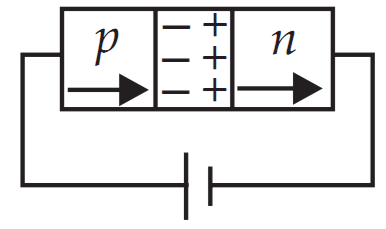

✓
Answer
- (c)
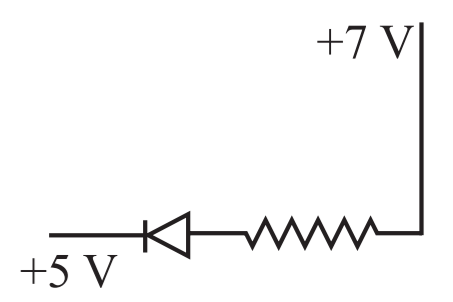
Explanation:
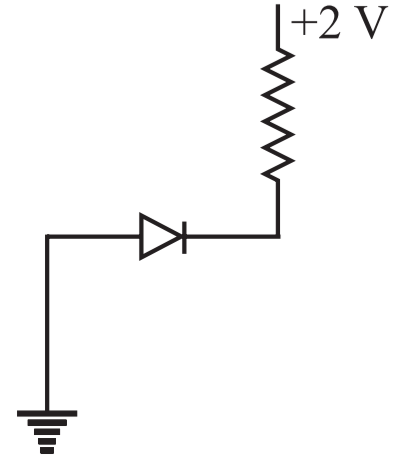
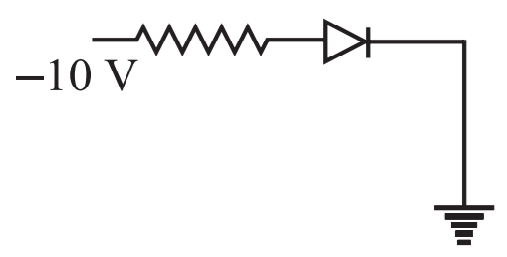
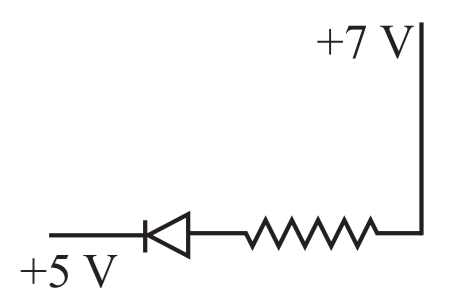
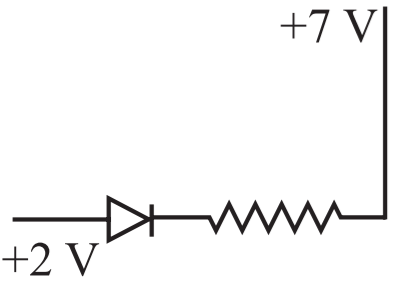
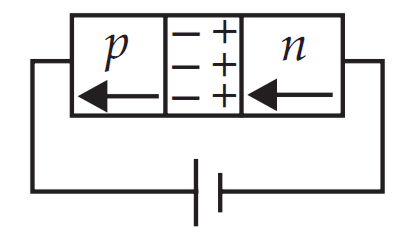
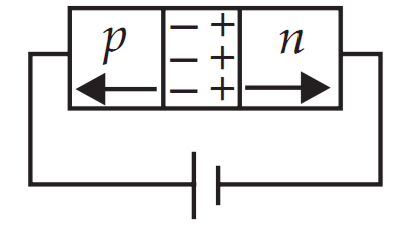
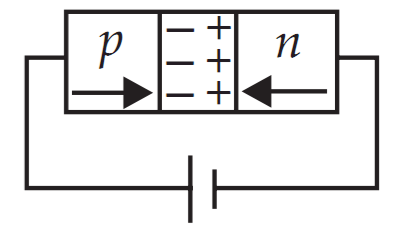
The p-n diode is forward biased when p-side is at a higher potential than n-side.
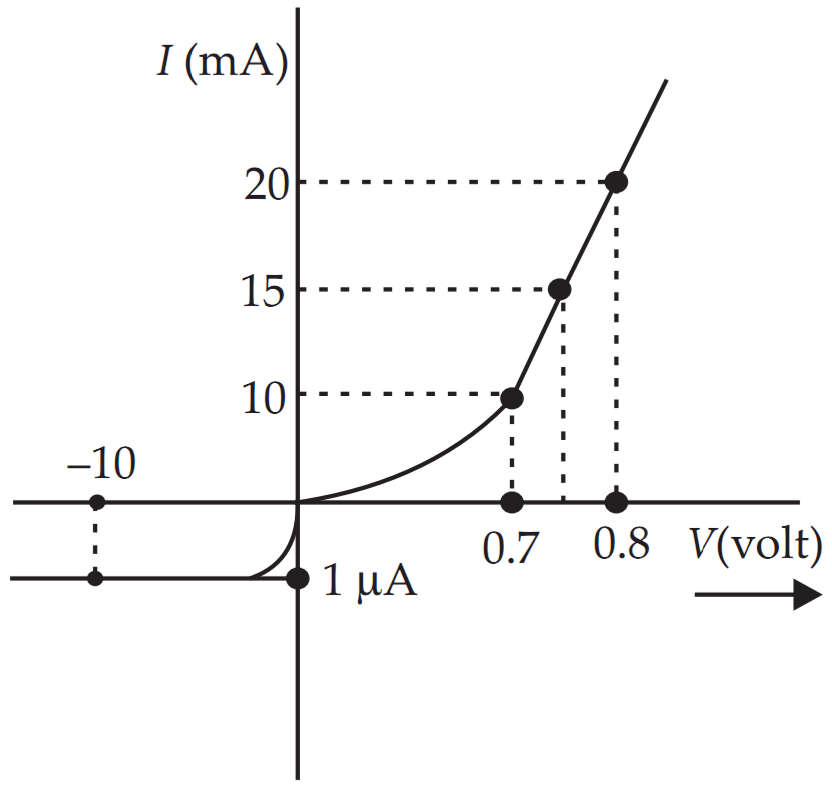
- (c) Non-ohmic device.
- (d) 10-6
Explanation:
Forward bias resistance,
$\text{R}_1=\frac{\triangle\text{V}}{\triangle\text{I}}=\frac{0.8-0.7}{(20-10)\times10^{-6}}$
$=\frac{0.1}{10\times10^{-3}}=10$
Reverse bias resistance, $\text{R}_2=\frac{10}{1\times10^{-6}}=10^7$
Then, the ratio of forward to reverse bias resistance,
$\frac{\text{R}_1}{\text{R}_2}=\frac{10}{10^7}=10^{-6}$
- (d)
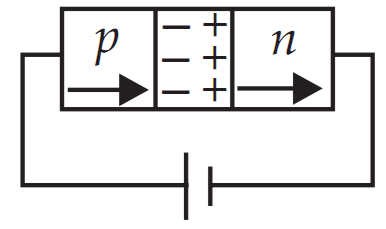
Explanation:
In p-region the direction of conventional current is same as flow of holes. In n-region, the direction of conventional current is opposite to the flow of electrons.
- (c) 0.01A
Explanation:
In the given circuit the junction diode is forward biased and offers zero resistance.
$\therefore$ The current, $\text{I}=\frac{\text{3V-1V}}{200\Omega}=\frac{\text{2V}}{200\Omega}=0.01\text{A}.$
Need a full question paper?
Generate a complete, print-ready paper with questions like this in minutes — across 16+ boards, with answer keys.
Explore more
Similar questions
Find the change in the volume of 1.0 litre kerosene when it is subjected to an extra pressure of 2.0 x 10⁵N/m2 from the following data. Density of kerosene = 800kg/m3 and speed of sound in kerosene = 1330m/s.
What is the de-Broglie wavelength of
(a) A bullet of mass 0.040 kg travelling at the speed of 1.0 km/s,
(b) A ball of mass 0.060 kg moving a t a speed of 1.0 m/s, and
(c) A dust particle of mass $1.0 \times 10^{-9}$ with a speed of 2.2 m/s?
→(a) A bullet of mass 0.040 kg travelling at the speed of 1.0 km/s,
(b) A ball of mass 0.060 kg moving a t a speed of 1.0 m/s, and
(c) A dust particle of mass $1.0 \times 10^{-9}$ with a speed of 2.2 m/s?
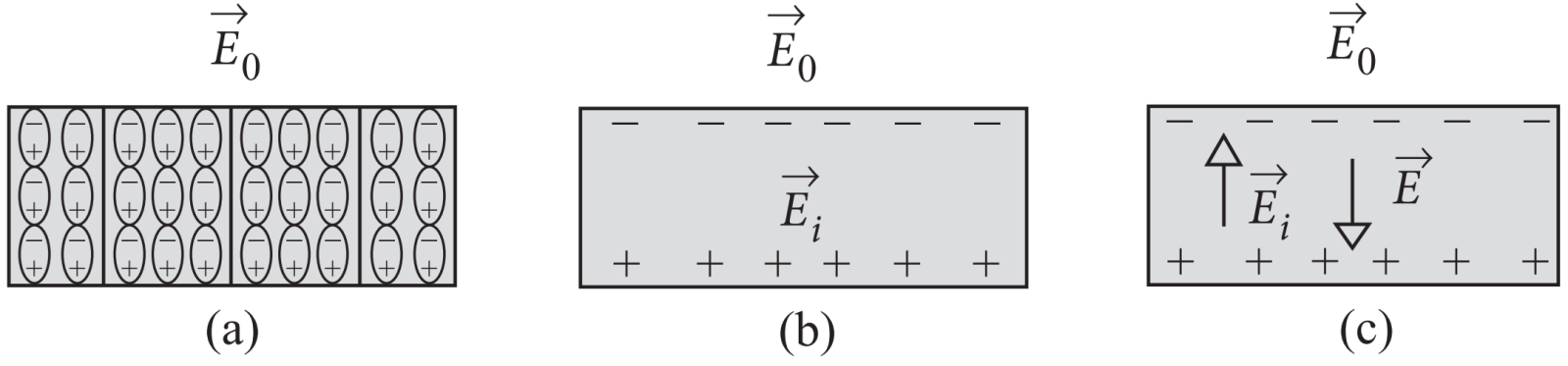
When an insulator is placed in an external field, the dipoles become aligned. Induced surface charges on the insulator establish a polarization field $\vec{\text{E}}_\text{i}$ in its interior. The net field $\vec{\text{E}}$ in the insulator is the vector sum of $\vec{\text{E}}_0$ and $\vec{\text{E}}_\text{i}$ as shown in the figure.
→
- Which among the following is an example of polar molecule?
- O2
- H2
- N2
- HCI
- When air is replaced by a dielectric medium of constant K, the maximum force of attraction between two charges separated by a distance:
- Increases K times.
- Remains unchanged.
- Decreases K times.
- Increases 2K times.
- Which of the following is a dielectric?
- Copper.
- Glass.
- Antimony (Sb).
- None of these.
- For a polar molecule, which of the following statements is true?
- The centre of gravity of electrons and protons coincide.
- The centre of gravity of electrons and protons do not coincide.
- The charge distribution is always symmetrical.
- The dipole moment is always zero.
- When a comb rubbed with dry hair attracts pieces of paper. This is because the?
- Comb polarizes the piece of paper.
- Comb induces a net dipole moment opposite to the direction of field.
- Electric field due to the comb is uniform.
- Comb induces a net dipole moment perpendicular to the direction of field.
A child has near point at 10cm. What is the maximum angular magnification the child can have with a convex lens of focal length 10cm?
Refer to the previous problem. Suppose, the goldsmith argues that he has not mixed copper or any other material with gold, rather some cavities might have been left inside the ornament. Calculate the volume of the cavities left that will allow the weights given in that problem.
To keep valuable instruments away from the earth's magnetic field, they are enclosed in iron boxes. Explain.
The charge density of two uniformly charged parallel infinite plane sheets ' 1 ' and ' 2 ' are $+\sigma$ and $-2 \sigma$ respectively. Find the magnitude and direction of the net electric field (i) at any point between these two sheets and (ii) at any point outisde these two sheets but near sheet ' 1 '.
→Hydrogen spectrum consists of discrete bright lines in a dark background, and it is specifically known as hydrogen emission spectrum. There is one more type of hydrogen spectrum that exists where we get dark lines on the bright background, it is known as absorption spectrum. Balmer found an empirical formula by the observation of a small part of this spectrum, and it is represented by $\frac{1}{\lambda}=\text{R}\bigg(\frac{1}{2^2}-\frac{1}{\text{n}^2}\bigg)$ where n = 3, 4, 5 For Lyman series, the emission is from first state to nth state, for Paschen series, it is from third state to nth state, for Brackett series, it is from fourth state to nth state and for Pfund series, it is from fifth state to nth state.
→- Number of spectral lines in hydrogen atom is:
- 8
- 6
- 15
- $\infty$
- Which series of hydrogen spectrum corresponds to ultraviolet region?
- Balmer series.
- Brackett series.
- Paschen series.
- Lyman series.
- Which of the following lines of the H-atom spectrum belongs to the Balmer series?
- 1025A
- 1218A
- 4861A
- 18751A
- Rydberg constant is.
- A universal constant.
- A universal constants.
- Different for different elements.
- None of these.
- Hydrogen atom is excited from ground state to another state with principal quantum number equal to 4. Then the number of spectral lines in the emission spectra will be.
- 3
- 5
- 6
- 2
The electric field intensity at a point at a distance of 20 cm from the centre of a sphere is 10 Volt/meter. Find the intensity of the electric field at a point located at a distance 8 cm from the centre of that circle. The radius of the sphere is 5 cm.