MCQ
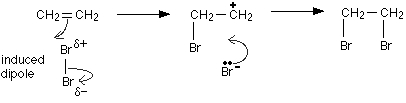
Ethylene reacts with bromine to form
  • A
    $Br - C{H_2} - C{H_3}$
  • B
    $C{H_3} - CB{r_3}$
  • $Br - C{H_2} - C{H_2}Br$
  • D
    $CHB{r_3}$

Answer

Correct option: C.
$Br - C{H_2} - C{H_2}Br$
c
Alkenes react in the cold with pure liquid bromine, or with a solution of bromine in an organic solvent like tetrachloromethane. The double bond breaks, and a bromine atom becomes attached to each carbon.... In the case of the reaction with ethene, $1,2$-dibromoethane is formed.

Need a full question paper?

Generate a complete, print-ready paper with questions like this in minutes — across 16+ boards, with answer keys.

Start Generating Free

Similar questions

When ${N_2}$ goes to $N_2^ + ,$ the $N - N$ bond distance ..... and when ${O_2}$ goes to $O_2^ + ,$ the $O - O$ bond distance .......
$\text{H}_2\text{O}(\text{l})+\text{H}_2\text{O}(\text{l})\xrightarrow{\ \ \ \ \ \ \ \ \ \ }\text{H}_3\text{O}^+(\text{aq})+\text{OH}^-(\text{aq})\\\ \ ^\text{Acide-1}\ \ \ \ \ \ ^\text{Base-2}\ \ \ \ \ \ \ \ \ \ \ \ \ \ \ \ \ \ \ \ ^\text{Acide-2}\ \ \ \ \ \ \ \ \ ^\text{Base-1}\\ \ \ ^\text{(Acid)}\ \ \ \ \ \ \ ^\text{(Base)}\ \ \ \ \ \ \ \ \ \ \ \ \ \ ^\text{(Conjugate acide)}\ \ ^\text{(Conjugate base)}$ The above reaction is known as:
For a certain reaction at $300 \mathrm{~K}, \mathrm{~K}=10$, then $\Delta \mathrm{G}^{\circ}$ for the same reaction is _____________$\times 10^{-1} \mathrm{~kJ} \mathrm{~mol}^{-1}$. (Given $\mathrm{R}=8.314 \mathrm{JK}^{-1} \mathrm{~mol}^{-1}$ )
Which of the following properties of atom could be explained correctly by Thomson model of atom?
$6$ moles of an ideal gas expand isothermally and reversibly from a volume of $1$ litre to a volume of $10$ litres at $27\,^oC$. What is the maximum work done
In ${H_2}{O_2}$, the two oxygen atoms have
${C_2}{H_5}Br\xrightarrow{{KCN}}A\xrightarrow{{Hydrolysis}}B$ 

The compound $A$ is a above reaction is

Which of the following occurs when two hydrogen atoms bond with each others
Consider the nitration of benzene using mixed conc. $H_2SO_4$ and $HNO_3. $ If a large amount of $KHSO_4$ is added to the mixture, the rate of nitration will be
Formulae for Nessler's reagent is: