Question
Evaluate the following:
In the adjoining figure, $\triangle\text{ABC}$ is a right-angled at B and $\angle\text{A}=30^\circ,$ If BC = 6cm.
Find:
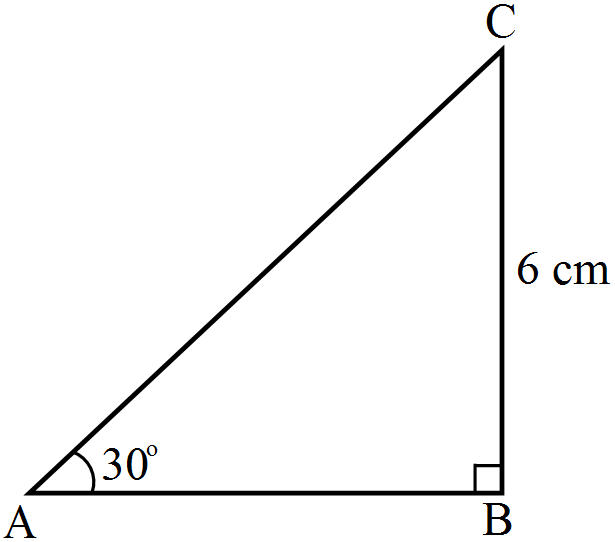
  1. AB
  2. AC.
​​​​​​​

Answer

From the given right-angled triangle, we have:
$\frac{\text{BC}}{\text{AB}}=\tan30^\circ$
$\Rightarrow\frac{6}{\text{AB}}=\frac{1}{\sqrt{3}}$
$\Rightarrow\text{AB}=6\sqrt{3}\text{cm}$
Also, $\frac{\text{BC}}{\text{AC}}=\sin30^\circ$
$\Rightarrow\frac{6}{\text{AC}}=\frac{1}{2}$
$\Rightarrow\text{AC}=(2\times6)=12\text{cm}$
$\therefore\ \text{AB}=6\sqrt{3}\text{cm}$ and $\text{AC}=12\text{cm}$

Need a full question paper?

Generate a complete, print-ready paper with questions like this in minutes — across 16+ boards, with answer keys.

Start Generating Free

Similar questions

Solve the following simultaneous equations using Cramer’s rule.
4x + 3y – 4 = 0; 6x = 8 – 5y
Solve for x and y:
x + y = 3,
4x - 3y = 26
If the altitude of two similar triangles are in the ratio 2 : 3, what is the ratio of their areas?
ABCD is a trapezium having AB || DC. Prove that O, the point of intersection of diagonals, divides the two diagonals in the same ratio. Also prove that $\frac{\text{ar}(\triangle\text{OCD})}{\text{ar}(\triangle\text{OAB})}=\frac{1}{9},$ if AB = 3CD.
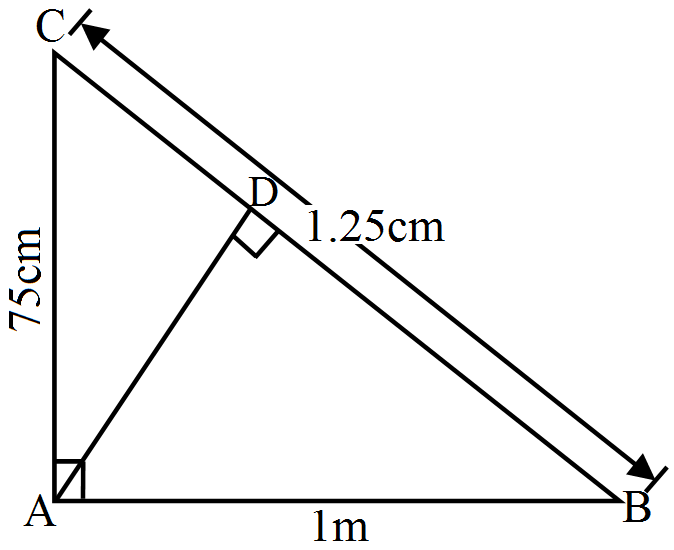
In the given figure, $\angle\text{CAB}=90^\circ$ and $\text{AD}\perp\text{BC}.$ Show that $\triangle\text{BDA}\sim\triangle\text{BAC}.$ If AC = 75cm, AB = 1m, and BC = 1,25m find AD.
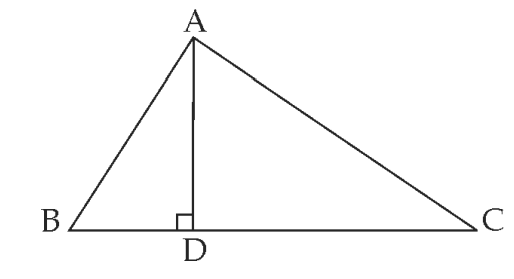
In adjoining figure, seg $AD \perp$ side BC , B -D-C. Prove that $A B ^2+ C D ^2= B D ^2+ A C ^2 \quad$ 
Image
Find the area of minor segment of a circle of radius 6 cm when its chord subtends an angle of 60° at its centre. $(\sqrt{3}=1.73)$
The perimeters of two similar triangles are 25cm and 15cm respectively. If one side of first triangle is 9cm, what is the corresponding side of the other triangle?
The sixth term of an A.P. is 5 times the $1^{\text {st }}$ term and the eleventh term exceeds twice the fifth term by 3. Find the $8^{\text {th }}$ term.
The. number of telephone calls received at an exchange per interval for 250 successive one-minute intervals are given in the following frequency table:
No of calls (x)
0
1
2
3
4
5
6
No of intervals (f)
15
24
29
46
54
43
39
Compute the mean number of calls per interval.