Question
Evaluate the following integrals:$\int\frac{\text{x}^2}{\text{x}^2+6\text{x}+12}\text{ dx}$
Answer

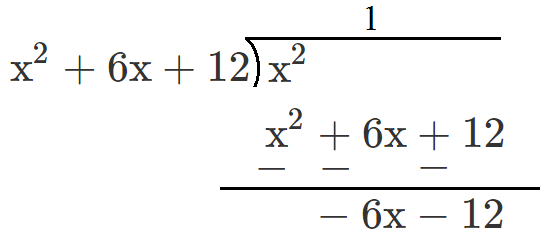
Let $\text{I}=\int\frac{\text{x}^2\text{ dx}}{\text{x}^2+6\text{x}+12}$ Now,
Therefore,
$\frac{\text{x}^2}{\text{x}^2+6\text{x}+12}=1-\frac{(6\text{x}+12)}{\text{x}^2+6\text{x}+12}\ ....(1)$Let $6\text{x}+12=\text{A}\frac{\text{d}}{\text{dx}}\big(\text{x}^2+6\text{x}+12\big)+\text{B}$
$\Rightarrow6\text{x}+12=\text{A}(2\text{x}+6)+\text{B}$
$\Rightarrow6\text{x}+12=(2\text{A})\text{x}+6\text{A}+\text{B}$
Equating coefficients of like terms $2\text{A}=6$ $\text{A}=3$ $6\text{A}+\text{B}=12$ $18+\text{B}=12$ $\text{B}=-6$ $\therefore\ \frac{\text{x}^2}{\text{x}^2+6\text{x}+12}=1-\frac{3(2\text{x}+6)}{\text{x}^2+6\text{x}+12}$ $\text{I}=\int\frac{\text{x}^2\text{ dx}}{\text{x}^2+6\text{x}+12}$ $=\int\text{dx}-3\int\frac{(2\text{x}+6)\text{ dx}}{\text{x}^2+6\text{x}+12}+6\int\frac{\text{dx}}{\text{x}^2+6\text{x}+12}$ $=\int\text{dx}-3\int\frac{(2\text{x}+6)\text{ dx}}{\text{x}^2+6\text{x}+12}+6\int\frac{\text{dx}}{\text{x}^2+6\text{x}+9+3}$ $=\int\text{dx}-3\int\frac{(2\text{x}+6)\text{ dx}}{\text{x}^2+6\text{x}+12}+6\int\frac{\text{dx}}{(\text{x}+3)^2+\big(\sqrt3\big)^2}$ $=\text{x}-3\log\big|\text{x}^2+6\text{x}+12\big|+\frac{6}{\sqrt3}\tan^{-1}\Big(\frac{\text{x}+3}{\sqrt3}\Big)+\text{C}$ $=\text{x}-3\log\big|\text{x}^2+6\text{x}+12\big|+2\sqrt3\tan^{-1}\Big(\frac{\text{x}+3}{\sqrt3}\Big)+\text{C}$

Need a full question paper?

Generate a complete, print-ready paper with questions like this in minutes — across 16+ boards, with answer keys.

Start Generating Free

Similar questions

Show that the vectors $\overrightarrow{\text{a}},\overrightarrow{\text{b}} \text{and}{\overrightarrow{\text{c}}}$ are coplanar if $\overrightarrow{\text{a}} +\overrightarrow{\text{b}}, \overrightarrow{\text{b}}+\overrightarrow{\text{c}}\text{and} \overrightarrow{\text{c}} + \overrightarrow{\text{a}}$ are coplanar.
Differentiate the following functions with respect to x:
$(\sin\text{x})^{\cos\text{x}}$
Evaluate the following integrals:
$\int\frac{\text{x}}{\sqrt{\text{x}^2+\text{a}^2}+\sqrt{\text{x}^2-\text{a}^2}}\text{ dx}$
Evaluate the following integrals:
$\int(3\text{x}+1)\sqrt{4-3\text{x}-2\text{x}^2}\text{dx}$
Find the points of discontinuity, if any of the following function:
$\text{f(x)}=\begin{cases}\text{x}^3-\text{x}^2+2\text{x}-2,&\text{if }\text{ x}\neq1\\4,&\text{if }\text{ x}=1\end{cases}$
A diet of two foods $F_1$ and $F_2$ contains nutrients thiamine, phosphorous and iron.
The amount of each nutrient in each of the food $($in milligrams per $25$gms$) $is given in the following table:
Nutrients Food $F_1$ $F_2$
Thiamine $0.25$ $0.10$
Phosphorous $0.75$ $1.50$
Iron $1.60$ $0.80$
The minimum requirement of the nutrients in the diet are $1.00$mg of thiamine, $7.50$mg of phosphorous and $10.00$mg of iron.
The cost of $F_1$ is $20$  paise per $25$gms while the cost of $F_2$ is 15 paise per 25gms.
Find the minimum cost of diet.
Find the area bounded by the circle $x^2+y^2=16$ and the line $\sqrt{3} y=x$ inthe first quadrant, using integration
Determine the area under the cutve $\text{y}=\sqrt{\text{x}^{2}-\text{x}^{2}}$ included between the lines $x = 0$ and $x = a$.
Find the shortest distance between the following pairs of lines whose vector equation are:
$\vec{\text{r}}=(\lambda-1)\hat{\text{i}}+(\lambda+1)\hat{\text{j}}-(1+\lambda)\hat{\text{k}}$ and $\vec{\text{r}}=(1-\mu)\hat{\text{i}}+(2\mu-1)\hat{\text{j}}+(\mu+2)\hat{\text{k}}$
Evaluate the following integrals as limit of sum:
$\int\limits^3_{1}(2\text{x}+3)\text{dx}$