Question
Evaluate the following limit:
$\lim\limits_{\text{x}\rightarrow\frac{\pi}{3}}\frac{\sqrt{1-\cos6\text{x}}}{\sqrt{2}\big(\frac{\pi}{3}-\text{x}\big)}$
Answer

$\lim\limits_{\text{x}\rightarrow\frac{\pi}{3}}\frac{\sqrt{1-\cos6\text{x}}}{\sqrt{2}\big(\frac{\pi}{3}-\text{x}\big)}$
$=\lim\limits_{\text{x}\rightarrow\frac{\pi}{3}}\frac{\sqrt{2\sin^23\text{x}}}{\sqrt{2}\big(\frac{\pi}{3}-\text{x}\big)}$ $\big(1-\cos2\theta=2\sin^2\theta\big)$
$=\lim\limits_{\text{x}\rightarrow\frac{\pi}{3}}\frac{\sqrt{2}\sin3\text{x}}{\sqrt{2}\big(\frac{\pi}{3}-\text{x}\big)}$
$=\lim\limits_{\text{x}\rightarrow\frac{\pi}{3}}\frac{\sin3\text{x}}{\big(\frac{\pi}{3}-\text{x}\big)}$
$=\lim\limits_{\text{h}\rightarrow0}\frac{\sin3\big(\frac{\pi}{3}+\text{h}\big)}{\frac{\pi}{3}-\big(\frac{\pi}{3}-\text{x}\big)}$ $\big(\text{Put x}=\frac{\pi}{3}+\text{h}\big)$
$=\lim\limits_{\text{h}\rightarrow0}\frac{\sin(\pi+3\text{h})}{-\text{h}}$
$=\lim\limits_{\text{h}\rightarrow0}\frac{-\sin3\text{h}}{-\text{h}}$ $[\sin(\pi+\theta)=-\sin\theta]$
$=3\times\lim\limits_{\text{h}\rightarrow0}\frac{\sin3\text{h}}{3\text{h}}$
$3\times1$ $\Big(\lim\limits_{\theta\rightarrow0}\frac{\sin\theta}{\theta}=1\Big)$
$=3$

Need a full question paper?

Generate a complete, print-ready paper with questions like this in minutes — across 16+ boards, with answer keys.

Start Generating Free

Similar questions

Prove the following : $\sin^8\theta – \cos^8\theta = (\sin^2 \theta – \cos^2 \theta ) (1 – 2sin^2 \theta \cos^2 \theta )$
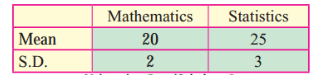
Given below is the information about marks obtained in Mathematics and Statistics by 100 students in a class. Which subject shows the highest variability in marks?

Image

Find the value of k,(i) if the area of a triangle is 4 square units and vertices are P(k, 0), Q(4, 0), R(0, 2).
Show the following quadratic equation by factorization method:
$x^2 + x + 1 = 0$
The numbers 1, 2, 3 and 4 are written separately on four slips of paper. The slips are then put in a box and mixed thoroughly. A person draws two slips from the box, one after the other, without replacement.
Describe the following events:
A = The number on the first slip is larger than the one on the second slip.
B = The number on the second slip is greater than 2.
C = The sum of the numbers on the two slips is 6 or 7.
D = The number on the second slips is twice that on the first slip.
Which pair(s) of events is (are) mutually exclusive?
There are two works each of $3$ volumes and two works each of $2$ volumes; In how many ways can the $10$ books be placed on a shelf so that the volumes of the same work are not separated?
Simplify the following and express in the form $a + ib:$
$(1+3 i)^2(3+i)$
Find the equation of the circle whose centre is (1, 2) and which passes through the point (4, 6).
A sequence is defined by $\text{a}_\text{n}=\text{n}^3-6\text{n}^2-11\text{n}-6,\text{n}\in\text{N.}$ show that the first three terms of the sequence are zero and all other terms are positive.
In the following examples, given $\in > 0,$ find a $\delta > 0$ such that whenever, $|x – a| < \delta,$ we must have $|f(x) – l| < \in.
\lim _{x \rightarrow-3}(3 x+2)=-7$